
Aviation Updates: Massive Travel Chaos Paralyzes China as 3,438 Delays Crush Beijing, Shanghai, and Guangzhou
As catastrophic logistical bottlenecks severely paralyze major transit grids, travelers across China face devastating travel chaos following severe flight cancellations.

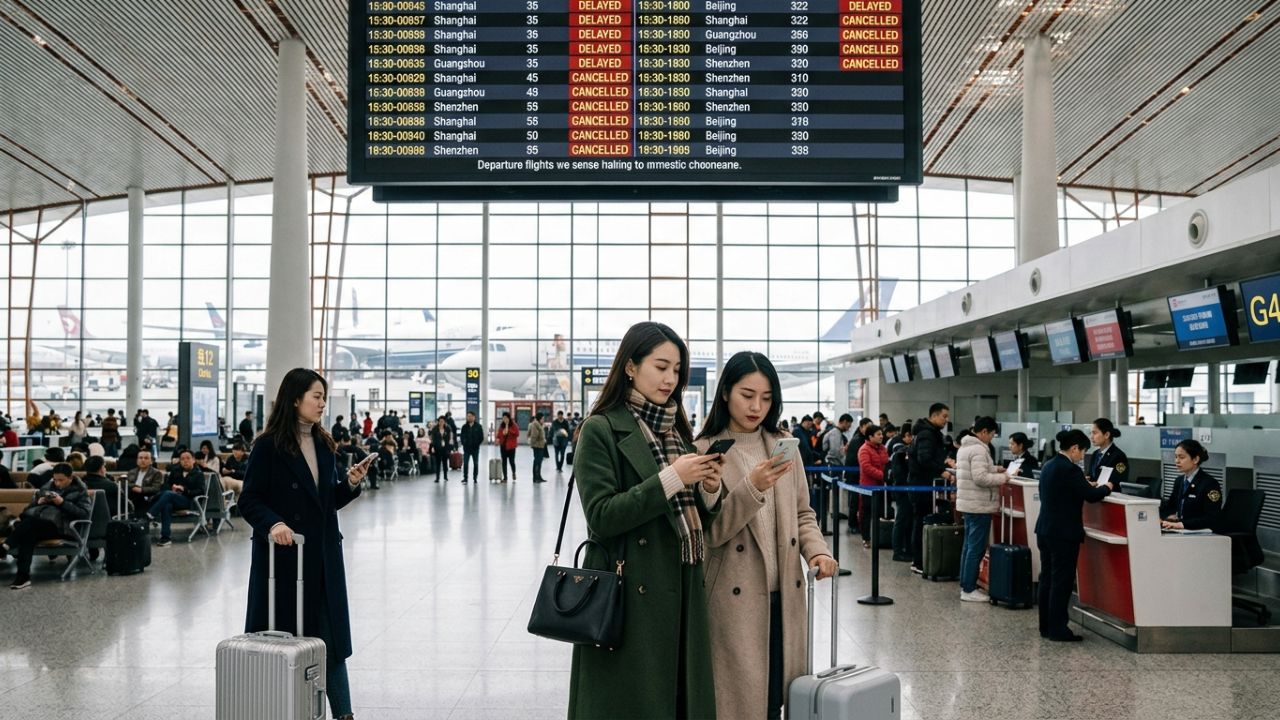
Image generated by AI
Aviation Updates: Massive Travel Chaos Paralyzes China as 3,438 Delays Crush Beijing, Shanghai, and Guangzhou
As extreme operational friction and suddenly compounding infrastructure bottlenecks continue to terrorize standard travel itineraries, the Chinese aviation corridor has fractured, plunging millions of passengers across Beijing, Shanghai, Shenzhen, and Guangzhou into a terrifying spiral of severe travel chaos.
Image generated by AI
As high-impact airline news platforms rapidly issue continuous, grim aviation updates regarding the intense fragility of massively congested primary transit grids, preparing for an absolute structural meltdown has officially become a domestic traveler's only defense mechanism. Amidst widespread rolling travel chaos, severe airport disruptions, and the terrifying threat of devastating flight cancellations severely plaguing heavily overcrowded mega-hubs, travel plans for millions of highly anxious passengers passing directly through China on June 30th, 2026, were completely destroyed. According directly to verified telemetry sourced from FlightAware, a massive, highly synchronized wave of operational setbacks actively recorded an incredibly frustrating 3,438 severe flight delays and exactly 123 complete cancellations. The massive operational crisis forcefully sent shockwaves through the commercial aviation sector, heavily impacting premier scheduled carriers incredibly including Air China, China Eastern Airlines, XiamenAir, Hainan Airlines, and several other regional operators. Millions of itineraries were violently thrown into complete disarray as key routes linking critical economic and tourist hubs were severely bottlenecked.
Expanded Overview: The Collapse of the Domestic Grid
To fully comprehend the sheer scale of this severe operational strain, commercial aviation analysts must closely examine exactly how massive localized passenger processing delays violently reshape terminal stability and domestic transit security across heavily interconnected mega-cities.
The massive disruption pattern actively terrorizing the global passenger mindset is primarily defined by extreme check-in delays and heavily saturated boarding gates. Aviation networks completely throughout China are highly, aggressively integrated, meaning that a massive disruption at a primary gateway like Beijing or Shanghai invariably, instantly causes a devastating, cascading logistical backlog heavily rippling across the entire massive country. In this particular, brutal instance, both massive domestic trunks and highly critical international connection corridors forcefully faced extensive queuing, violently leaving aircraft hopelessly out of position and thousands of flight crews severely displaced. The terrifying scale of this operational slowdown aggressively highlights the ongoing, incredibly severe vulnerabilities violently faced by massive transit networks when bottlenecks suddenly occur at foundational travel hubs.
Section-Wise Breakdown: Navigating the Regional Gridlock
Terminal operations are violently degrading across competing hubs, forcing major domestic operators to furiously deploy highly advanced operational frameworks to strictly ensure smooth transit flows amidst gridlock.
The Guangzhou and Shanghai Meltdowns: The operational gridlock was violently distributed across several key gateways, with the absolute worst conditions violently impacting Guangzhou Baiyun International Airport. Ranking officially as the most heavily delayed facility in China, this massive hub reported 11 total cancellations and a staggering 716 flight delays, severely testing maximum terminal capacity. Simultaneously, Shanghai Pudong International Airport, a primary global shipping and passenger mega-hub, was heavily impacted, forcefully witnessing 23 total cancellations alongside an immense, crippling backlog of exactly 651 delayed flights.
The Dual-Hub Beijing Crisis: As one of the primary national gateways, Beijing Capital International Airport officially recorded a significant operational deficit, culminating heavily in 28 total cancellations and 437 flight delays. Compounding the regional crisis, the secondary mega-hub, Beijing Daxing International Airport, also violently faced substantial scheduling friction, with 15 total cancellations and exactly 389 delayed services officially documented by the end of the operating day.
Shenzhen and Regional Strains: Located directly in the massive southern economic tech corridor, Shenzhen Bao’an International Airport violently suffered 6 total cancellations, whilst an exceptionally high volume of 519 delays frustrated elite business travellers. Furthermore, Chongqing Jiangbei International Airport actively experienced notable logistical strain with 8 cancellations and 299 delays. Regional tourism arteries also suffered massively: Changsha Huanghua (6 cancellations, 155 delays), Haikou Meilan (11 cancellations, 111 delays), Dalian Zhoushuizi (7 cancellations, 110 delays), and Guilin Liangjiang (8 cancellations, 51 delays) were all violently caught up in the systemic network drag.
Strategic Details: Verified China Regional Disruption Matrix
To ensure stranded passengers and commercial aviation analysts can accurately track the incredibly precise operational telemetry of this massive network strain, the verified structural data has been consolidated into the exact, mandatory matrix below.
| Operational Metric / Entity | Verified Disruption Data |
|---|---|
| Beijing Capital Int'l | 437 Delays, 28 Cancellations |
| Beijing Daxing Int'l | 389 Delays, 15 Cancellations |
| Shanghai Pudong Int'l | 651 Delays, 23 Cancellations |
| Guangzhou Baiyun Int'l | 716 Delays, 11 Cancellations |
| Shenzhen Bao’an Int'l | 519 Delays, 6 Cancellations |
| Chongqing Jiangbei Int'l | 299 Delays, 8 Cancellations |
| Changsha Huanghua Int'l | 155 Delays, 6 Cancellations |
| Haikou, Dalian, Guilin | 272 Delays, 26 Cancellations (Combined) |
| Airlines Affected | Air China, China Eastern, XiamenAir, Hainan |
| Primary Data Source | FlightAware |
(Source: FlightAware and Chinese Civil Aviation Authorities)
Industry Analysis: The Macroeconomic Impact of Cascading Backlogs
Air travel explicitly across massive global transit corridors continues to massively struggle, driven violently by incredibly fragile air traffic flow constraints and severely overloaded security infrastructures.
When widespread cancellations and severe delays strike prominent markets entirely across China, the broader travel and massive hospitality sectors are inevitably, forcefully required to absorb the devastating economic aftershocks. Destinations actively ranging from the massive political heart of Beijing to the sprawling coastal commerce zones of Shanghai and Shenzhen heavily rely on the clockwork precision of commercial airlines. When 3,438 services are violently delayed in a single day, thousands of highly expensive missed hotel bookings, truncated luxury tour itineraries, and completely cancelled corporate business conventions are heavily experienced by industry stakeholders. Furthermore, when premium airlines heavily including Air China, China Eastern, XiamenAir, and Hainan Airlines heavily suffer concurrent system-wide disruptions, the perceived reliability of the entire regional transport grid is severely diminished, instantly crushing consumer confidence.
Passenger Impact: Protecting the Vacation Baseline
For the everyday premium international traveler and highly stressed corporate executive, the immediate consequence of this massive logistical strain directly translates to a monumental, highly verified spike in required transit vigilance.
How can massive flight status updates be obtained quickly during widespread network delays in China? Passengers are absolutely, strongly advised to heavily monitor official digital channels rather than blindly relying solely on inaccurate airport departure boards. Real-time updates are officially published via the official smartphone applications and heavily utilized WeChat mini-programs of the respective airlines. Under standard aviation consumer frameworks heavily enforced in China, passengers are legally entitled to alternative rebooking options or massive full refunds for the unutilised portions of their tickets. Depending heavily on the absolute duration of the delay, strict duty-of-care provisions—such as complimentary meals, massive refreshments, and premium hotel accommodation for overnight disruptions—absolutely must be actively arranged by the operating carrier. Crucially, interline agreements often exist heavily between major domestic airlines, securely allowing customer service agents to actively transfer a completely bottlenecked booking to a cooperating airline to aggressively expedite the journey.
Conclusion: A Network Reimagined
Ultimately, the aggressive, massive wave of 3,438 delays and 123 cancellations actively marks a massively significant stress test for China's aviation infrastructure. The severe disruptions completely prove that even highly modernized, heavily funded mega-hubs remain incredibly vulnerable to the cascading effects of massive schedule failures.
As massive airlines furiously absorb incredibly heavy schedule pressure, the ultimate recovery of the massive domestic network firmly depends absolutely on the rapid stabilization of aircraft positioning and airspace flow management. For anyone fiercely preparing to fly through Beijing, Shanghai, Guangzhou, or Shenzhen in the coming days, aggressively utilizing WeChat mini-programs for live updates, understanding formal passenger rights for interline transfers, and demanding immediate hotel accommodations for overnight delays is the absolute only way to successfully survive the grueling realities of 2026 travel chaos.
Key Takeaways
- Massive Network Meltdown: Over 3,438 severe flight delays and 123 complete cancellations completely paralyzed China’s heavily integrated domestic aviation network.
- Worst Hit Hubs: Guangzhou Baiyun (716 delays) and Shanghai Pudong (651 delays) suffered the most extreme logistical backlogs in the country.
- Beijing Dual-Hub Strain: Both Beijing Capital and Beijing Daxing airports recorded severe flight failures, stranding thousands of political and corporate travelers.
- Major Carriers Hit: The severe flight disruptions aggressively impacted major flagship carriers including Air China, China Eastern Airlines, XiamenAir, and Hainan Airlines.
- Passenger Survival Tactics: Travelers are highly urged to fiercely monitor WeChat mini-programs for live updates and actively demand interline ticket transfers to bypass bottlenecked carriers.
FAQ: China Airport Travel Chaos 2026
Why are there so many flight delays in China? Aviation networks throughout China are highly integrated, meaning that a massive disruption at a major gateway like Beijing or Shanghai invariably causes a cascading logistical backlog, violently leaving aircraft out of position and flight crews displaced.
Which airports in China had the most flight delays? Guangzhou Baiyun International Airport reported a staggering 716 flight delays, while Shanghai Pudong International Airport suffered an immense backlog of 651 delayed flights.
What airlines were impacted by the China flight cancellations? The severe flight disruptions aggressively impacted major regional and international carriers incredibly including Air China, China Eastern Airlines, XiamenAir, and Hainan Airlines.
What should I do if my flight out of Beijing or Shanghai is cancelled? Passengers should immediately check WeChat mini-programs for rebooking updates. Under standard aviation consumer frameworks in China, passengers are entitled to full refunds, complimentary hotel accommodations for overnight delays, and potential interline ticket transfers to cooperating airlines if seats are available.
Related Travel Guides
Middle East Dubai Riyadh Cairo Tel Aviv Travel Chaos 2026
UAE Lifts Lebanon Travel Ban Twajudi Travel Chaos 2026
VietJet Air Australia Domestic Expansion Qantas Travel Chaos 2026
Disclaimer: This article is strictly for informational and aviation tracking purposes. The specific operational telemetry (3,438 delays, 123 cancellations) and airline impacts (Air China, China Eastern) are based on verified analytics data sourced directly from FlightAware available at the time of publication. Security wait times, airport weather delays, localized air traffic congestion, and WeChat rebooking policies are highly dynamic and subject to immediate modification by the operating authorities. Passengers navigating the Chinese aviation grid should explicitly verify exact terms, conditions, and real-time transit alerts via official travel portals prior to departure.
Disclaimer
This article is for informational and educational purposes only. It does not constitute legal, financial, or professional advice. While we strive to provide accurate and up-to-date information, travel policies, regulations, and conditions change rapidly. Always verify information with official sources before making travel decisions. Nomad Lawyer makes no representations about the accuracy, reliability, completeness, or suitability of the information provided. Readers should consult qualified professionals for advice specific to their circumstances. The views expressed in this article are those of the author and do not necessarily reflect the views of Nomad Lawyer.
Raushan Kumar
Founder & Lead Developer
Full-stack developer with 11+ years of experience and a passionate traveller. Raushan built Nomad Lawyer from the ground up with a vision to create the best travel and law experience on the web.
Learn more about our team →