
Canada Flight Disruptions Hit Eight Cities, April 2026
Hundreds of Canadian air travelers faced disruptions across eight major airports on April 13, 2026, with 403 delays and 32 cancellations affecting Air Canada, WestJet, and regional carriers across the nation's aviation network.

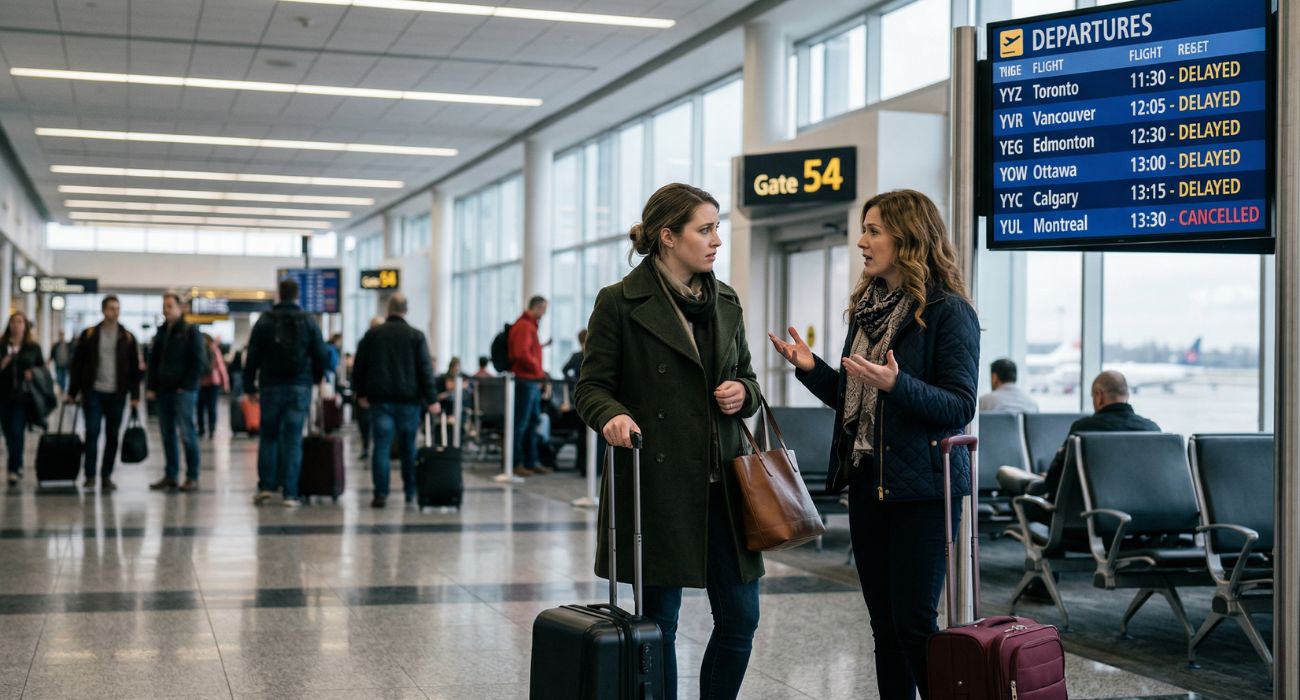
Image generated by AI
Hundreds of Travelers Disrupted Across Canada's Aviation Network
Canada's aviation system experienced significant operational strain on April 13, 2026, as eight major airports reported cascading delays and cancellations affecting thousands of passengers. Toronto Pearson International Airport, Montreal-Trudeau, Calgary International, Vancouver International, Ottawa Macdonald-Cartier, Halifax Stanfield, St. John's International, and Deer Lake Airport collectively logged 403 delayed flights and 32 cancellations across six major carriers. The widespread Canada flight disruptions highlighted vulnerabilities in the nation's interconnected air network, where delays at hub airports rapidly cascade through regional operations.
Air Canada, WestJet, Jazz Aviation, Porter Airlines, PAL Airlines, and several regional operators all experienced schedule strain. The incident underscores how modern airline networks, designed for efficiency, can amplify minor disruptions into system-wide challenges affecting hundreds of thousands in travel plans.
Widespread Disruptions Across Canada's Major Hubs
The geographic breadth of April 13's Canada flight disruptions revealed a network-wide operational crisis rather than isolated airport issues. Toronto Pearson bore the heaviest burden with 149 delays and 7 cancellations, reflecting its role as Canada's busiest international gateway handling connecting passengers destined for cross-border and overseas routes. Montreal-Trudeau followed with 76 delays and 10 cancellations, particularly affecting transatlantic services and Eastern Canadian connections.
Western Canada's critical hubs also experienced substantial pressure. Calgary International recorded 43 delays and 5 cancellations, while Vancouver International logged 60 delays and 2 cancellations. These disruptions compounded challenges for travelers connecting through Western Canada's domestic network. Smaller but strategically vital airports also felt the ripple effects: Ottawa registered 24 delays and 1 cancellation, Halifax logged 31 delays and 2 cancellations, St. John's reported 14 delays and 3 cancellations, and Deer Lake recorded 6 delays and 2 cancellations.
For real-time information on flight status during future disruptions, check FlightAware for live tracking and delay estimates across Canadian airports.
Toronto Pearson Bears Heaviest Impact
Toronto Pearson International Airport absorbed the largest volume of Canada flight disruptions, with nearly 150 delayed departures and arrivals concentrated during peak operating hours. As Canada's primary hub for Air Canada and a major connecting point for Jazz Aviation, Toronto Pearson's challenges immediately affected downstream airports across the country.
The airport's capacity constraints, combined with tight aircraft turnaround windows required to maintain high-frequency domestic service, meant that even modest delays compressed recovery options. A single inbound flight arriving 15–20 minutes late could cascade into multiple subsequent departures missing their scheduled departure windows. For passengers scheduled through Toronto Pearson during this period, missed connections and multi-hour delays became unavoidable.
Porter Airlines, which has expanded significantly at Toronto's Island Airport in recent years, also experienced secondary effects as ground handling resources and crew positions became strained across the wider Greater Toronto Area aviation system. Air Canada's tight scheduling dependency on Toronto Pearson means the airline lacks substantial schedule elasticity when primary hub operations deteriorate.
Regional Airports Feel Network-Wide Strain
Canada's network-wide flight disruptions extended beyond major metropolitan hubs to secondary and regional airports, demonstrating how integrated modern aviation scheduling has become. Halifax Stanfield, a critical Atlantic Canada hub, experienced 31 delays—a substantial disruption for a airport of its size. PAL Airlines' network serving Newfoundland and Labrador felt particular pressure, with St. John's International reporting 14 delays and 3 cancellations, while Deer Lake Airport (serving western Newfoundland) logged 6 delays and 2 cancellations.
These smaller airports depend on feeder connections from major hubs. When Air Canada and Jazz flights from Toronto, Montreal, and other major centers run late, regional service becomes compromised, effectively stranding passengers intended for smaller communities. The April 13 Canada flight disruptions illustrated how regional route viability depends entirely on hub-and-spoke network reliability.
Ottawa Macdonald-Cartier, positioned between Toronto and Montreal, recorded 24 delays and 1 cancellation, typical of secondary hub experiences during widespread disruptions. When primary hubs (Toronto and Montreal) experience strain, secondary hubs absorb secondary effects as aircraft positioning and crew scheduling shift to maintain essential trunk routes. This prioritization leaves regional and leisure routes vulnerable to compression and cancellation.
Airlines and Crew Rotation Challenges
Major Canadian carriers faced operational constraints linked to crew scheduling and aircraft availability during April 13's disruptions. Air Canada and Jazz Aviation, which collectively operate the densest domestic schedule among Canada's carriers, rely on precise aircraft rotations to maintain multiple daily frequencies on trunk routes like Toronto–Montreal, Toronto–Vancouver, and Montreal–Calgary.
When a single aircraft arrives 30 minutes late, subsequent flights on that aircraft's daily rotation shift late as well. Crew duty limits—governed by Canadian Aviation Regulations—prevent flight crews from working beyond prescribed daily and weekly maximums. If an aircraft runs behind schedule, crews may exceed their allowable duty hours, necessitating crew changes and reserve crew deployment. This cascades quickly through multi-leg daily rotations.
WestJet, positioned as Air Canada's primary domestic competitor, maintains significant operations at Calgary and Vancouver. Delays at these Western hubs affected its schedule symmetry between East and West Canadian operations. Porter Airlines, the fastest-growing Canadian airline, encountered particular difficulty as its short-haul network provides limited schedule flexibility compared to Air Canada and WestJet's longer-range routes.
For passenger rights information during disruptions, visit the US DOT Air Consumer Protection Division for regulations applicable to cross-border travel, and check Canada's transportation ministry guidance for domestic rights.
Operational and Weather Factors
The April 13 Canada flight disruptions appear rooted in a combination of operational strain and meteorological conditions rather than a single catastrophic event. Elevated delays concentrated during peak travel windows suggest that modest weather-related slowdowns—including low visibility, gusty wind conditions, or isolated precipitation—triggered congestion when airports already operated near maximum capacity.
Canada's aviation system has managed broader seasonal challenges throughout 2026, including winter weather persistence into spring and ongoing staffing constraints in ground handling and air traffic management. Earlier severe winter systems brought record snowfall to Ontario, demonstrating how fragile scheduling margins become when weather, ground handling resources, and air traffic control capacity simultaneously experience pressure.
When minor weather disturbances occur system-wide, the primary impact manifests not as outright cancellations but as large volumes of late departures and arrivals. Each delayed inbound flight pushes subsequent flights behind schedule; once this pattern spreads across multiple hubs, on-time recovery becomes mathematically difficult. The April 13 figures—with more than twelve delayed flights per cancellation—typify scenarios where airlines maximize schedule completion despite running late.
| Airport | Delays | Cancellations | Primary Carriers |
|---|---|---|---|
| Toronto Pearson | 149 | 7 | Air Canada, Jazz, Porter |
| Montreal-Trudeau | 76 | 10 | Air Canada, Jazz, Porter |
| Vancouver International | 60 | 2 | Air Canada, WestJet, Jazz |
| Calgary International | 43 | 5 | Air Canada, WestJet, Jazz |
| Halifax Stanfield | 31 | 2 | Air Canada, PAL, Jazz |
| Ottawa Macdonald-Cartier | 24 | 1 | Air Canada, Porter, Jazz |
| St. John's International | 14 | 3 | PAL, Air Canada, Jazz |
Disclaimer
This article is for informational and educational purposes only. It does not constitute legal, financial, or professional advice. While we strive to provide accurate and up-to-date information, travel policies, regulations, and conditions change rapidly. Always verify information with official sources before making travel decisions. Nomad Lawyer makes no representations about the accuracy, reliability, completeness, or suitability of the information provided. Readers should consult qualified professionals for advice specific to their circumstances. The views expressed in this article are those of the author and do not necessarily reflect the views of Nomad Lawyer.
Kunal K Choudhary
Co-Founder & Contributor
A passionate traveller and tech enthusiast. Kunal contributes to the vision and growth of Nomad Lawyer, bringing fresh perspectives and driving the community forward.
Learn more about our team →