
C-5M Super Galaxy Landing Gear Rotation: 28 Wheels Turn 90 Degrees
The U.S. Air Force's C-5M Super Galaxy rotates its 28-wheel landing gear 90 degrees horizontally to retract into the fuselage. Learn how this engineering marvel maximizes cargo capacity in 2026.

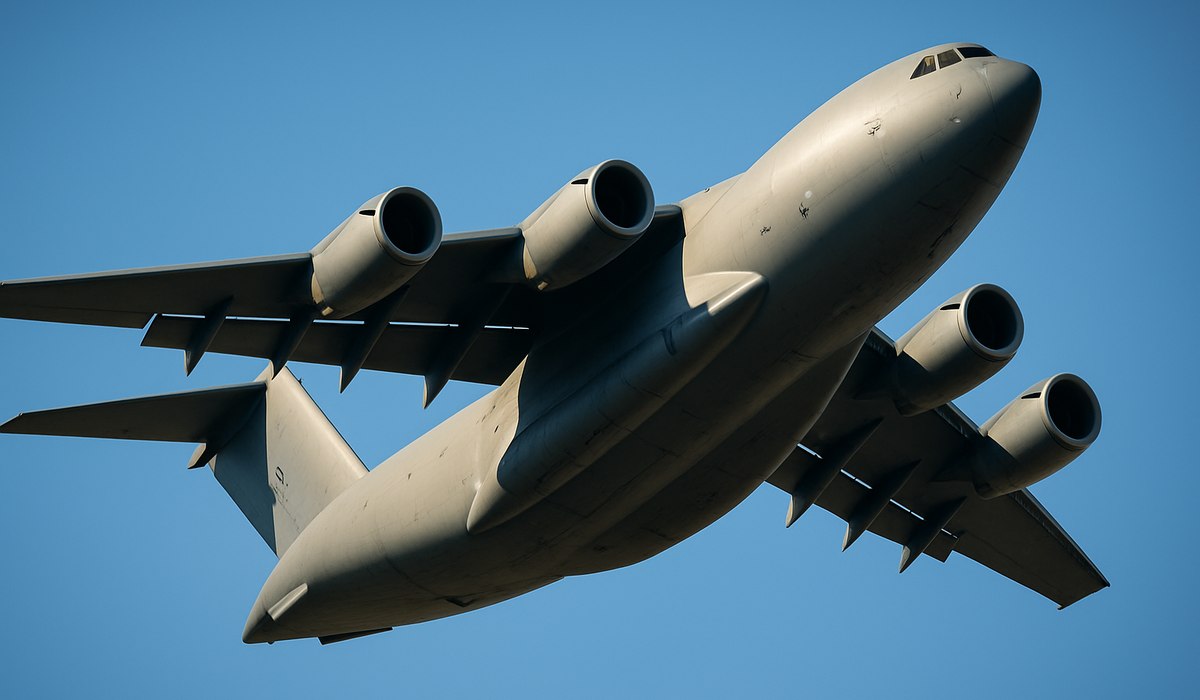
Image generated by AI
The U.S. Air Force's Extraordinary Landing Gear Engineering Challenge
The C-5M Super Galaxy, one of the world's largest military transport aircraft operated by the United States Air Force, employs an ingenious landing gear system that defies conventional aircraft design. The massive 28-wheel landing gear must rotate 90 degrees horizontally before retracting into the fuselage—a solution that engineers implemented to preserve cargo capacity while maintaining structural integrity. This remarkable mechanical adaptation allows the strategic airlifter to distribute its weight across multiple contact points without sacrificing the sleek aerodynamic profile necessary for efficient long-range flight operations.
Why The Wheels Must Rotate: A Space Problem
The fundamental challenge behind the C-5M Super Galaxy's 28-wheel landing gear rotation stems from pure geometry. Each of the four main landing gear units features six-wheel bogies arranged in a specific configuration. In their natural ground position, these assemblies measure too wide to fit through the aircraft's fuselage bays without significant structural modifications.
Engineers faced a critical decision point. Widening the fuselage would compromise aerodynamics and fuel efficiency. Reducing the wheel count would create unacceptable stress concentrations on the airframe when the aircraft carries its maximum 840,000-pound payload. The breakthrough solution: rotate the entire landing gear assembly 90 degrees horizontally during the retraction sequence.
This rotation allows the landing gear legs to align with the narrow profile of the internal wheel bays. Once positioned correctly, the assemblies retract smoothly into specially designed compartments. The design preserves the aircraft's cargo capacity—critical for moving oversized military equipment, humanitarian supplies, and strategic assets across global distances. Without this engineering innovation, the C-5M would require either a wider fuselage or fewer wheels, both unacceptable compromises for a strategic airlifter.
Engineering Marvel: How The Rotation System Works
The 90 degree rotation mechanism represents decades of aerospace engineering refinement. The system activates automatically during the landing gear retraction sequence initiated by pilots from the flight deck.
Hydraulic actuators power the rotation movement with precision timing. The system coordinates multiple sequential steps: initial gear collapse, horizontal rotation initiation, alignment verification, and final bay closure. Redundant safety systems monitor each phase to ensure the gear returns to its ground position correctly for landing. Pilots can override the automated system and manually extend the landing gear if necessary, though this rarely occurs during normal operations.
The 28 wheels themselves represent a distributed weight-bearing solution. Rather than concentrating landing impact forces on a few large wheels, the Super Galaxy spreads forces across 28 contact points. This distribution allows the aircraft to operate from austere airfields with unprepared surfaces—a critical capability for military operations. The wheel assembly complexity requires specialized maintenance protocols and trained technicians at every operational base.
The FAA maintains oversight of military aircraft design specifications, while the U.S. Air Force publishes detailed technical documentation for the C-5M program through official defense channels.
Impact on Strategic Airlift Capability
The landing gear rotation innovation directly enables the C-5M's strategic mission. Without this engineering solution, the aircraft's cargo capacity would decrease substantially. Military planners depend on the Super Galaxy to transport oversized equipment: main battle tanks, Apache helicopters, Patriot missile systems, and other critical defense assets.
International humanitarian missions also benefit from the aircraft's capabilities. During disaster response operations, the U.S. Air Force deploys C-5Ms to deliver emergency supplies, medical equipment, and personnel to affected regions. The preserved cargo capacity means fewer sorties required, reducing operational costs and response times. Allies and partner nations requesting airlift support benefit from the aircraft's maximum payload potential.
The design also impacts global logistics and commercial aviation indirectly. Military airlift capabilities influence strategic reserve positioning and emergency response networks. When the U.S. Air Force operates at full efficiency, it reduces pressure on commercial charter services and civilian airports handling overflow cargo demand.
Maintaining Performance Without Compromise
The 28-wheel landing gear system requires rigorous maintenance protocols to ensure operational readiness. Air Force technicians at installations worldwide perform regular inspections, replacement cycles, and system verifications. The hydraulic actuators powering the rotation mechanism undergo pressure testing and component replacement on scheduled intervals.
Wheel tire management represents another significant maintenance consideration. With 28 wheels rotating through operational cycles, the Super Galaxy requires specialized tire compounds designed for the aircraft's weight and speed characteristics. Replacement tire procurement and inventory management consume substantial logistics resources across Air Force maintenance depots.
The rotation mechanism's complexity means that any single system failure requires immediate repair before flight operations resume. This reliability requirement drives training programs for C-5M maintenance personnel. Technicians must understand the interdependencies between hydraulic systems, electrical controls, and mechanical linkages that coordinate the 90-degree rotation sequence.
Despite these maintenance demands, the design has proven highly reliable throughout the C-5M fleet's operational history. The engineering innovation demonstrates how constraints often drive creative solutions in aviation design—solutions that ultimately enhance aircraft performance and capability.
Key Technical Specifications Table
| Specification | Detail |
|---|---|
| Landing Gear Units | Four main gear assemblies |
| Total Wheels | 28 wheels across all units |
| Wheels Per Bogie | 6 wheels per unit |
| Rotation Angle | 90 degrees horizontal |
| Maximum Payload | 840,000 pounds |
| Fuselage Bay Width | Narrower than ground position width |
| Rotation Power Source | Hydraulic actuators |
| Activation Method | Automated during retraction sequence |
| Manual Override | Pilot-controlled emergency extension |
| Maintenance Interval | Regular hydraulic and mechanical inspections |
What This Means for Travelers
While the C-5M Super Galaxy operates exclusively in military service and doesn't carry civilian passengers, understanding advanced aerospace engineering informs travelers about aviation safety and capability. The aircraft's design innovations influence how the industry approaches engineering challenges.
Actionable Takeaways for Travel-Minded Readers:
-
Recognize that military airlift innovations often precede civilian applications by years, with technologies eventually trickling into commercial aircraft design.
-
Monitor defense industry developments if you're interested in aerospace careers—companies like Lockheed Martin hire engineers solving next-generation transportation challenges.
-
Appreciate aircraft complexity by learning about systems like landing gear rotation when booking flights—modern aircraft represent generations of engineering refinement.
-
Consider cargo aircraft logistics if you work in international supply chain management, where military airlift capabilities impact global commerce.
-
Follow aviation news through reliable sources like FlightAware and the FAA to stay informed about aerospace developments.
Frequently Asked Questions
Why can't the C-5M just have a wider fuselage like other large aircraft?
Widening the fuselage would increase empty aircraft weight, reducing cargo capacity and fuel efficiency. The C-5M's design prioritizes payload over structural size, making the 28-wheel rotation system a more elegant solution than airframe redesign.
How long does the landing gear rotation take during retraction?
The automated rotation sequence completes in seconds as part of the overall landing gear retraction process. Hydraulic systems coordinate the movement with precision timing to ensure smooth, reliable operation.
Can pilots manually control the 90-degree rotation if the automatic system fails?
Pilots can extend the landing gear manually using backup hydraulic systems, though the rotation mechanism typically functions reliably. Military aircraft design includes multiple redundancies for critical systems.
**Does the 28-wheel
Disclaimer
This article is for informational and educational purposes only. It does not constitute legal, financial, or professional advice. While we strive to provide accurate and up-to-date information, travel policies, regulations, and conditions change rapidly. Always verify information with official sources before making travel decisions. Nomad Lawyer makes no representations about the accuracy, reliability, completeness, or suitability of the information provided. Readers should consult qualified professionals for advice specific to their circumstances. The views expressed in this article are those of the author and do not necessarily reflect the views of Nomad Lawyer.
Raushan Kumar
Founder & Lead Developer
Full-stack developer with 11+ years of experience and a passionate traveller. Raushan built Nomad Lawyer from the ground up with a vision to create the best travel and law experience on the web.
Learn more about our team →