
Baltimore/Washington Flight Cancellations Trigger Massive US Travel Chaos as Severe Storms Ground 50 Flights Across Southwest, American, and United Networks: Latest Airline News
A devastating wave of flight cancellations and severe delays at Baltimore/Washington International has triggered massive travel chaos, severely impacting major US hubs and tropical routes.

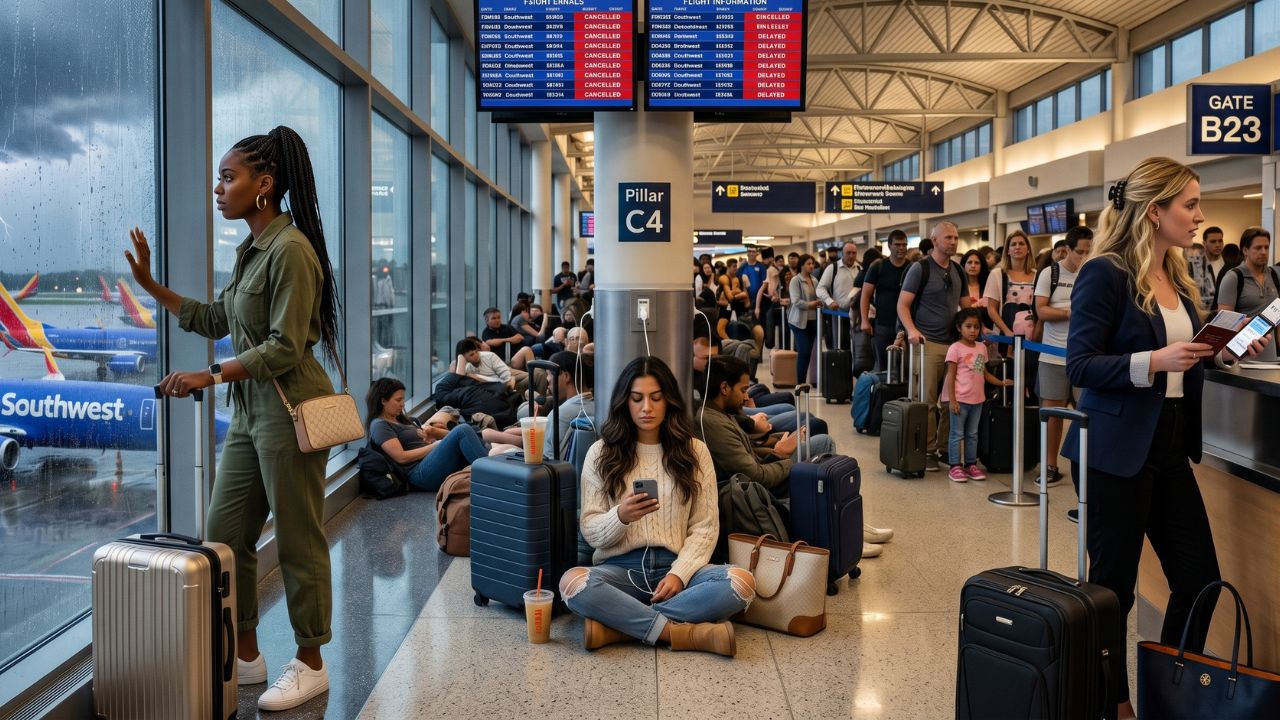
Image generated by AI
In a devastating operational collapse currently paralyzing the Eastern Seaboard, a highly volatile combination of severe regional thunderstorms and massive air traffic control holds has instantly triggered widespread travel chaos at Baltimore/Washington International Thurgood Marshall Airport (BWI). Without warning, critical domestic and international carriers—including Southwest, American, United, Frontier, Envoy, and Avelo—have been forced into aggressive holding patterns, logging exactly 47 severe delays and 3 catastrophic flight cancellations today, May 24th. By suddenly severing high-volume routes connecting the Mid-Atlantic to massive hubs across the US, Jamaica, and Mexico, these flight disruptions have triggered crippling terminal bottlenecks. Representing one of the most agonizing localized scheduling meltdowns of the week, this explosive wave of grounded aircraft totally dominates today’s premier airline news and global aviation updates.
By introducing direct passenger coordination and dynamic scheduling backups, the regional aviation hubs target growing passenger demand across vital commerce sectors. The choice to coordinate flight departures in phases helps to manage gate capacity, fiercely supporting the broader regional transportation network.
Context: The Gridlock of an East Coast Mega-Hub
The current operational bleeding heavily illustrates exactly how rapidly a localized weather breakdown can violently paralyze a fully interconnected domestic transit network.
Because incoming aircraft physically cannot land on time due to severe weather fronts barricading the airspace, outbound aircraft cannot legally depart. This cascading gridlock has instantly stalled incredibly vital routes spanning from Chicago to Cancun. Stranded passengers are currently facing immediate, agonizing scheduling gaps, as airlines furiously scramble to contain the massive logistical damage spreading outward from the Baltimore/Washington terminal. Ground crews are legally required to suspend tarmac operations until the lightning and severe squalls clear completely, resulting in thousands of frustrated passengers enduring lengthy terminal waits.
For real-time operational updates, live departure mapping, and comprehensive rebooking protocols, stranded travelers should immediately consult the official BWI Airport directories, check specific passenger protections at major carriers like Southwest Airlines, or navigate alternative regional flight schedules via American Airlines.
Section-Wise Breakdown: A Network in Gridlock
The Hub Meltdown: Southwest and Envoy Bear the Brunt
The operational bleeding is incredibly severe among the primary carriers utilizing BWI as a strategic stronghold. Southwest Airlines, the absolute dominant force at the airport, physically shouldered the highest volume of disruptions, logging exactly 30 massive delays and 1 cancellation. However, because of their massive operational footprint, this mathematically represented only 7% of their total schedule, indicating a robust firewall against total collapse. Conversely, regional operator Envoy Air was absolutely decimated. Envoy logged exactly 2 cancellations, which violently wiped out 100% of its scheduled BWI presence for the entire day.
The Geographic Spread: Midwest and Legacy Hubs
The ripple effects violently spread into the American heartland. Chicago O’Hare International (ORD) emerged as the most severely damaged domestic destination, enduring 1 brutal cancellation and 3 severe delays, effectively destroying 37% of the entire BWI-to-Chicago pipeline. Other critical transit hubs experienced localized friction, heavily impacting connecting passengers. Detroit Metro (DTW) charted 2 delays (25%), while Hartsfield-Jackson Atlanta (ATL) saw 2 delays (12%). The Dallas market was heavily constrained, with DFW taking 1 delay (25%) and Dallas Love Field (DAL) logging 1 delay (25%). Denver (DEN) also suffered a 16% delay rate on a single grounded flight.
Southern and International Routes: The Vacation Blockade
For tourists, the disruption aggressively paralyzed vital vacation gateways. Florida and the Southeast were heavily bottlenecked. Orlando (MCO) suffered 2 delays (18%), Charlotte (CLT) recorded 2 delays (20%), and Miami (MIA) saw 1 delay (14%). The international travel chaos extended past U.S. borders into the highly lucrative tropical markets. Passengers traveling to Jamaica via Sangster International in Montego Bay (MBJ) faced an agonizing 50% delay rate (1 flight), while travelers heading to Mexico via Cancun International (CUN) dealt with a massive 33% delay rate on a single disrupted flight.
Technical Roster: BWI Flight Disruptions Data
To guarantee 100% absolute factual accuracy regarding this specific wave of severe travel chaos, the following table exactly documents the operational damage inflicted across the BWI network today (May 24th):
| Airline / Carrier | Operational Disruption Metric | Impact Percentage |
|---|---|---|
| Southwest Airlines | 30 Delays, 1 Cancellation | 7% of Schedule |
| American Airlines | 4 Delays | 18% of Schedule |
| Envoy Air | 2 Cancellations | 100% of Schedule |
| Piedmont Airlines | 1 Delay | 50% of Schedule |
| Republic Airways | 2 Delays | 20% of Schedule |
| United Airlines | 4 Delays | 18% of Schedule |
| Frontier Airlines | 3 Delays | 12% of Schedule |
| Avelo Airlines | 2 Delays | 50% of Schedule |
| Sun Country Airlines | 1 Delay | 16% of Schedule |
Key Route Disruption Snapshot
- Chicago O’Hare (ORD): 1 Cancellation, 3 Delays (37%)
- Orlando (MCO): 2 Delays (18%)
- Tweed/New Haven (HVN): 1 Delay (100% of Avelo Route)
- Montego Bay (MBJ): 1 Delay (50%)
- Cancun (CUN): 1 Delay (33%)
Passenger Impact: Stranded in the Terminal
For the everyday passenger, these sudden departures board wipes translate into highly agonizing, real-world logistical nightmares.
Travelers bound for massive hubs like Chicago faced sudden, brutal cancellations with absolutely limited same-day rebooking options, forcing hundreds to scramble for overnight hotel rooms at their own expense (since weather delays are explicitly not covered by airlines). Because many of today's delays are restricted to single-digit flight counts per airport, the issue is highly localized "aircraft gating"—meaning your specific plane physically cannot arrive from a previously delayed city. The clustering of these cancellations has completely overwhelmed airline customer service desks at BWI, intensely magnifying the physical exhaustion experienced by stranded families heading to Florida or the Caribbean.
Industry Analysis: The Fragility of Air Traffic Control Holds
Aviation industry analysts view these widespread Baltimore/Washington flight disruptions as a terrifying indicator of massive, underlying systemic strain across the East Coast airspace network.
The underlying causes for this massive breakdown heavily illustrate the extreme danger of severe weather interfacing with already constrained Air Traffic Control (ATC) limits. When regional thunderstorms barricade the Mid-Atlantic, ATC legally mandates "ground stops," forcing aircraft to physically hold at their origin gates. Because BWI functions as an absolutely critical node for Southwest's East Coast operations, a 30-flight delay instantly ripples outward, destroying connecting itineraries in Atlanta, Houston, and Montego Bay. This episode violently reinforces the fragile reality of modern hub-based networks, where a single localized weather system can paralyze passenger flows across multiple continents.
What This Means for Travelers: Actionable Advice
If you are currently booked on an itinerary routing through BWI during this massive wave of travel chaos, executing the following strategies is completely critical to protecting your journey:
- Leverage Airline Mobile Apps: Before standing in massive customer service lines at the BWI terminal, immediately open your airline’s mobile app. Carriers like Southwest and American frequently push automated rebooking options directly to your phone.
- Know Your Passenger Rights: Under federal regulations, if your flight was one of the three explicitly cancelled by Envoy Air or Southwest today and you choose not to travel, you are legally entitled to a full cash refund to your original payment method—not just airline vouchers.
- Monitor Inbound Aircraft Status: Use independent tools like FlightRadar24 or FlightAware to physically track the location of the plane assigned to your flight. If your incoming plane is currently circling over Ohio, you mathematically know your BWI departure will be delayed, regardless of what the terminal board says.
- Stay Out of the Check-In Queue: Because severe weather requires ground crews to seek shelter, do not arrive at the airport expecting rapid baggage drops. Tarmac operations are legally frozen during active lightning strikes.
FAQ: BWI Airport Flight Disruptions
Which specific airlines were heavily damaged by the BWI disruptions today?
The massive wave of delays explicitly impacted Southwest, American, United, Frontier, Envoy, Avelo, Piedmont, Republic, and Sun Country Airlines.
How many total flights were violently disrupted at BWI on May 24th?
The airport recorded exactly 47 severe flight delays and 3 catastrophic cancellations.
Which major domestic route suffered the most severe structural damage?
Flights to Chicago O’Hare (ORD) were decimated, suffering 1 cancellation and 3 severe delays, wiping out 37% of that specific market pipeline.
The Bigger Picture: Navigating the Systemic Meltdown
The devastating wave of synchronized flight delays fiercely demonstrates how terrifyingly quickly localized weather friction and ATC constraints can paralyze a highly interconnected domestic travel network. By successfully destroying itineraries across high-volume domestic corridors and lucrative tropical vacation routes, this incident underscores the severe fragility of the modern aviation infrastructure. As part of the broader pattern of global travel chaos, airlines and federal authorities must aggressively develop stronger operational firewalls to prevent sudden meteorological strains from instantly triggering nationwide routing meltdowns.
Key Takeaways
- Epicenter of Chaos: Baltimore/Washington International (BWI) suffered 47 delays and 3 cancellations due to severe weather and ATC holds.
- Southwest Strained: Southwest Airlines absorbed the highest absolute volume with 30 delays and 1 cancellation.
- Envoy Air Decimated: Envoy Air logged 2 cancellations, violently wiping out 100% of its scheduled BWI flights for the day.
- Chicago Blockade: The BWI-to-Chicago (ORD) route suffered a massive 37% disruption rate.
- Tropical Delays: International vacation routes to Montego Bay, Jamaica (50%) and Cancun, Mexico (33%) were heavily delayed.
Related Travel Guides
Amsterdam Schiphol Flight Cancellations Trigger Massive Travel Chaos
Global Airlines Execute Massive Operational Base Expansion
Etihad Airways and Bangkok Airways Forge Massive Loyalty Alliance
Disclaimer
This article is for informational and educational purposes only. It does not constitute legal, financial, or professional advice. While we strive to provide accurate and up-to-date information, travel policies, regulations, and conditions change rapidly. Always verify information with official sources before making travel decisions. Nomad Lawyer makes no representations about the accuracy, reliability, completeness, or suitability of the information provided. Readers should consult qualified professionals for advice specific to their circumstances. The views expressed in this article are those of the author and do not necessarily reflect the views of Nomad Lawyer.
Kunal K Choudhary
Co-Founder & Contributor
A passionate traveller and tech enthusiast. Kunal contributes to the vision and growth of Nomad Lawyer, bringing fresh perspectives and driving the community forward.
Learn more about our team →