
Buffalo Niagara International Airport Fuel System Outage Causes Flight Diversions and Delays in 2026
Emergency repairs to the apron fuel system at Buffalo Niagara International Airport triggered widespread flight delays and technical diversions on August 24, 2026.
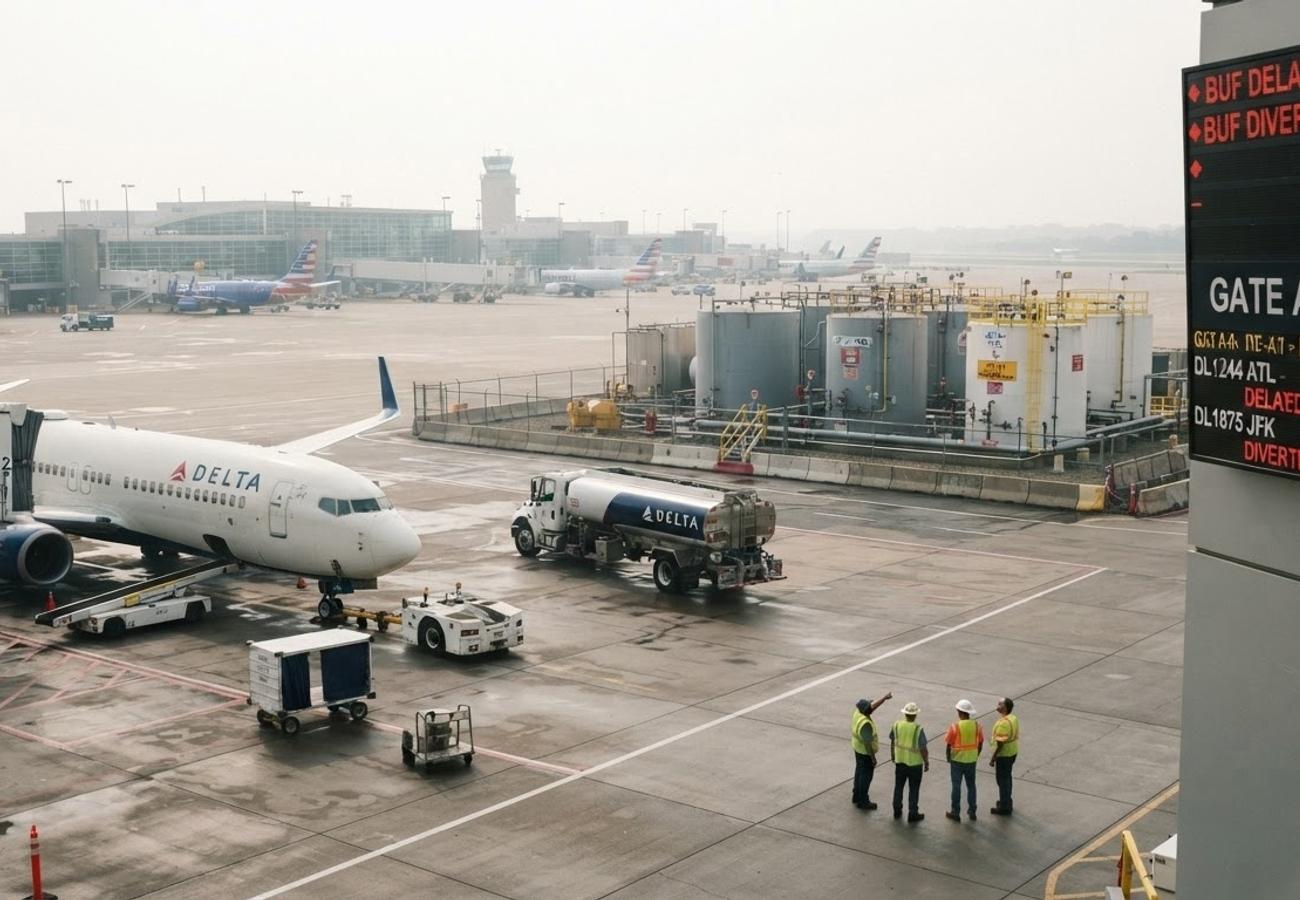
Image generated by AI
Flight operations at Buffalo Niagara International Airport were severely compromised on Monday, August 24, 2026, after a critical apron fuel system outage forced emergency repairs and unplanned technical stops.
Fuel Transfer Disruption and Operational Impact
On August 24, 2026, Buffalo Niagara International Airport experienced a technical failure within its apron fueling infrastructure. Aviation notices confirmed that fueling services were unavailable during a specific window spanning the morning and early afternoon, restricting the ability of aircraft to refuel at the gates.
The Niagara Frontier Transportation Authority (NFTA), which manages the facility, clarified that the incident was a technical failure in the fuel transfer system—the "fuel farm" infrastructure responsible for moving jet fuel from storage tanks to ramp hydrants and tanker trucks—rather than a shortage of the fuel supply itself.
Our analysis of flight tracking data and passenger reports indicates a significant ripple effect across regional schedules:
- Technical Diversions: Multiple outbound flights were forced to depart with minimal fuel, necessitating intermediate technical stops at nearby hubs, specifically Pittsburgh and Rochester, to refuel before continuing to their final destinations.
- Gate Congestion: Aircraft remained stationary at gates for extended periods as ground crews awaited the availability of limited-volume fuel trucks.
- Schedule Cascades: While mass cancellations were avoided by midday, the disruption caused a backlog of departures, affecting aircraft rotations and crew duty hours for subsequent flights.
Infrastructure Analysis: The Buffalo Fuel Farm
The fueling architecture at Buffalo Niagara International Airport relies on a combination of a central fuel farm and on-airport storage tanks. This system is designed to facilitate rapid turnarounds for commercial and cargo carriers. When a bottleneck occurs in the pumps, valves, or hydrant lines, the airport must pivot to less efficient refueling methods.
Federal aviation safety guidelines require conservative restrictions when equipment failure or potential contamination is suspected. Because Buffalo's fuel farm is fenced and bermed for environmental protection, these safety layers can increase the complexity and duration of emergency inspections and repairs.
Passenger Rights & Advisory
For passengers affected by these delays or diverted flights, the nature of the disruption determines the available recourse. Because this was a technical failure of airport infrastructure rather than a weather event, it may be classified as an "avoidable" or "controllable" delay depending on the airline's specific contract of carriage.
For the affected passenger, this means:
- Duty of Care: Under standard aviation guidelines, if a delay exceeds a certain threshold (typically 2-4 hours), airlines should provide vouchers for food and communications.
- Rebooking Rights: Passengers on flights that required unplanned technical stops or suffered significant delays are entitled to be rebooked on the next available flight to their destination at no additional cost.
- Compensation Analysis: While U.S. DOT guidelines are less stringent than EU261/2004, passengers should document all out-of-pocket expenses resulting from the diversion. If the airline failed to provide timely notification of the fuel-related delay, passengers may have grounds for a customer service gesture or partial refund of ancillary fees.
- Connection Risks: Those with tight connections at major hubs are advised to monitor gate changes in real-time, as the "padding" added to flight times to accommodate fuel stops often results in revised arrival windows.
This incident highlights a growing vulnerability in mid-sized U.S. aviation hubs. While major international airports often have redundant fueling systems, regional airports like Buffalo can see an entire operation grind to a halt due to a single point of failure in the fuel farm.
The shift toward sustainable master planning and modernized infrastructure, as noted in NFTA documents, is necessary, but this event proves that legacy distribution systems remain a critical risk factor for regional resilience. The ability of carriers to pivot to alternate airports like Rochester and Pittsburgh mitigated a total shutdown, but the resulting "schedule drift" typically takes 24 to 48 hours to fully resolve.
Operational stability returns only after the final displaced aircraft is repositioned.
Related Travel Guides
Disclaimer
This article is for informational and educational purposes only. It does not constitute legal, financial, or professional advice. While we strive to provide accurate and up-to-date information, travel policies, regulations, and conditions change rapidly. Always verify information with official sources before making travel decisions. Nomad Lawyer makes no representations about the accuracy, reliability, completeness, or suitability of the information provided. Readers should consult qualified professionals for advice specific to their circumstances. The views expressed in this article are those of the author and do not necessarily reflect the views of Nomad Lawyer.