
British Airways Cabin Fire Triggers Las Vegas Airport Disruptions and Severe Travel Chaos as Lithium Battery Emergency Sparks Mid-Air Panic: Latest Airline News
As a mobile phone violently catches fire mid-flight on British Airways BA271, the emergency response at Las Vegas Airport exposes the terrifying risk lithium batteries pose to global flight schedules.

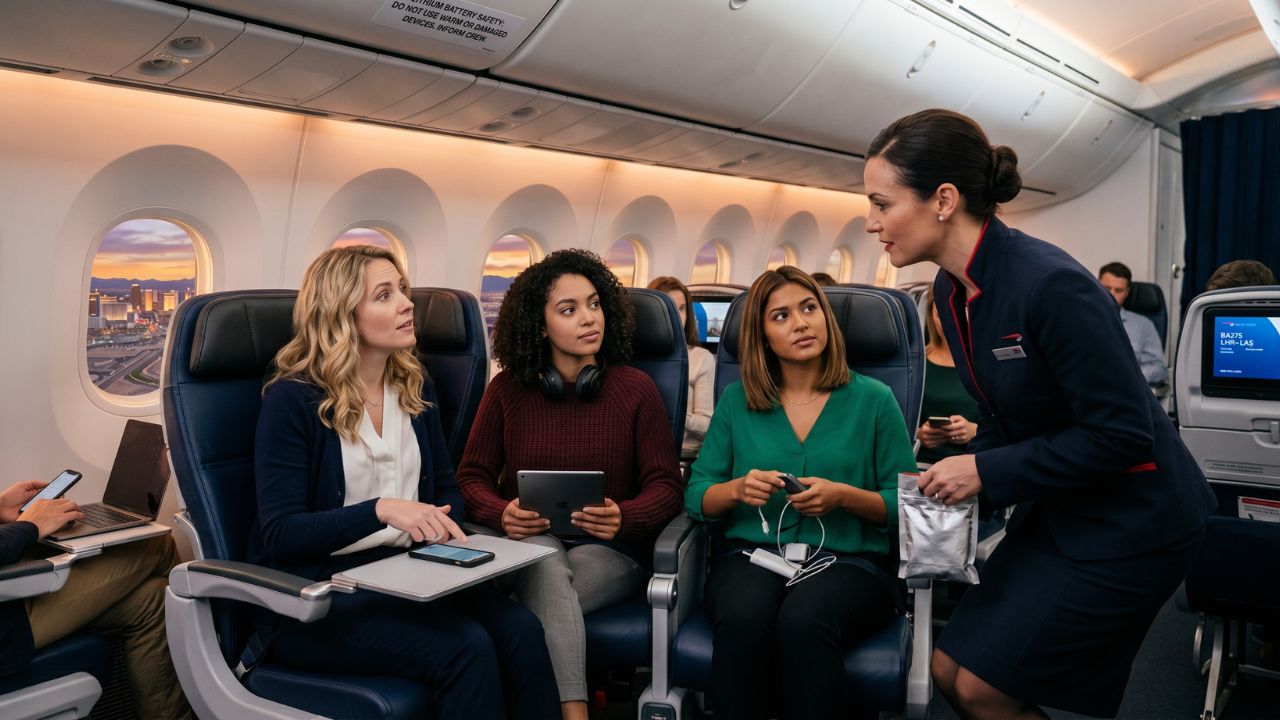
Image generated by AI
In a terrifying mid-air emergency that instantly triggered localized travel chaos and severe airport disruptions on the ground, a mobile phone violently caught fire inside the cabin of British Airways flight BA271 during its final descent into Las Vegas. On Monday, 15 June 2026, as the wide-body jet completed its 10-hour transatlantic journey from London Heathrow, the sudden lithium battery combustion forced the crew into emergency containment protocols. While the aircraft landed safely at Harry Reid International Airport with no major injuries, the immediate deployment of emergency responders to the runway generated a massive logistical bottleneck, heightening the risk of rolling flight cancellations for subsequent departures. As millions of passengers pack their carry-ons with highly volatile portable power banks, this near-disaster exposes a massive, hidden safety crisis that represents the premier headline in today's breaking airline news and essential global aviation updates.
By introducing direct passenger coordination and dynamic scheduling backups, the regional aviation hubs target growing passenger demand across vital commerce sectors. The choice to coordinate flight departures in phases helps to manage gate capacity, supporting the country's broader regional transportation network.
Context: The Hidden Threat of Cabin Combustions
For the everyday holidaymaker and the high-yield corporate traveler, the assumption of cabin safety is absolute. However, the BA271 incident proves that modern passengers are unwittingly flying inside a highly volatile battery zone, which can instantly plunge a flight into travel chaos.
Historically, lithium battery fires were rare anomalies. Today, the modern business traveler flies with phones, laptops, tablets, vapes, cameras, and multiple power banks. When these devices are buried deep inside overhead bins, crushed between passenger seats, or connected to low-grade, unregulated chargers during a 10-hour flight, they become active thermal hazards. On BA271, the crew's rapid reaction prevented a catastrophic mid-air disaster. If this fire had occurred mid-Atlantic rather than during the final descent, the aircraft would have been forced to execute an immediate emergency diversion. Such mid-air diversions instantly destroy international fleet rotations, causing massive flight cancellations, stranding hundreds of passengers at remote airfields, and triggering severe airport disruptions across the carrier's entire global network.
To view live flight schedules, specific airline battery policies, or alternative connection statuses resulting from emergency delays, travelers must consult official aviation directories. For direct booking access, travelers should check the official British Airways portal. To explore live flight tracking and monitor the exact severity of the airspace bottlenecks caused by emergency runway deployments at Harry Reid International Airport, passengers can consult the official FlightAware tracking service.
Section-Wise Breakdown of the BA271 Emergency
The Transatlantic Descent: Mid-Air Combustion
Flight BA271 is a massive, high-profile route connecting London Heathrow directly to Las Vegas. The journey typically requires 10 hours of flight time. During the absolute final stage of the flight—often the most critical phase for pilots—a mobile phone reportedly caught fire inside the densely packed cabin. Panic is the enemy of aviation safety, but the highly trained crew successfully contained the thermal runaway situation before the flames could spread to the surrounding cabin architecture.
The Tarmac: Harry Reid Airport Disruptions
Because the aircraft declared a mid-air emergency regarding a cabin fire, Las Vegas airport authorities immediately confirmed an alert. Upon touching down, emergency responders were deployed directly to the aircraft. While the plane safely taxied to the gate and passengers evacuated without major injury, the massive emergency presence physically blocked gate access and tarmac pathways. This localized travel chaos directly disrupted the tightly scheduled turnaround times at Harry Reid International Airport, increasing the likelihood of cascading flight cancellations for aircraft queued behind the British Airways jet.
The Las Vegas Demographic: High-Risk Battery Loads
The fact that this occurred on a flight to Las Vegas is critical. Vegas is a global convention mega-hub. The passengers on BA271 were likely carrying significantly more devices than standard tourists, including heavy presentation tools, multiple portable chargers, and wireless tech gear. This creates a uniquely dangerous "hidden risk group." When passengers simultaneously charge multiple devices under blankets to prepare for business conventions, the cabin temperature spikes, setting the stage for sudden, violent battery combustions.
Technical Roster: Incident Data and Lithium Battery Survival Matrix
To ensure absolute factual accuracy regarding the BA271 incident and to provide travelers with the exact safety protocols required to prevent massive in-flight travel chaos, the following matrices detail the event:
Incident Data: British Airways Flight BA271
| Category | Verified Details |
|---|---|
| Airline | British Airways |
| Flight Number | BA271 |
| Date of Incident | Monday, 15 June 2026 |
| Route | London Heathrow to Las Vegas (Harry Reid International Airport) |
| Flight Duration | Approximately 10 hours |
| Incident | Mobile phone caught fire inside the cabin during the final stage of flight |
| Outcome | Crew contained the fire; aircraft landed safely; emergency responders deployed; no major injuries |
Passenger Safety Checklist: Preventing Cabin Fires
| Action Required | Safety Justification |
|---|---|
| Keep power banks/spare batteries in cabin baggage only | Allows crew rapid access to extinguish thermal events |
| Never pack loose lithium batteries in checked luggage | A fire in the cargo hold cannot be easily reached or contained |
| Check the watt-hour rating before travel | Ensures battery size complies with strict international aviation limits |
| Avoid damaged, swollen, hot or recalled devices | Swollen batteries are highly susceptible to sudden, violent combustion |
| Protect terminals with tape, packaging, or a pouch | Prevents loose coins or keys from causing a dead short circuit |
| Tell cabin crew immediately if a phone slips into a seat gap | Seat mechanisms can crush the battery, sparking an instant fire |
| Avoid charging devices while sleeping | Overheating devices will not be noticed until the fire has already started |
| Stop using any device that smells, heats up, or smokes | Chemical smells are the primary warning sign of an impending thermal runaway |
Passenger Impact: The Threat of Immediate Grounding
For the everyday passenger, a mid-air cabin fire represents the most terrifying form of travel anxiety, while simultaneously guaranteeing immediate schedule destruction.
The immediate passenger impact on BA271 was severe psychological stress, followed by delayed disembarkation as emergency crews secured the jet. However, the broader impact for the flying public is the threat of sudden flight cancellations. If a passenger drops their phone between the mechanical seats of a premium cabin, the flight crew is legally required to halt operations. If the phone cannot be safely retrieved, the aircraft cannot take off, causing immediate airport disruptions. Furthermore, if a power bank ignites in an overhead bin during the middle of a 10-hour flight, the ensuing emergency diversion will force hundreds of passengers into an unexpected terminal, generating massive, multi-day travel chaos as airlines struggle to deploy rescue aircraft.
Industry Analysis: The Evolution of Cabin Safety
Aviation industry analysts view the BA271 Las Vegas incident as a critical wake-up call regarding the evolution of passenger education and cabin safety.
Analysts note that airlines simply cannot remove every lithium battery from the cabin; modern commerce requires them. Therefore, the defense strategy must shift. The BA271 incident proves that while the crew’s rapid reaction was flawless, the passenger side of the safety chain is desperately weak. A senior aviation commentary perspective from TTW Founder and Editor-in-Chief, Mr. Anup Kumar Keshan, perfectly captures the severe industry sentiment: "This incident is a sharp reminder that aviation safety now begins before passengers reach the aircraft door. Travellers must pack smarter, airlines must communicate clearer, and the industry must treat lithium battery awareness as a front-line safety issue, not a footnote in baggage rules." Analysts agree that until passengers stop burying cheap, unregulated power banks deep inside inaccessible bags, the risk of mid-air combustions forcing severe flight cancellations will continue to skyrocket.
Actionable Advice for Surviving the Battery Crisis
If you are a passenger carrying multiple electronic devices and you wish to avoid triggering an emergency diversion that results in severe travel chaos, execute this strategic survival checklist immediately:
- Never Charge Devices Unattended: Do not plug your power bank into your phone and fall asleep on a long-haul flight. If the battery enters thermal runaway while you sleep, the fire will spread before you can alert the crew.
- Keep Devices Visible and Accessible: Do not bury your power bank at the bottom of a tightly packed carry-on bag in the overhead bin. Keep it in your personal item under the seat so the crew can instantly access and isolate it if it begins to smoke.
- Halt Seat Movement Immediately: If you drop your phone between your seat cushions, DO NOT attempt to adjust the electronic seat controls to retrieve it. The motor will crush the battery and spark a massive fire. Alert the flight attendants immediately.
- Buy Certified Electronics Only: Stop purchasing extremely cheap, unbranded power banks from online marketplaces. These devices lack the internal thermal regulation required to safely charge devices at altitude, directly risking an emergency landing and flight cancellations.
FAQ: British Airways BA271 Cabin Fire & Travel Chaos
What happened on British Airways flight BA271 to Las Vegas?
On Monday, 15 June 2026, during the final stage of the 10-hour flight from London Heathrow to Las Vegas, a mobile phone violently caught fire inside the cabin, forcing an immediate emergency response on the tarmac.
Did the cabin fire cause flight cancellations or airport disruptions?
While the aircraft landed safely without major injuries, the emergency deployment of fire crews to the BA271 jet caused localized tarmac congestion at Harry Reid International Airport, disrupting gate access for subsequent flights.
What should passengers do to prevent mid-air battery fires?
Passengers must keep all power banks and spare batteries in accessible cabin baggage, never pack them in checked luggage, stop charging devices while sleeping, and immediately notify crew if a device smells of chemicals or overheats.
The Brutal Reality of Modern Cabin Hazards
The terrifying mid-air combustion aboard British Airways flight BA271 proves definitively that the modern aircraft cabin is essentially a high-altitude battery storage facility. By safely containing the Las Vegas fire, the BA crew successfully prevented a physical disaster, but the ensuing emergency response highlights how easily a single damaged phone can trigger massive airport disruptions. As business travelers load their bags with unregulated chargers and heavy electronics, passengers must accept a critical new reality: avoiding the severe travel chaos of an emergency mid-air diversion requires absolute discipline in how you pack, charge, and store your lithium batteries at 35,000 feet.
Key Takeaways
- Mid-Air Cabin Fire: A mobile phone violently caught fire inside the cabin of British Airways flight BA271 during its final descent from London to Las Vegas on June 15, 2026.
- Emergency Tarmac Response: The 10-hour flight landed safely, but the deployment of emergency responders to the runway generated localized airport disruptions at Harry Reid International Airport.
- The Hidden Risk Group: Business travelers heading to Vegas conventions carry massive, heavy loads of lithium batteries and power banks, creating a highly dangerous, densely packed cabin environment.
- Strict Battery Protocols: Passengers must legally keep power banks in their cabin baggage, never in checked luggage, to ensure the crew can rapidly access and extinguish any thermal events.
- A Warning to the Industry: The incident exposes a massive flaw in passenger education; a single overheating device crushed in a seat gap can trigger an emergency diversion, guaranteeing severe flight cancellations and travel chaos.
Related Travel Guides
Air India Express 737 MAX Emergency Triggers Travel Chaos
Massive World Cup Fleet Repainting Triggers Travel Chaos
British Airways Cabin Fire and Lithium Battery Rules on Reddit
Disclaimer
This article is for informational and educational purposes only. It does not constitute legal, financial, or professional advice. While we strive to provide accurate and up-to-date information, travel policies, regulations, and conditions change rapidly. Always verify information with official sources before making travel decisions. Nomad Lawyer makes no representations about the accuracy, reliability, completeness, or suitability of the information provided. Readers should consult qualified professionals for advice specific to their circumstances. The views expressed in this article are those of the author and do not necessarily reflect the views of Nomad Lawyer.
Kunal K Choudhary
Co-Founder & Contributor
A passionate traveller and tech enthusiast. Kunal contributes to the vision and growth of Nomad Lawyer, bringing fresh perspectives and driving the community forward.
Learn more about our team →