
Aviation Updates: Viral Boeing 777F Low Flyby in Texas Sparks Global Safety Outrage Amid Travel Chaos
A pre-delivery Boeing 777F freighter executes a terrifyingly low pass over a Texas airport, igniting a fierce viral debate over aviation safety and pilot discipline.

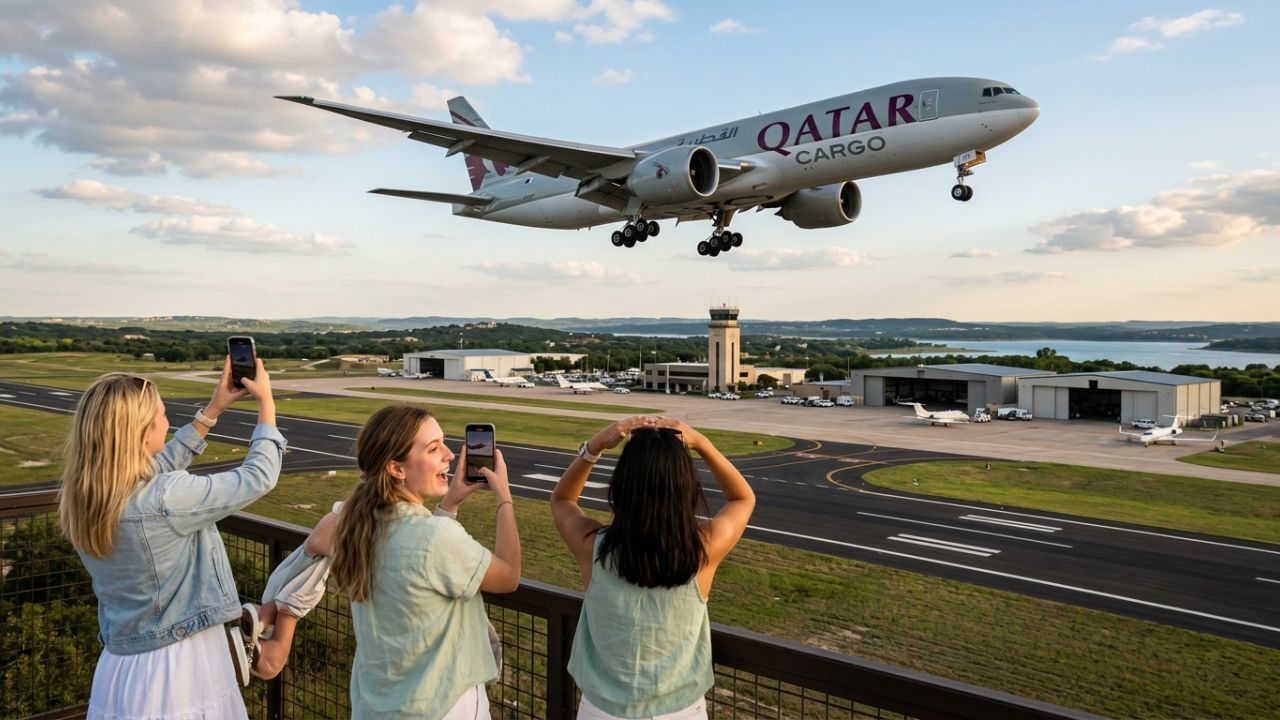
Image generated by AI
Aviation Updates: Viral Boeing 777F Low Flyby in Texas Sparks Global Safety Outrage Amid Travel Chaos
As the global aviation industry frantically battles severe operational volatility, a terrifyingly low flyby by a massive widebody freighter in Texas has instantly hijacked the news cycle, igniting a fierce international debate over pilot discipline and safety optics.
Image generated by AI
As mainstream airline news networks and urgent aviation updates desperately focus on the escalating waves of summer travel chaos and system-wide flight cancellations, a highly dramatic, non-commercial aviation incident has completely dominated the public narrative. On June 25, 2026, a 2009-built Boeing 777F freighter—distinctly painted in Qatar Airways Cargo livery—executed an incredibly aggressive, extremely low-altitude flyby directly over Horseshoe Bay Resort Airport in Texas. Captured on video, the massive widebody maneuver went instantly viral, fracturing the global aviation community. While this specific event did not trigger systemic airport disruptions, the breathtaking footage of the aircraft aggressively banking mere feet above the runway has triggered urgent, highly public questions regarding severe procedural discipline during pre-delivery test flights. Within hours of the footage emerging, veteran pilots and furious safety analysts were aggressively debating whether the maneuver was a legitimate, highly calculated calibration pass or an outrageously unnecessary, highly reckless public display.
Expanded Overview: The Viral Distortion of Safety Optics
When analyzing the modern intersection of aviation and social media, highly visual events fundamentally distort public risk perception.
The aircraft involved in the Texas flyby, officially registered as N705DN, was not actually in active commercial airline service. It was operating completely under the control of a leasing specialist, undergoing highly complex, final pre-delivery acceptance procedures before formally joining the cargo operator’s massive fleet. However, the viral nature of the video entirely erased that context for the general public. As clips of the massive freighter screaming over the airfield saturated social platforms, public audiences instantly interpreted the maneuver as a catastrophic near-miss. This intense, highly public scrutiny creates a massive crisis for an aviation industry that relies entirely on projecting absolute safety and operational predictability, proving that the optics of a single test flight can instantly erode hard-earned public trust.
Section-Wise Breakdown: The Horseshoe Bay Detour
The physical mechanics of the controversial flyby were undeniably intense and highly unusual for a massive widebody jet.
The Boeing 777F was officially scheduled to execute a routine transit flight directly between Grissom Aeroplex and Perot Field Fort Worth Alliance Airport. However, the flight crew executed a completely unplanned, highly aggressive detour over the Horseshoe Bay airfield. Shocked ground witnesses at the airport reported a genuinely striking sequence: the massive widebody aircraft approached the runway environment at an extremely low altitude, keeping its heavy landing gear completely retracted. Executing a highly aggressive right bank maneuver, the pilots brought one wingtip visually, terrifyingly close to the runway surface. While aggressive acceptance flights are certainly common within aviation manufacturing cycles, low-altitude flybys possessing this level of intense visual severity are incredibly rare and highly discouraged unless explicitly mandated by deeply structured, heavily supervised test protocols.
Section-Wise Breakdown: The Legacy of a Retired Passenger Jet
The complex operational history of aircraft N705DN adds massive, critical context to this highly publicized test flight.
This specific airframe possesses a highly complex operational background. It was originally manufactured and delivered in 2009 as a standard passenger jet for Delta Air Lines. When Delta aggressively phased out its entire Boeing 777 fleet during the brutal 2020 aviation collapse, the aircraft was completely retired from passenger service. It was subsequently acquired by massive leasing specialist Jetran, aggressively converted into a dedicated freighter, and ultimately prepared for high-yield cargo operations under the Qatar Airways Cargo brand. According to strict industry transition norms, aircraft undergoing this level of massive structural modification require full systems re-certification and exhaustive acceptance flights before final delivery, placing the aircraft in a highly sensitive operational limbo during the Texas incident.
Flight Details: Boeing 777F Pre-Delivery Incident Matrix
The exact operational telemetry outlining this highly controversial pre-delivery flyby, detailing the specific aircraft registration and the executed maneuver, has been consolidated into the mandatory matrix below.
Boeing 777F Pre-Delivery Incident Matrix
| Incident Detail | Flight Data |
|---|---|
| Aircraft Registration | N705DN |
| Aircraft Type | Boeing 777F (Freighter conversion, 2009-built) |
| Current Operator | Jetran (Pre-delivery phase) |
| Branding / Livery | Qatar Airways Cargo |
| Incident Date | 25 June 2026 |
| Location | Horseshoe Bay Resort Airport, Texas |
| Intended Route | Grissom Aeroplex to Perot Field Fort Worth Alliance |
| Maneuver Details | Low-altitude pass, landing gear retracted, right bank |
Public Impact: The Erosion of Safety Confidence
For the millions of passengers currently navigating global transit delays, viral clips of perceived pilot recklessness are highly damaging.
Experienced pilots and senior aviation commentators reacted with profound swiftness, heavily condemning the maneuver as wildly inconsistent with the incredibly conservative safety norms legally required during ferry or acceptance flights. The total lack of any clear operational necessity for such an extreme low-altitude pass instantly increased public risk perception. When a senior aviation professional publicly describes a maneuver as "dangerously close to disaster territory," it deeply unsettles the pilot community and fundamentally shatters the illusion of highly controlled operational discipline. Even if the maneuver was technically executed within the aircraft's physical capabilities, the devastating visual impact creates massive reputational damage.
Industry Analysis: Accountability and Branding Exposure
Aviation legal strategists explicitly note that this incident brilliantly highlights a massive, emerging industry challenge: branding exposure during non-revenue operations.
Following the intense global backlash, Jetran issued a highly urgent clarification, explicitly stating that the aircraft was absolutely not owned or operated by Qatar Airways Cargo at the time of the terrifying flyby. The flight crew was entirely unaffiliated with the airline, as the jet was still under strict pre-delivery evaluation. However, in the age of instant viral flight tracking, branding reality is irrelevant. The aircraft was fully painted in Qatar Airways livery, meaning the airline absorbed the massive, instantaneous reputational damage of a rogue flight maneuver they did not control. Aviation safety frameworks established by the FAA and EASA heavily emphasize procedural discipline and absolute risk minimization; this incident proves that modern logistics must also aggressively account for reputational risk during highly visible test operations.
Conclusion: The New Era of Viral Accountability
Ultimately, the breathtaking June 25 flyby of the Boeing 777F over Texas proves that the era of isolated, invisible aviation testing is completely over. What began as a single, highly questionable pre-delivery maneuver has instantly become a massive global talking point regarding aviation safety culture and pilot discipline. While aviation authorities will undoubtedly review the event to determine if any severe procedural deviations occurred, the public verdict is already secured. As airlines and lessors continue to navigate incredibly complex aircraft transitions, they must immediately recognize that every single second of flight footage can now be instantly weaponized across social media, permanently redefining public trust in global aviation safety.
Key Takeaways
- Viral Incident: On June 25, 2026, a Boeing 777F freighter executed a highly controversial, extremely low-altitude flyby over Horseshoe Bay Resort Airport in Texas.
- Aircraft Status: The 2009-built jet (N705DN), formerly a Delta passenger plane, was undergoing final pre-delivery test flights by leasing company Jetran.
- Branding Exposure: Although operated by Jetran test pilots, the aircraft was painted in Qatar Airways Cargo livery, severely exposing the brand to unearned reputational damage.
- The Maneuver: The aircraft made a shockingly low pass with landing gear retracted, executing a steep right bank that brought the wingtip dangerously close to the runway.
- Safety Debate: The footage sparked massive backlash from veteran pilots and aviation experts, who deeply questioned the operational necessity and safety discipline of the maneuver.
FAQ: Boeing 777F Texas Low Flyby
Which airline was operating the Boeing 777F during the Texas flyby? The aircraft was fully painted in Qatar Airways Cargo livery, but it was actively operated by pilots from the leasing company, Jetran, during a pre-delivery test flight. Qatar Airways was not operating the flight.
When and where did the low flyby occur? The highly dramatic, low-altitude flyby occurred on June 25, 2026, directly over the runway of Horseshoe Bay Resort Airport in Texas.
Why are aviation experts criticizing the maneuver? Senior pilots and safety analysts argue the extreme low-altitude pass with retracted gear and a steep bank was completely unnecessary for a standard acceptance flight and wildly inconsistent with conservative aviation safety protocols.
Related Travel Guides
VietJet Thailand Resumes Kolkata Bangkok Flights Travel Chaos 2026
Alaska Airlines Ninth Circuit Religious Bias Lawsuit Travel Chaos 2026
Understanding Flight Tracking and Aviation Safety Transparency 2026
Disclaimer: This article is strictly for informational purposes. The aviation incident data, specific flight telemetry (Boeing 777F N705DN), operational dates (June 25, 2026), and involved corporate entities (Jetran, Qatar Airways Cargo, Delta Air Lines) are based on public video evidence and industry statements available at the time of publication. FAA-aligned operational guidance, pre-delivery test flight regulations, and specific pilot disciplinary actions are highly dynamic and subject to official investigation by federal aviation authorities. Readers and industry stakeholders must explicitly refer to official FAA incident reports for verified, real-time updates on regulatory breaches or subsequent safety mandates.
Disclaimer
This article is for informational and educational purposes only. It does not constitute legal, financial, or professional advice. While we strive to provide accurate and up-to-date information, travel policies, regulations, and conditions change rapidly. Always verify information with official sources before making travel decisions. Nomad Lawyer makes no representations about the accuracy, reliability, completeness, or suitability of the information provided. Readers should consult qualified professionals for advice specific to their circumstances. The views expressed in this article are those of the author and do not necessarily reflect the views of Nomad Lawyer.
Preeti Gunjan
Contributor & Community Manager
A passionate traveller and community builder. Preeti helps grow the Nomad Lawyer community, fostering engagement and bringing the reader experience to life.
Learn more about our team →