
Berlin Brandenburg Airport Terminal 1 Evacuated Following Hazardous Materials Alert in 2026
A hazardous materials alert triggered the evacuation of Terminal 1 at Berlin Brandenburg Airport (BER) on September 3, 2026, causing significant flight delays and regional rail suspensions.

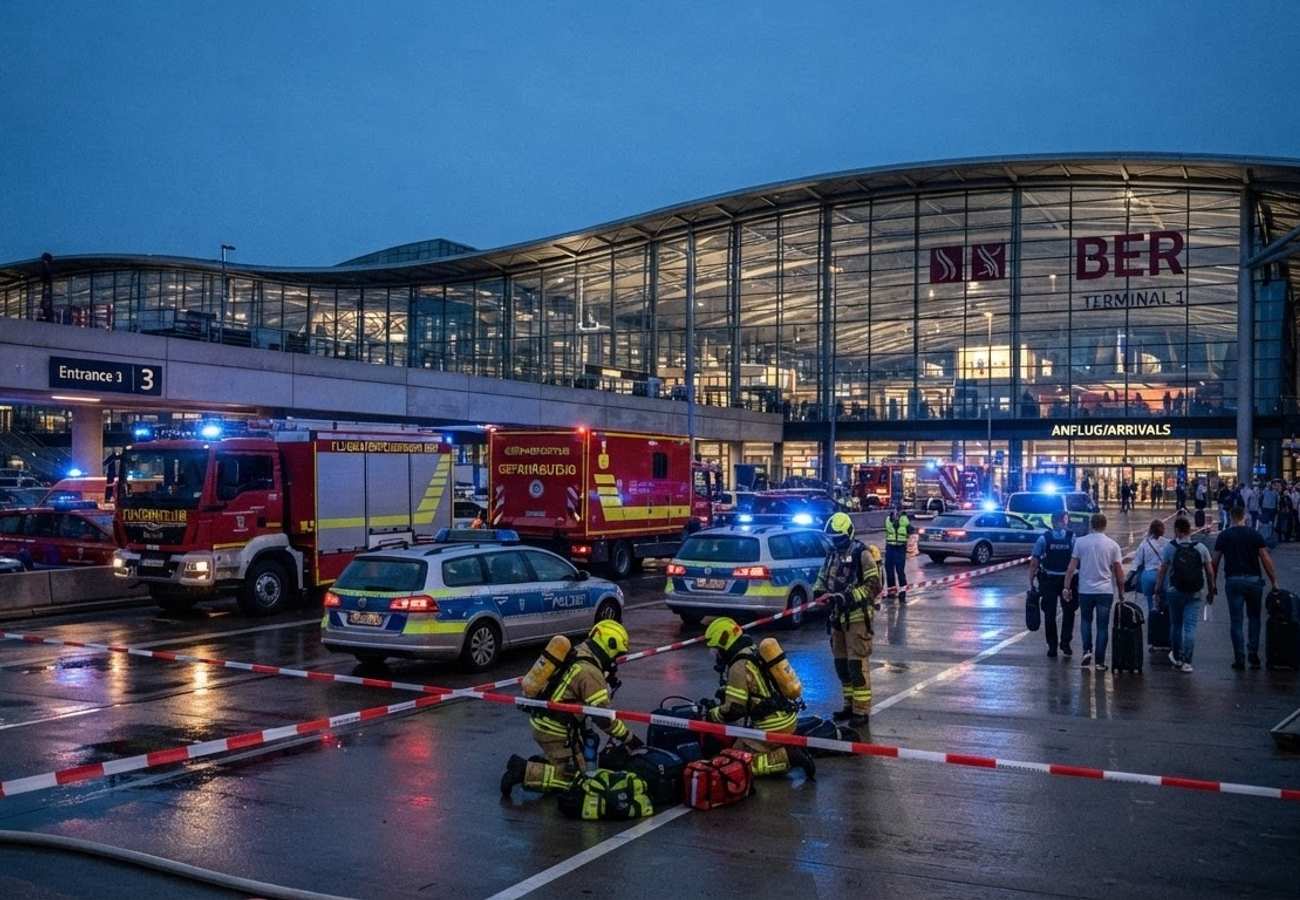
Image generated by AI
A hazardous materials alert on September 3, 2026, forced the full evacuation of Terminal 1 at Berlin Brandenburg Airport (BER). The incident triggered a security cordon, disrupted evening departures, and temporarily suspended regional rail links.
Hazardous Materials Incident at Terminal 1
The disruption began on the evening of September 3, 2026, when a 52-year-old woman approached the federal police service point in Terminal 1. The passenger reported that she was carrying a dangerous substance, specifically claiming that her clothing was contaminated with a hazardous material.
In accordance with safety protocols for crowded transport hubs, federal police and fire services declared a hazardous materials alert. This necessitated the immediate clearance of the public areas within Terminal 1. Emergency responders, including firefighters in full chemical protection suits, established a security cordon around the passenger's belongings to contain the suspected substance.
While the public areas were evacuated, the secure zones beyond the checkpoints remained operational. This allowed passengers who had already cleared security to proceed to their gates, although new passenger processing was halted for several hours.
Flight and Airport Operational Impact
Our analysis of airport operations indicates that while a total shutdown was avoided, the evacuation created a severe bottleneck for evening travel.
- Passenger Processing: Check-in and security screening in Terminal 1 were suspended for several hours.
- Airline Adaptations: To mitigate the crisis, several airlines shifted check-in and passenger handling operations to Terminal 2.
- Flight Status: Aircraft already on the apron or in the secure zone generally departed. However, flights that could not land at BER during the peak of the operation were canceled.
- Recovery Timeline: By the morning of September 4, regular schedules were largely restored, though residual delays occurred as airlines repositioned aircraft.
Ground Transportation and Rail Disruptions
The security perimeter extended to the airport's critical infrastructure, impacting ground access. Regional news reports confirm that rail services between the community of Schönefeld and Berlin Brandenburg Airport were temporarily suspended.
This suspension trapped passengers attempting to reach the terminal and those attempting to exit the airport into central Berlin. Consequently, road and bus connections experienced heavy congestion as travelers sought alternative routes. All rail services resumed normal timetables following the conclusion of the police deployment.
Post-Incident Findings
Following a specialist examination on September 4, the substance reported by the passenger was classified as non-hazardous. Investigators ruled out any acute danger to the public or airport staff.
The 52-year-old woman was taken into custody by federal police for further questioning to determine the circumstances behind the false alarm. The airport's cleaning and airline personnel were permitted to return to Terminal 1 on Thursday night, ensuring the facility was fully operational by Friday morning.
Passenger Rights & Advisory
For the affected passenger, this incident falls under a complex category of disruption. Because the evacuation was triggered by a passenger report and handled as a security/safety emergency, airlines may categorize this as "extraordinary circumstances."
Our analysis of passenger rights suggests the following:
- Duty of Care: Regardless of the cause (even extraordinary circumstances), airlines are required to provide "duty of care." This includes vouchers for food and drinks, and if an overnight stay is required, hotel accommodation and transport.
- Rebooking vs. Refund: Passengers whose flights were canceled have the right to choose between a full refund or re-routing to their final destination at the earliest opportunity.
- EU261/2004 Compensation: Since the disruption was caused by an external security alert (a "hazardous materials" scare), airlines will likely argue that they are not liable for monetary compensation under EU261. However, if the delay was exacerbated by airline inefficiency after the terminal reopened, a claim may still be viable.
Actionable Advice for Travelers:
- Document Everything: Save all boarding passes and keep receipts for any out-of-pocket expenses incurred for food or hotels during the evacuation.
- Request Written Proof: Ask the airline for a written statement confirming the reason for the flight cancellation or delay.
- Verify Status: Continue to monitor the BER digital channels and airline apps, as equipment repositioning can cause sporadic delays for 24-48 hours following such an event.
This incident highlights the vulnerability of high-traffic aviation hubs to "single-point" disruptions. The decision to evacuate a main terminal based on a self-report underscores the zero-tolerance policy regarding hazardous materials in European aviation. While the substance was ultimately non-hazardous, the scale of the response—including the suspension of rail links—demonstrates the integrated nature of modern airport security protocols where a terminal threat is treated as a regional transport threat.
The airport has returned to standard operations, but the incident serves as a reminder of the fragility of tight flight schedules during security emergencies.
Related Travel Guides
Disclaimer
This article is for informational and educational purposes only. It does not constitute legal, financial, or professional advice. While we strive to provide accurate and up-to-date information, travel policies, regulations, and conditions change rapidly. Always verify information with official sources before making travel decisions. Nomad Lawyer makes no representations about the accuracy, reliability, completeness, or suitability of the information provided. Readers should consult qualified professionals for advice specific to their circumstances. The views expressed in this article are those of the author and do not necessarily reflect the views of Nomad Lawyer.
Preeti Gunjan
Contributor & Community Manager
A passionate traveller and community builder. Preeti helps grow the Nomad Lawyer community, fostering engagement and bringing the reader experience to life.
Learn more about our team →