
AWS Fastnet Cable Transforms Cork Into AI Travel Hub: Ireland's €200M Aviation Bet on Transatlantic Digital Connectivity by 2028
AWS Fastnet subsea cable to Cork reshapes Ireland's travel economy. New digital infrastructure drives MICE growth, aviation expansion, and corporate travel demand across transatlantic routes.

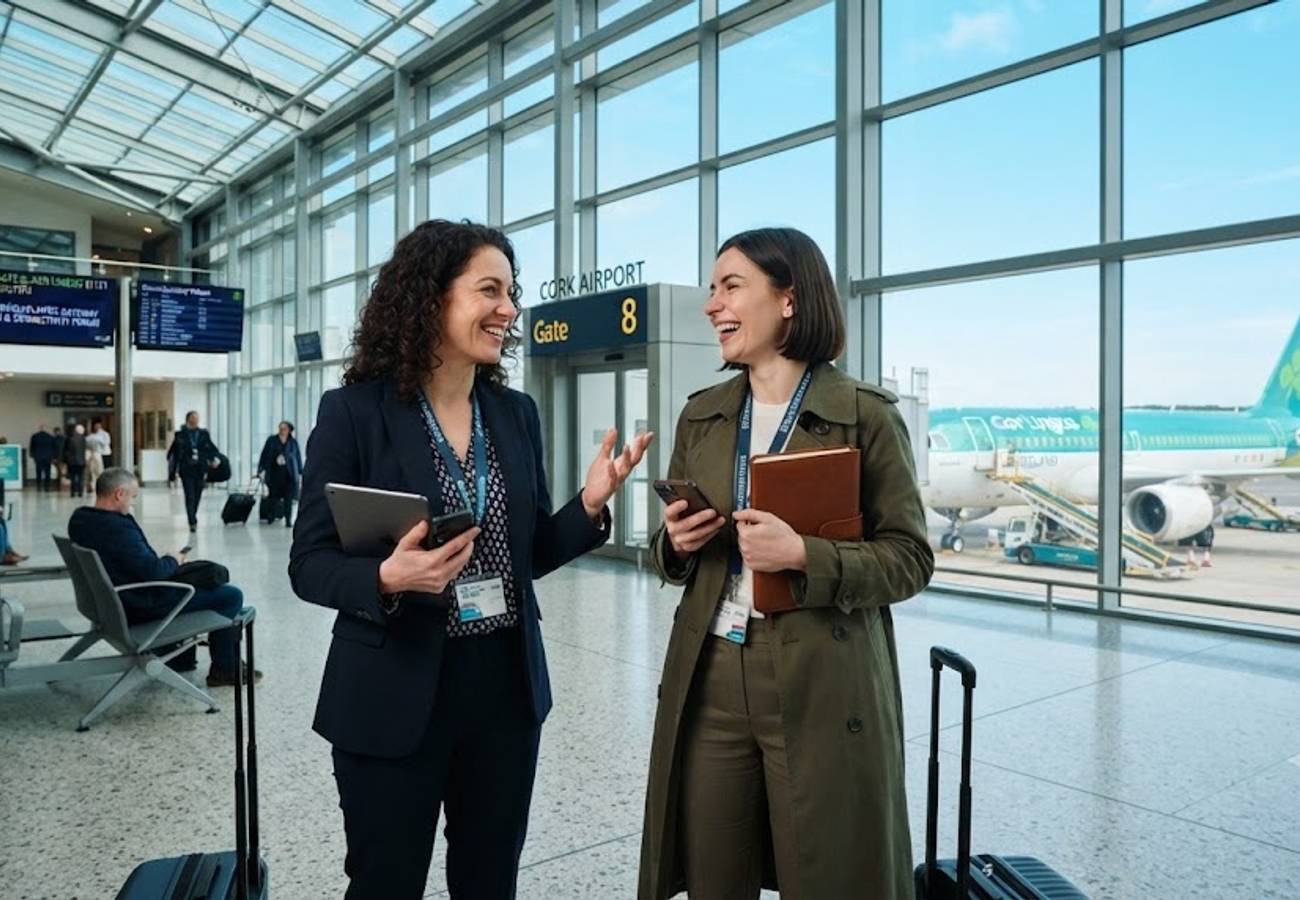
Image generated by AI
Ireland's travel economy is about to be rewired. Not by policy or marketing campaigns, but by 320 terabits per second of undersea fibre-optic cable arriving in County Cork by 2028. The AWS Fastnet infrastructure project isn't just about data speeds. It's fundamentally reshaping how Ireland competes for high-value corporate visitors, tech conferences, research delegations, and transatlantic business travel.
I spent weeks tracking how this single cable project cascades through aviation, hospitality, event venues, and destination strategy. What emerged was a story far more consequential than typical infrastructure announcements: Ireland is engineering itself into the AI-era travel economy, but the risks—subsea security threats, energy demands, and resilience pressure—are equally real.
Cork Graduates From Regional Airport To Transatlantic Digital Gateway
For decades, Cork Airport has lived in Dublin's shadow. That's about to change.
The AWS Fastnet cable will physically land in County Cork, creating the first direct, dedicated transatlantic AI and cloud data corridor between Maryland and Ireland's southwest coast. That geographic specificity matters enormously for destination positioning.
According to DAA's 2025 annual report, Cork Airport handled 3.5 million passengers in 2025, a 13 per cent increase on 2024. The airport isn't resting there. A €200 million capital development programme has been green-lit to modernise terminals, upgrade ground infrastructure, and support future annual capacity of five million passengers. That's a 43 per cent increase from current throughput.
Reddit: "Cork could actually become a real hub for tech conferences now. Dublin's overloaded, and if the infrastructure lands there physically, it makes sense to hold events nearby." — r/travel
Compare that to Dublin Airport, which handled 36.4 million passengers in 2025, up just 5 per cent year-on-year. Dublin remains Ireland's dominant gateway, but Cork's infrastructure investment signals a deliberate strategy to disperse corporate and technology-linked travel demand across the island.
The Cable Itself: 320 Terabits Per Second of Business Travel Demand
AWS Fastnet is designed to carry more than 320 terabits per second—enough capacity to support cloud computing, AI workloads, European research initiatives, and enterprise-grade transatlantic connectivity. That's not hyperbole. This single cable will become critical infrastructure for companies weighing European headquarters, AI research labs, cloud operations centres, and regulated digital services.
For the travel industry, cable capacity translates directly into visitor demand. Technology site inspections, investor delegations, product launches, research conferences, incentive travel programmes, and high-level corporate mobility all follow infrastructure investment. Ireland's updated Digital and AI Strategy explicitly connects this cable to MICE growth, international conferences, and business event positioning.
The cable is expected to be operational by 2028, which gives Irish hospitality, venues, ground handlers, and destination marketing organisations a three-year window to position Cork and regional Ireland as preferred hosts for tech-driven business travel.
Subsea Cable Security: A New Risk Factor for Event Planners
Here's where the story darkens.
The European Commission has documented that submarine communication cables carry 99 per cent of intercontinental internet traffic. It's also warned that hybrid campaigns—combining physical attacks, cyber sabotage, and disinformation—can disable critical undersea cable infrastructure, disrupting everything from airline operations to border systems to hotel payment networks.
The EU's cable-security framework focuses on prevention, detection, response, recovery, and deterrence. New EU funding has been allocated for backbone infrastructure resilience, smart subsea cable monitoring, and rapid repair capacity.
For travel operators, this matters because international conferences, real-time distribution systems, airline bookings, event streaming, and payment processing all depend on stable transatlantic connectivity. A cable compromise—whether accidental, intentional, or environmental—can cascade across the entire visitor economy.
Ireland's own Digital and AI Strategy explicitly links future digital infrastructure with security and resilience across networks and subsea cable routes. That's not defensive jargon. It's a public acknowledgment that infrastructure risk is now a business continuity variable for tourism stakeholders.
The Energy Burden: Can Ireland's Grid Support AI Growth?
Ireland's AI opportunity is powerful. Its energy challenge is equally visible.
Central Statistics Office data shows that metered electricity consumption by data centres surged 10 per cent from 2023 to 2024, rising from 6,335 gigawatt hours to 6,969 gigawatt hours. More dramatically, data centres accounted for 22 per cent of metered electricity consumption in 2024, up from just 5 per cent in 2015.
That's a 4.4x increase in data centre energy intensity in nine years.
Large energy users overall accounted for 31 per cent of total metered electricity consumption in 2024. For tourism marketers, this creates a reputational question: Can Ireland credibly position itself as a sustainable, climate-conscious destination while data centres consume nearly one-quarter of the national grid?
Event planners and corporate travel buyers increasingly scrutinize destination sustainability. Ireland can win high-value AI-linked business, but it must also demonstrate that infrastructure growth is compatible with renewable energy commitments and climate targets. Ireland's climate framework addresses this directly, but execution risk remains.
Foreign Investment Surge Converts Infrastructure Into Visitor Demand
The cable doesn't exist in isolation. IDA Ireland—the state investment agency—recorded 323 approved investments in 2025, a 38 per cent increase on 2024, with more than 15,300 expected jobs. It also tracked 80 research, development, and innovation investments, supporting a record €2.5 billion in client expenditure.
IDA's 2025-2029 strategy identifies digitalisation, AI, semiconductors, health, and sustainability as key growth drivers. It explicitly prioritises regional investment, innovation hubs, and strategic sites—a direct alignment with Cork's emerging position as a digital gateway.
When companies invest in Irish operations, they generate site visits, management delegations, investor conferences, and corporate travel flows. More investments mean more visitor demand. The cable provides infrastructure credibility for companies evaluating European headquarters or AI-centre-of-excellence locations.
Aviation Capacity Follows Infrastructure: North America Up 9 Per Cent
Tourism Ireland's March 2026 access outlook recorded 20.6 million scheduled summer aviation seats to the island of Ireland, up 4 per cent year-on-year. Capacity to Ireland was filed at +3.5 per cent overall, while North America capacity reached 2.3 million summer seats, up 9 per cent—nearly double the growth rate of the broader market.
US capacity specifically reached 2 million summer seats, plus 306,000 from Canada. Tourism Ireland documented a 2026 sales mission to Chicago, Raleigh, Washington DC, and Philadelphia with 14 island of Ireland tourism companies, 5 US tour operators, and 2 airlines. The agency also noted direct service from a record 23 US gateways, including the newly launched Raleigh-Durham to Dublin route.
That's not coincidental. The AWS Fastnet cable lands in Maryland—directly adjacent to the Washington DC economic corridor. Direct air connectivity between US East Coast tech hubs and Dublin/Cork makes sense when infrastructure is being deployed in real-time.
The Convergence: Infrastructure, Aviation, and MICE Strategy
Three forces are now converging:
First, subsea cable infrastructure creates technical and political reasons for technology companies to expand Irish operations.
Second, aviation capacity—especially North American routes—is being expanded ahead of cable deployment, signalling airline confidence in future demand.
Third, Cork's €200 million airport upgrade positions the region to absorb regional dispersal of corporate and technology-linked visitors, reducing pressure on Dublin.
Ireland isn't waiting for the cable to arrive. It's building the travel infrastructure now, betting that 2028 will see a wave of technology-linked business travel, site visits, research conferences, and corporate delegations flowing into Cork and regional Ireland.
The risks are real: subsea cable security exposure, grid energy constraints, execution delays on airport modernisation, and competition from other European digital hubs. But the opportunity—positioning Ireland not as a leisure or legacy financial centre, but as the transatlantic AI-era travel hub—is transforming how the industry thinks about infrastructure and visitor strategy.
The cable doesn't just carry data. It carries the future of corporate travel to Ireland.
Related Travel Guides
Disclaimer
This article is for informational and educational purposes only. It does not constitute legal, financial, or professional advice. While we strive to provide accurate and up-to-date information, travel policies, regulations, and conditions change rapidly. Always verify information with official sources before making travel decisions. Nomad Lawyer makes no representations about the accuracy, reliability, completeness, or suitability of the information provided. Readers should consult qualified professionals for advice specific to their circumstances. The views expressed in this article are those of the author and do not necessarily reflect the views of Nomad Lawyer.
Preeti Gunjan
Contributor & Community Manager
A passionate traveller and community builder. Preeti helps grow the Nomad Lawyer community, fostering engagement and bringing the reader experience to life.
Learn more about our team →