
Australia’s Digital Border Disruption Puts Travel Resilience and Manual Processing Under Scrutiny
Australia’s Digital Border Disruption Puts Travel Resilience and Manual Processing Under Scrutiny

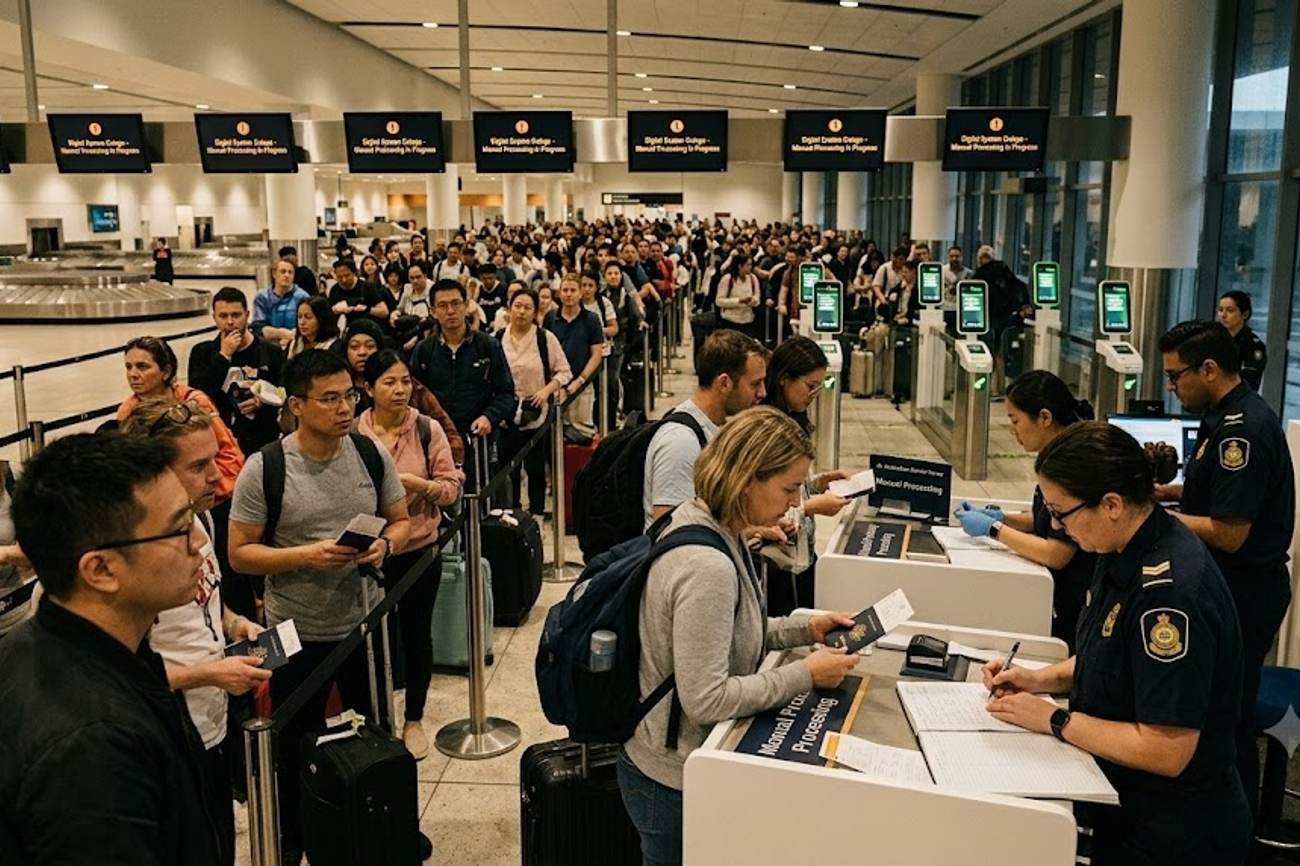
Image generated by AI
[Canberra, September 2026] — Australia's heavy reliance on automated border processing has created a systemic vulnerability, raising urgent questions about the government's ability to revert to manual passport control during widespread technology failures. As the nation aggressively expands its digital border infrastructure, the gap between automated capacity and human-led fallback options is becoming a primary concern for aviation resilience in Sydney and Melbourne.
The Australian Border Force (ABF) currently manages a system where the vast majority of international arrivals are filtered through SmartGates. While official guidance confirms that manual processing remains the designated safety net, the sheer volume of modern passenger traffic suggests that a total system outage could trigger unprecedented bottlenecks. This tension arrives as the federal government pushes forward with a A$56.1 million investment in digital declarations and contactless arrivals, further reducing the role of paper-based backups.
The Automation Dependency Trigger
The current crisis of resilience is driven by the scale of adoption. Automation is no longer a secondary convenience; it is the primary engine of Australian border movement. Data from the Department of Home Affairs 2024–25 Annual Report reveals that of the 45,390,834 air travellers processed during that period, 36,006,730 (79.33%) were eligible for SmartGate use.
The actual utilization rate is even more telling. A total of 27,654,177 eligible passengers successfully used the automated gates, representing 76.80% of the eligible cohort. This figure marks an increase from the 74.90% recorded in the 2023–24 period, proving that travellers are migrating toward digital channels at an accelerating pace.
The Bureau of Infrastructure and Transport Research Economics (BITRE) further underscores the pressure on these systems. For the year ending June 2026, international scheduled passenger traffic reached 45.647 million movements, a 6.1% increase over the previous year's 43.011 million. This trajectory indicates that any failure in the SmartGate system now impacts a significantly larger volume of people than it did five years ago.
Affected Travelers, Airlines and Logistics by System Fragility
The impact of a digital border failure is not distributed evenly, but the scale of the risk covers nearly all international gateways.
| Passenger Group | Impact Level | Primary Risk |
|---|---|---|
| SmartGate Eligible Travellers | High | Forced redirection to manual queues, leading to multi-hour delays. |
| High-Volume Hubs (SYD, MEL) | Critical | Severe terminal congestion and potential aircraft tarmac delays. |
| Non-Eligible Travellers | Medium | Increased wait times at manual desks due to the influx of redirected automated users. |
| Airline Ground Staff | High | Operational chaos during peak arrival banks if passengers cannot clear the border. |
The Department of Home Affairs 2025–26 Corporate Plan explicitly links SmartGate uptake to formal performance measures, while admitting that physical infrastructure constraints at airports limit the ability to simply "add more desks" during a crisis.
Practical Traveler Advisory and Strategic Insights
For the average passenger, the transition to a "digital-first" border means that the experience is seamless when the technology works, but potentially catastrophic when it does not.
The Manual Fallback Reality If a SmartGate fails to recognize a face or read a chip, the ABF directs the passenger to manual passport control or SmartGate assistance. While this works for individual errors, a system-wide outage transforms these small assistance points into massive bottlenecks.
The Death of Paper Travellers should be aware that the traditional safety net—the paper Incoming Passenger Card—is being phased out. The introduction of the Australia Travel Declaration (ATD) across all international airports and seaports by the end of 2027 means that the "analog" backup for passenger data is disappearing. If the digital declaration system fails simultaneously with the SmartGates, there is no longer a universal paper form to capture essential customs and immigration data.
The Australian government's digital border disruption has raised concerns about travel resilience and manual processing, with the Australian Government Department of Home Affairs working to resolve the issue and minimize delays for international travelers. The disruption has affected multiple airports, including Sydney and Melbourne, and has resulted in lengthy wait times for passengers. As a result, travelers are advised to check with their airlines for updates on flight schedules and border processing times.
Increased Transit Friction Passengers booking tight connections in Sydney or Melbourne are at higher risk. A technology glitch that adds two hours to border processing can lead to missed domestic transfers, as the manual processing capacity cannot currently match the throughput of the automated gates.
The Path to Total Digitization
The Australian government is not retreating from automation in the face of these resilience concerns; it is doubling down. A commitment of A$56.1 million over four years starting in 2026–27 is earmarked for "traveller modernisation."
This funding is directed toward:
- Full national deployment of the Australia Travel Declaration (ATD).
- Implementation of contactless arrival clearance.
- Redesigning airport operating models to handle baggage more efficiently for domestic transfers.
Historical records obtained via Freedom of Information (FOI) show that the government has previously used the Incoming Passenger Card as a business-continuity tool during outages. However, as the ATD becomes the standard, the government is moving toward an "offline mode" for its digital platforms. The critical unknown remains the actual hourly capacity of manual desks to handle 45 million annual passengers if the digital layer vanishes.
FAQ: Australia Border Automation 2026
What happens if the SmartGates are down when I land? You will be redirected to Manual Passport Control. Be prepared for significantly longer wait times, as manual desks cannot process passengers as quickly as the automated gates.
Do I still need to fill out a paper arrival card? The paper Incoming Passenger Card is being phased out in favor of the digital Australia Travel Declaration (ATD), which will be mandatory at all airports and seaports by the end of 2027.
Will a border technology failure affect my connecting flight? Yes. If manual processing causes delays at the border, you may miss your connecting flight. It is recommended to allow extra buffer time when travelling through high-volume hubs like Sydney or Melbourne.
How much is the government spending on these digital upgrades? The federal government has allocated A$56.1 million over a four-year period starting in 2026–27 to modernize border processing and implement contactless arrivals.
The digital border is a race for efficiency that may be outrunning the capacity for human backup.
Related Travel Guides
- Wuhan Municipal Culture and Tourism Bureau Introduces Heartbeat Weekend Passes and Digital Passports
- US Tourism Websites Face New Accessibility Era as ADA Digital Rules Raise Stakes for Public Travel Platforms
- United States Aligns With China As AI Safety Talks Raise New Travel And Global Security Questions
Disclaimer
This article is for informational and educational purposes only. It does not constitute legal, financial, or professional advice. While we strive to provide accurate and up-to-date information, travel policies, regulations, and conditions change rapidly. Always verify information with official sources before making travel decisions. Nomad Lawyer makes no representations about the accuracy, reliability, completeness, or suitability of the information provided. Readers should consult qualified professionals for advice specific to their circumstances. The views expressed in this article are those of the author and do not necessarily reflect the views of Nomad Lawyer.
Raushan Kumar
Founder & Lead Developer
Full-stack developer with 11+ years of experience and a passionate traveller. Raushan built Nomad Lawyer from the ground up with a vision to create the best travel and law experience on the web.
Learn more about our team →