
Australia Travel Demand Rises as Qantas and Jetstar Add Thousands of Seats for AFL Grand Final Rush
Australia Travel Demand Rises as Qantas and Jetstar Add Thousands of Seats for AFL Grand Final Rush

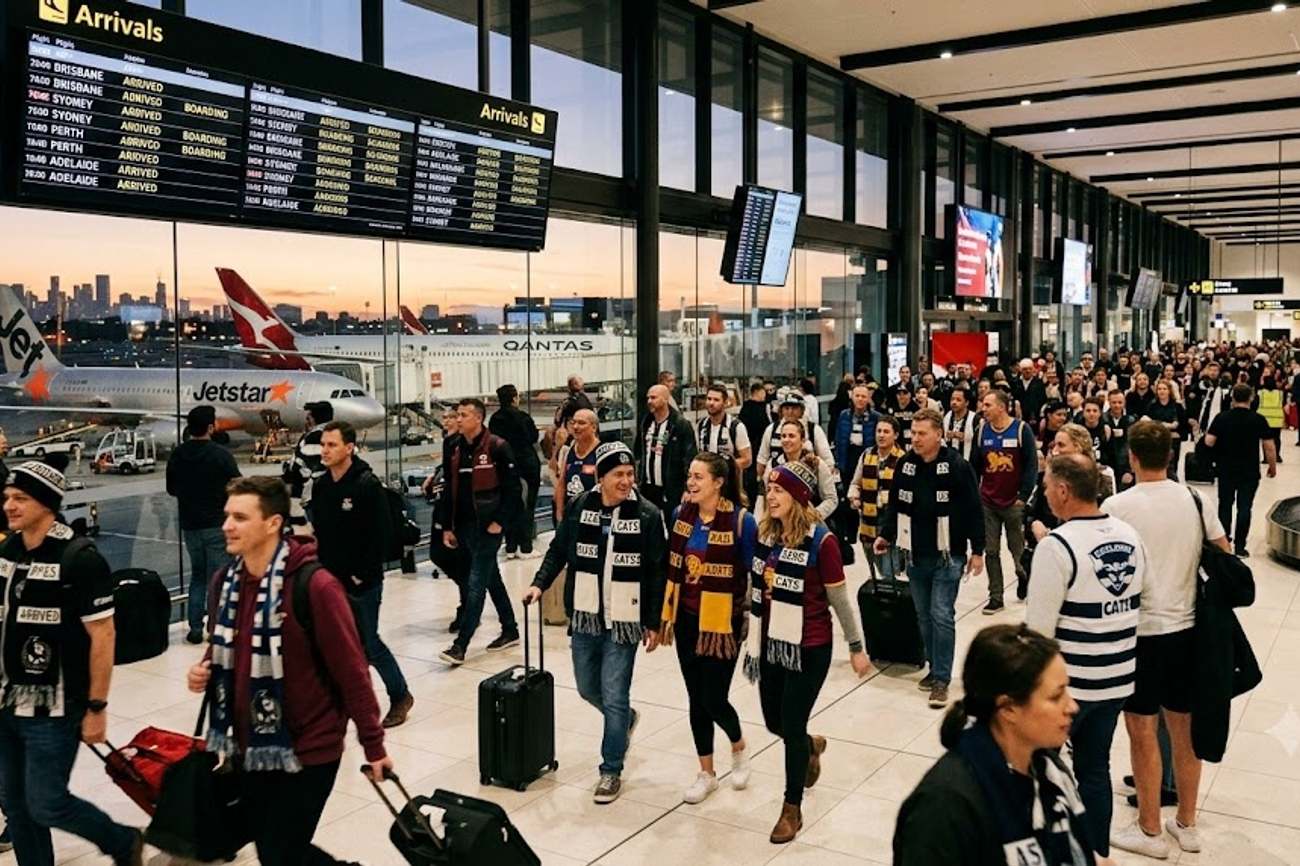
Image generated by AI
8,000 additional seats allocated specifically for Western Australian travelers signals a massive escalation in how Australian carriers manage "event-driven" demand spikes. This surge in capacity, deployed by Qantas and Jetstar, represents nearly double the supplementary seating provided during the 2024 finals period, highlighting a strategic shift toward aggressive capacity scaling for the 2026 AFL Grand Final.
The Logistics of Speculative Capacity
The aviation strategy employed for the late September window is not a static schedule but a reactive operational model. Because the specific origin of the demand depends on the outcomes of the preliminary finals, the airlines have implemented a "standby" framework. This involves securing aircraft and flight crews in a state of readiness, allowing for the rapid deployment of flights from Sydney, Perth, or Brisbane once the competing teams are finalized following the Friday and Saturday night matches.
This operational agility is necessary because the AFL Grand Final does not exist in a vacuum. The period between 23 and 28 September 2026 coincides with the commencement of school holidays across several Australian states, alongside a cluster of nationwide concerts and sporting fixtures. By decoupling their capacity additions from a fixed calendar and tying them to match results, the carriers are attempting to mitigate the risk of "ghost flights"—empty seats on routes where the local team failed to qualify—while maximizing yield on the routes where demand will be absolute.
Pricing Volatility and Seat Availability
The financial impact of this demand surge is evident in the fare snapshots recorded as of 3pm AEST on 17 September 2026. The pricing reflects a steep premium for last-minute interstate travel to Melbourne, particularly from the West Coast.
| Departure Date | Route | Airline | Lowest One-Way Fare |
|---|---|---|---|
| 24 September 2026 | Perth $\rightarrow$ Melbourne | Qantas | $1,211 |
| 24 September 2026 | Brisbane $\rightarrow$ Melbourne | Jetstar | $469 |
| 24 September 2026 | Sydney $\rightarrow$ Melbourne | Jetstar | $329 |
| 25 September 2026 | Perth $\rightarrow$ Melbourne | Jetstar | $829 |
| 25 September 2026 | Brisbane $\rightarrow$ Melbourne | Jetstar | $409 |
| 25 September 2026 | Sydney $\rightarrow$ Melbourne | Jetstar | $239 |
These figures illustrate a stark disparity in pricing based on distance and carrier tier. The $1,211 fare for Qantas passengers from Perth demonstrates the extreme pricing power airlines wield when capacity is constrained and the "will-to-travel" is driven by a high-stakes sporting event rather than leisure or business necessity.
Expert Analysis: The Economics of Event-Based Aviation
For travelers booking these routes, the direct consequence is a transition from standard market pricing to "event pricing," where the value of the seat is tied to the urgency of the event rather than the operational cost of the flight. When Qantas Domestic CEO Markus Svensson reports record-level bookings, it indicates that the market has reached a saturation point where only the introduction of supplementary aircraft can prevent fares from climbing even higher.
The decision to double the Western Australian capacity compared to 2024 suggests a data-driven realization: the "tyranny of distance" for Perth-based fans creates a captive market. Because there are few viable alternatives to flying for a weekend trip to Melbourne, the airlines can maintain high yields even while increasing seat counts.
Furthermore, the reliance on standby crews and aircraft reveals the fragility of the current domestic network. The fact that airlines must specifically announce "operational measures" to handle a predictable annual event suggests that the baseline capacity of the Australian domestic market is operating at a razor-thin margin. Any unforeseen disruption—such as weather events or technical failures—during the 23 to 28 September window could lead to a systemic collapse of the schedule, as there is little "slack" left in the system once these extra flights are deployed.
From a regulatory perspective, this concentration of capacity on a few key routes during a peak window puts immense pressure on Melbourne's airport infrastructure. The coordination required between the International Air Transport Association (IATA) standards for slot management and local airport operations becomes critical when thousands of passengers are condensed into a 72-hour window.
Key Takeaways
- Capacity Surge: Over 8,000 extra seats have been added for WA travelers, nearly twice the volume of the 2024 finals period.
- Reactive Scheduling: Additional flights from Sydney, Perth, and Brisbane will be released only after the preliminary finals results are confirmed.
- Pricing Peaks: One-way fares from Perth to Melbourne have peaked as high as $1,211 for Qantas flights on 24 September.
- Operational Window: The high-intensity travel period is concentrated between 23 and 28 September 2026.
- Compounding Factors: Demand is amplified by the overlap of the AFL Grand Final with national school holidays and other major entertainment events.
FAQ: AFL Grand Final Travel 2026
When will the extra flights for the Grand Final be released? Additional flights from Sydney, Perth, and Brisbane will be released immediately following the preliminary finals on Friday and Saturday nights, depending on which teams qualify for the final match.
Why are flights to Melbourne so expensive in late September? Prices are driven up by a "perfect storm" of demand: the AFL Grand Final, the start of school holidays, and various other national sporting and music events occurring simultaneously.
Which routes are seeing the highest price increases? The Perth to Melbourne route is experiencing the most significant pricing pressure, with some Qantas one-way fares exceeding $1,200.
Are there flights available for the return journey? Yes, Qantas and Jetstar have increased capacity for both arrivals into Melbourne and return journeys departing after the event between 23 and 28 September.
When the game dictates the flight path, the traveler pays the premium.
Related Travel Guides
- Hong Kong Airlines Supports Five-Year Plan as Carrier Targets Stronger Routes, Smart Travel and Aviation Growth
- IndiGo Raises Passenger Charges in India as Travellers Pay More for Infant Travel, Baggage and Priority Services
- Tasmania Travel Surges as Air New Zealand Adds 170 Flights Linking Hobart and Auckland
Disclaimer
This article is for informational and educational purposes only. It does not constitute legal, financial, or professional advice. While we strive to provide accurate and up-to-date information, travel policies, regulations, and conditions change rapidly. Always verify information with official sources before making travel decisions. Nomad Lawyer makes no representations about the accuracy, reliability, completeness, or suitability of the information provided. Readers should consult qualified professionals for advice specific to their circumstances. The views expressed in this article are those of the author and do not necessarily reflect the views of Nomad Lawyer.
Kunal K Choudhary
Co-Founder & Contributor
A passionate traveller and tech enthusiast. Kunal contributes to the vision and growth of Nomad Lawyer, bringing fresh perspectives and driving the community forward.
Learn more about our team →