
Oceania Aviation Gridlock: Qantas and Air New Zealand Suffer Massive Operational Collapse as 39 Flight Cancellations Paralyze Sydney, Brisbane, and Wellington Triggering Travel Chaos
As massive operational bottlenecks paralyze primary aviation gateways across Australia and New Zealand, major airports log a devastating 39 absolute flight cancellations, plunging passengers into terrifying travel chaos.

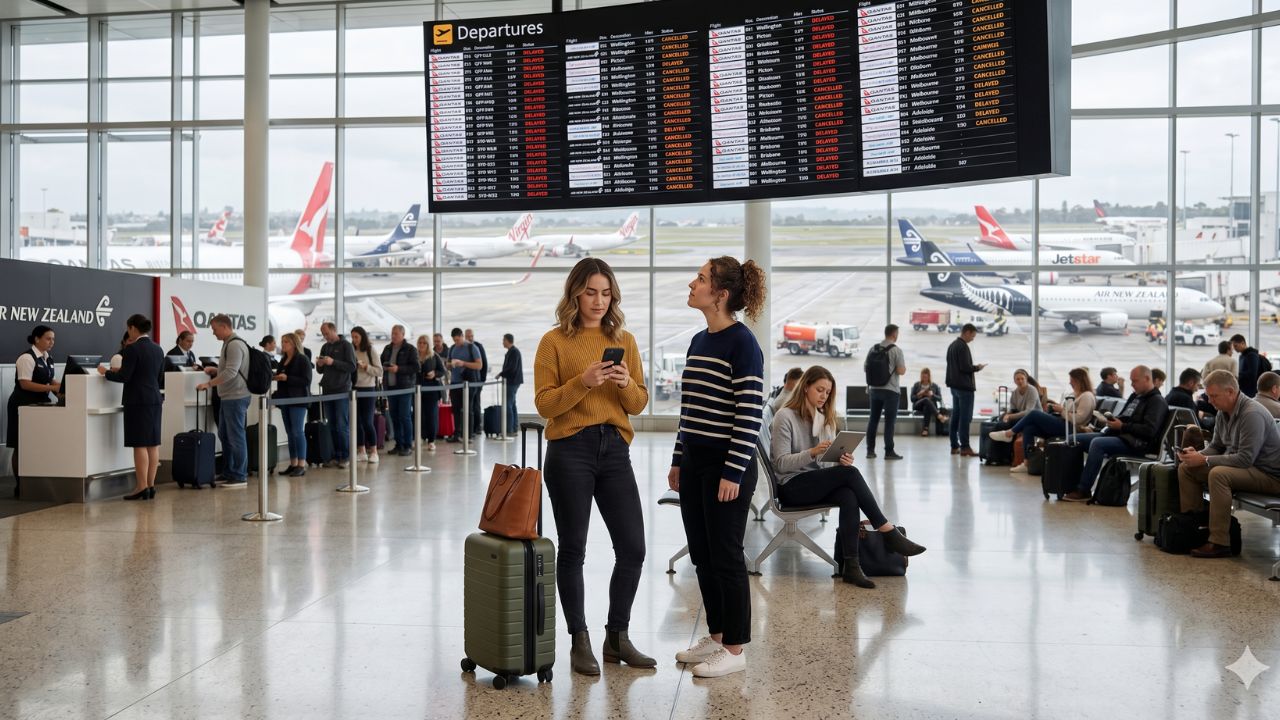
Image generated by AI
A Massive Operational Collapse Triggers Oceania Terminal Panic
While massive sectors of the global passenger network frequently battle highly unpredictable extreme weather events, synchronized logistical bottlenecks, and horrific commercial fleet constraints, the sudden, unmanageable collapse of Oceania's primary transit infrastructure remains the absolute most terrifying catalyst for cascading airport disruptions. Delivering highly urgent, breaking airline news, verified regional aviation trackers confirm that a massive operational disaster has actively detonated, completely exposing vulnerable domestic commuters and international tourists to severe travel chaos across the highly connected Australian and New Zealand aviation network. This week, highly alarming operational news forcefully emerged confirming that an unprecedented wave of sudden flight cancellations completely paralyzed major airports in Sydney, Brisbane, Canberra, and Wellington, violently isolating hundreds of passengers.
While desperate travelers usually attempt to navigate terrifying terminal gridlock caused by isolated regional failures, these exclusive aviation updates reveal a highly systemic, incredibly dangerous logistical meltdown actively destroying flight schedules across the region's most vital aviation hubs. Official tracking data based on FlightAware confirms that the massive network violently recorded a staggering total of 39 absolute flight cancellations today. The sheer scale of this disruption immediately plunged departure boards across Australia and New Zealand into an absolute state of emergency. With massive international and regional carriers like Qantas, Virgin Australia, Air New Zealand, and Sounds Air frantically struggling to maintain basic operational integrity, highly vulnerable transit passengers are currently trapped inside overflowing terminals, facing totally ruined itineraries and brutal missed connections across vital domestic and international routes.
Expanded Overview: The Scale of the Transnational Flight Disruption
The sudden, highly publicized execution of this massive regional operational slowdown serves as an undeniable example of how rapidly complex continental logistics can collapse into extreme transit pressure. A total of 39 flight cancellations were recorded across four critical airports. When a sudden disruption of this magnitude strikes a nationwide network explicitly designed to funnel passengers across vast distances, it completely shatters the entire passenger pipeline. For a massive corporate and leisure corridor heavily reliant on robust, high-frequency flight schedules, this massive wave of flight cancellations heavily exposes the entire network to terrifying bottlenecks, severe travel safety concerns, and massive economic damage to regional tourism.
The terrifying reality of the current transit crisis is found in the sheer vulnerability of passengers utilizing these massive hubs as primary entry points. A cancelled departure from Sydney instantly triggers violently missed onward connections across the Tasman or to Asia, creating devastating ripple effects that extend far beyond Australia’s borders. The cancellations affected a broad mix of aircraft, ranging from small regional turboprops (C208, DH8D) and commuter aircraft to narrowbody Boeing 737s, Airbus A320s, and massive widebody Boeing 787 Dreamliners.
Detailed Aviation Disruption and Flight Data
To fully comprehend the massive operational scale and strategic deployment dictating this highly destructive capacity crisis, the following mandatory tables explicitly detail the exact flight metrics heavily impacting Oceania airports today. The disruptions heavily compromised on-time performance across Qantas (QFA), Virgin Australia (VOZ), QantasLink (QLK), National Jet Express (UTY), Air New Zealand (ANZ), Sounds Air (SDA), and AJX.
Cancelled Departures – Sydney Airport (YSSY)
Sydney suffered the largest disruption with 16 total cancellations. Below are the 7 cancelled departures.
| Flight | Aircraft Type | Destination | Scheduled Departure |
|---|---|---|---|
| VOZ868 | B738 | Melbourne Tullamarine (MEL/YMML) | Thu 05:15 PM AEST |
| QLK1439 | DH8D | Canberra International (CBR/YSCB) | Thu 02:00 PM AEST |
| QFA437 | B738 | Melbourne Tullamarine (MEL/YMML) | Thu 11:05 AM AEST |
| QFA518 | B738 | Brisbane (BNE/YBBN) | Thu 10:20 AM AEST |
| VOZ551 | B738 | Perth International (PER/YPPH) | Thu 07:15 AM AEST |
| QLK1507 | BCS3 | Hobart International (HBA/YMHB) | Wed 07:50 PM AEST |
| AJX890 | B789 | Tokyo Haneda (HND/RJTT) | Wed 11:45 AM AEST |
Departures by Destination: Melbourne (2), Canberra (1), Brisbane (1), Perth (1), Hobart (1), Tokyo Haneda (1). Total: 7.
Cancelled Arrivals – Sydney Airport (YSSY)
The following 9 arrivals into Sydney were violently aborted.
| Flight | Aircraft Type | Origin | Scheduled Arrival |
|---|---|---|---|
| VOZ558 | B738 | Perth International (PER/YPPH) | Thu 03:35 PM AWST |
| QLK1444 | DH8D | Canberra International (CBR/YSCB) | Thu 04:20 PM AEST |
| VOZ849 | B738 | Melbourne Tullamarine (MEL/YMML) | Thu 03:25 PM AEST |
| QFA448 | B738 | Melbourne Tullamarine (MEL/YMML) | Thu 02:55 PM AEST |
| QFA529 | B738 | Brisbane (BNE/YBBN) | Thu 02:15 PM AEST |
| QLK1508 | BCS3 | Hobart International (HBA/YMHB) | Thu 08:05 AM AEST |
| QLK1508 | BCS3 | Hobart International (HBA/YMHB) | Thu 01:25 PM AEST |
| AJX889 | B789 | Tokyo Haneda (HND/RJTT) | Wed 06:10 PM JST |
| QLK2018 | DH8D | Broken Hill (BHQ/YBHI) | Wed 02:20 PM ACST |
Arrivals by Origin: Melbourne (2), Hobart (2), Perth (1), Canberra (1), Brisbane (1), Tokyo Haneda (1), Broken Hill (1). Total: 9.
Cancelled Departures – Brisbane Airport (YBBN)
Brisbane recorded 12 total cancellations. Below are the 6 cancelled departures.
| Flight | Aircraft Type | Destination | Scheduled Departure |
|---|---|---|---|
| QFA529 | B738 | Sydney (SYD/YSSY) | Thu 12:40 PM AEST |
| QFA1949 | E190 | Canberra International (CBR/YSCB) | Thu 11:20 AM AEST |
| QFA1918 | E190 | Gladstone (GLT/YGLA) | Thu 08:35 AM AEST |
| UTY1822 | E190 | Mackay (MKY/YBMK) | Thu 08:10 AM AEST |
| UTY1801 | E190 | Adelaide International (ADL/YPAD) | Thu 06:25 AM AEST |
| UTY1844 | E190 | Rockhampton (ROK/YBRK) | Tue 10:35 AM AEST |
Departures by Destination: Sydney (1), Canberra (1), Gladstone (1), Mackay (1), Adelaide (1), Rockhampton (1). Total: 6.
Cancelled Arrivals – Brisbane Airport (YBBN)
The following 6 arrivals into Brisbane were violently aborted.
| Flight | Aircraft Type | Origin | Scheduled Arrival |
|---|---|---|---|
| QFA1950 | E190 | Canberra International (CBR/YSCB) | Thu 03:35 PM AEST |
| UTY1810 | E190 | Adelaide International (ADL/YPAD) | Thu 01:00 PM ACST |
| UTY1823 | E190 | Mackay (MKY/YBMK) | Thu 12:05 PM AEST |
| QFA518 | B738 | Sydney (SYD/YSSY) | Thu 11:55 AM AEST |
| QFA1917 | E190 | Gladstone (GLT/YGLA) | Thu 11:35 AM AEST |
| UTY1845 | E190 | Rockhampton (ROK/YBRK) | Tue 01:45 PM AEST |
Cancelled Departures – Canberra International Airport (YSCB)
Canberra experienced severe operational strain with 3 cancelled departures.
| Flight | Aircraft Type | Destination | Scheduled Departure |
|---|---|---|---|
| QLK1444 | DH8D | Sydney (SYD/YSSY) | Thu 03:25 PM AEST |
| QFA1950 | E190 | Brisbane (BNE/YBBN) | Thu 01:50 PM AEST |
| QLK2551 | DH8D | Adelaide International (ADL/YPAD) | Thu 07:40 AM AEST |
Departures by Destination: Sydney (1), Brisbane (1), Adelaide (1). Total: 3. (Aircraft Type Breakdown: DH8D - 2, E190 - 1).
Cancelled Departures – Wellington International Airport (NZWN)
Across the Tasman, Wellington suffered 8 cancelled departures, heavily impacting regional connectivity.
| Flight | Aircraft Type | Destination | Scheduled Departure |
|---|---|---|---|
| SDA123 | C208 | Picton Aerodrome (PCN/NZPN) | Thu 02:15 PM NZST |
| SDA243 | C208 | Woodbourne (BHE/NZWB) | Thu 12:05 PM NZST |
| SDA121 | C208 | Picton Aerodrome (PCN/NZPN) | Thu 10:20 AM NZST |
| SDA123 | C208 | Picton Aerodrome (PCN/NZPN) | Wed 02:15 PM NZST |
| SDA243 | C208 | Woodbourne (BHE/NZWB) | Wed 12:05 PM NZST |
| ANZ5375 | DH8C | Christchurch International (CHC/NZCH) | Tue 05:45 PM NZST |
| SDA253 | C208 | Woodbourne (BHE/NZWB) | Tue 04:30 PM NZST |
| ANZ327 | A320 | Christchurch International (CHC/NZCH) | Tue 07:00 AM NZST |
Departures by Destination: Picton Aerodrome (3), Woodbourne (3), Christchurch International (2). Total: 8. (Aircraft Type Breakdown: C208 - 6, DH8C - 1, A320 - 1).
Passenger Impact: Navigating the Terminal Gridlock
For the modern commuter attempting to navigate this highly volatile Oceania network, the passenger impact of this massive operational meltdown is completely terrifying. Reliable, on-time flights are the absolute backbone of regional transit, and this hub collapse completely destroyed that promise. Passengers facing these massive disruptions must employ immediate survival tactics.
Immediate Survival Strategies:
- Survive the Rebooking Gridlock: When a flight is violently cancelled at Sydney or Brisbane, stranded travelers are aggressively urged to demand immediate rebooking via official airline mobile apps. Avoid the massive physical queues forming inside the isolated terminals.
- The Threat of Ruined Connections: Because Sydney is heavily utilized as a launchpad for Asian international flights (such as the cancelled Tokyo Haneda flight), a 39-flight cancellation block guarantees that passengers will violently miss their connecting flights. Always aggressively demand that your operating carrier rebook the entire onward journey.
- Regional Isolation: Passengers bound for smaller airports like Picton or Woodbourne aboard Sounds Air Cessna 208s face severe isolation when flights are cancelled, as alternative ground transport across the Cook Strait is often impossible on short notice.
Conclusion: A Highly Destructive Aviation Meltdown
The massive, highly publicized collapse of flight schedules across Australia and New Zealand represents a severe, incredibly dangerous wake-up call for the Oceania aviation sector. By actively demonstrating that operational friction can instantly overwhelm primary gateways with an astonishing 39 absolute flight cancellations, this incident completely shatters passenger confidence in regional hub reliability. As executive leadership across Qantas, Virgin Australia, and Air New Zealand frantically scramble to diagnose the logistical failures and appease thousands of isolated passengers, tourists are heavily urged to aggressively monitor their flight status via airline apps, actively prepare for sudden flight delays, and fully expect this unprecedented disaster to trigger massive regional travel chaos.
Key Takeaways
- Massive Oceania Hub Meltdown: Airports in Sydney, Brisbane, Canberra, and Wellington violently recorded a combined total of 39 absolute flight cancellations this week.
- Sydney Takes the Hardest Hit: Sydney Airport suffered the absolute worst disruptions, logging 16 total cancellations across domestic and international (Tokyo) routes.
- Major Carriers Paralyzed: Operations for Qantas, Virgin Australia, Air New Zealand, and Sounds Air were completely overrun by massive schedule friction.
- Global Routes Severed: Vital passenger corridors connecting Australia to Japan (Tokyo Haneda) and massive inter-state domestic arteries were violently severed.
- Passenger Survival Tactics: Travelers caught in the disruption are aggressively urged to use digital airline apps, bypass massive terminal queues, and secure immediate rebooking for compromised international and regional itineraries.
Disclaimer: The specific flight cancellation metrics, aircraft fleet deployment, and carrier impact assessments presented in this report are based on verified aviation tracking data (FlightAware) regarding operations across Australia and New Zealand in June 2026. Official airline technical reports, terminal congestion levels, and regional air traffic control clearances are highly volatile and subject to continuous, real-time update based on active operational shifts. Prospective passengers are urgently advised to fiercely monitor their specific booking status and verify active flight schedules directly via the airline's official portal prior to airport arrival.
Disclaimer
This article is for informational and educational purposes only. It does not constitute legal, financial, or professional advice. While we strive to provide accurate and up-to-date information, travel policies, regulations, and conditions change rapidly. Always verify information with official sources before making travel decisions. Nomad Lawyer makes no representations about the accuracy, reliability, completeness, or suitability of the information provided. Readers should consult qualified professionals for advice specific to their circumstances. The views expressed in this article are those of the author and do not necessarily reflect the views of Nomad Lawyer.
Kunal K Choudhary
Co-Founder & Contributor
A passionate traveller and tech enthusiast. Kunal contributes to the vision and growth of Nomad Lawyer, bringing fresh perspectives and driving the community forward.
Learn more about our team →