
Auckland City Rail Link Faces Immediate Operational Crisis After NZ$5.5 Billion Opening
A small fire at Waitematā Station has disrupted the debut of New Zealand's first underground rail system, testing the resilience of a NZ$5.5 billion infrastructure project designed to quadruple passenger capacity.

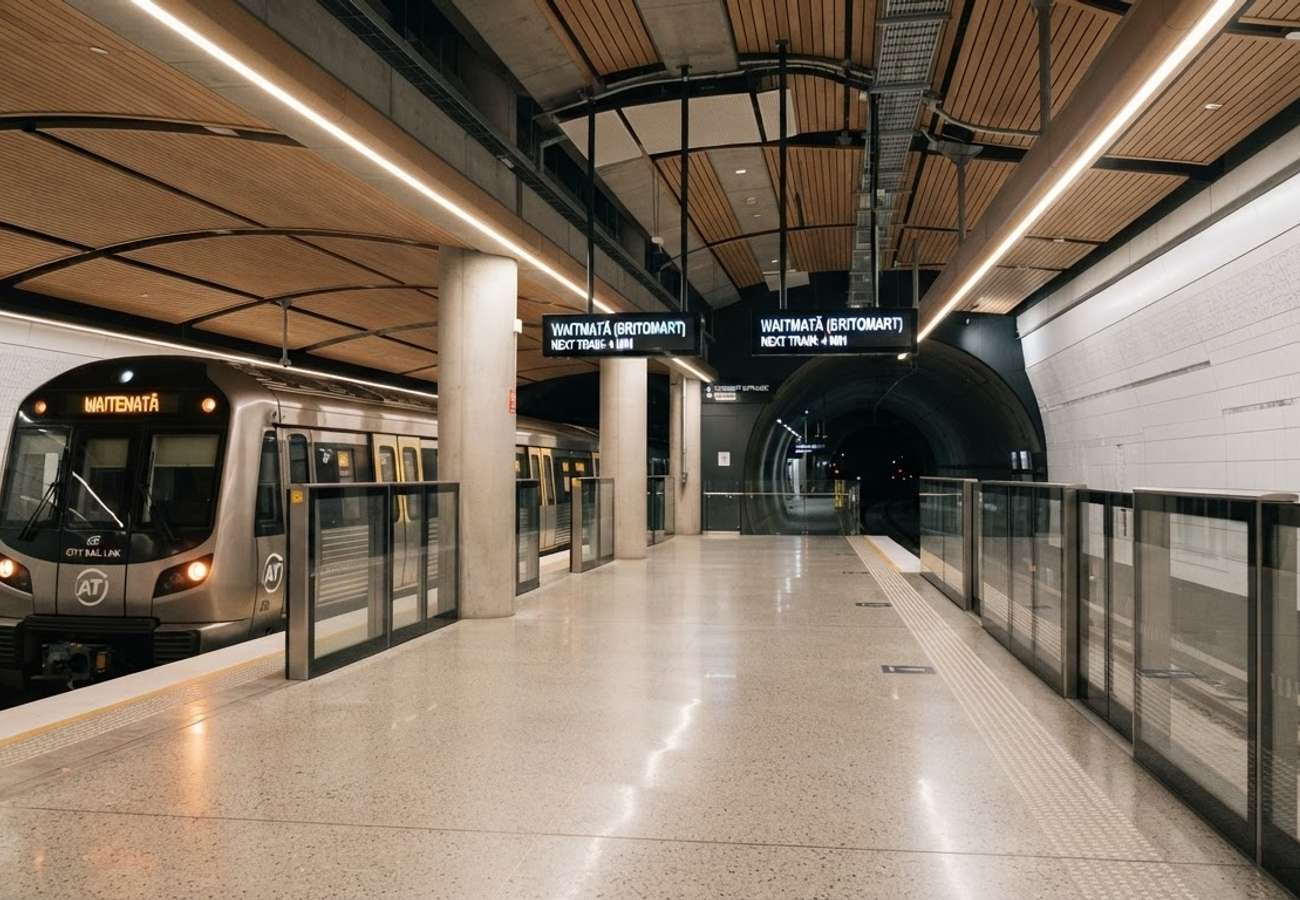
Image generated by AI
NZ$5.5 billion in transport infrastructure was put to an immediate stress test when a fire at Waitematā Station triggered system-wide cancellations and delays just hours after the official debut of New Zealand’s first underground rail network. The incident occurred on a Sunday morning, coinciding with the first passenger operations of the City Rail Link (CRL), transforming a landmark celebration of urban modernization into an operational recovery exercise.
The Anatomy of the Waitematā Station Disruption
The City Rail Link was designed to be the crown jewel of Auckland's transit evolution, yet its operational baptism was marred by a technical failure. A small fire, detected in the upper reaches of the Waitematā Station, forced emergency response teams to intervene immediately. Because the station serves as a critical node in the new underground sequence, the fire necessitated a rapid shift in traffic patterns to maintain passenger safety.
Railway authorities implemented a strategy of temporary avoidance, routing trains around Waitematā Station while safety inspections were conducted. This created a ripple effect across the wider network, resulting in modified stopping patterns and significant delays for the first wave of commuters and tourists attempting to navigate the new system.
The scale of the project makes such disruptions particularly visible. The CRL represents nearly a decade of engineering and planning, involving the construction of two underground tunnels that stretch approximately 3.45 kilometres beneath the central business district. By transitioning from a terminal-based system to a through-city model, Auckland aimed to eliminate the bottlenecks that have historically plagued its rail connectivity.
Infrastructure Specifications and Capacity Goals
The financial and physical scale of the City Rail Link is unprecedented for New Zealand. The project was not merely about adding new tracks, but about fundamentally altering the throughput of the city's transit core.
| Feature | Specification |
|---|---|
| Total Investment | NZ$5.5 Billion |
| Tunnel Length | ~3.45 Kilometres |
| Primary Incident Site | Waitematā Station |
| Capacity Target | Nearly 4x previous passenger capacity |
| System Type | First major underground rail connection in NZ |
The primary objective of this investment is the aggressive expansion of passenger capacity. The International Air Transport Association (IATA) often highlights the link between seamless urban transit and aviation hub efficiency; for Auckland, this rail expansion is the terrestrial equivalent of expanding a runway. By allowing trains to move through the city center rather than terminating at a single point, the network can support the high-frequency service required by a growing urban population.
Expert Analysis: The Fragility of First-Run Infrastructure
For travelers and commuters in Auckland, the direct consequence of the Waitematā incident is a temporary loss of confidence in the "seamless" promise of the CRL. However, from a logistical perspective, this disruption reveals a critical cause-and-effect relationship: the more integrated a system becomes, the more a single point of failure can paralyze the entire network.
In the old terminal system, a delay at the end of the line was a localized problem. In the new through-city model, Waitematā Station is a vital link in a chain. When that link is broken—even by a small fire—the entire chain is affected. This is a classic trade-off in urban planning: higher efficiency and capacity come at the cost of increased systemic interdependence.
The pricing pressure created by a NZ$5.5 billion expenditure means the government and transport authorities are under immense pressure to prove the system's reliability. Any prolonged instability in the early operational phase could lead to political scrutiny regarding the project's management. For the average visitor, the immediate impact is the need for flexible itinerary planning. Relying on the CRL for time-sensitive connections to the airport or business districts currently carries a risk premium until the "teething" phase of the underground operations is concluded.
Furthermore, the response by emergency teams indicates that while the hardware (the tunnels and stations) is complete, the operational software (the emergency protocols) is still being refined in real-time. The decision to bypass the station rather than shut down the entire line shows a level of operational maturity, but the fact that a "small fire" caused system-wide cancellations suggests that the buffer for error in the new schedule is currently razor-thin.
Key Takeaways
- Financial Scale: The City Rail Link is New Zealand's largest transport project to date, costing NZ$5.5 billion.
- Operational Hit: A fire at Waitematā Station caused immediate delays and cancellations shortly after the system opened to the public.
- Network Design: The system features 3.45 kilometres of tunnels, moving Auckland from a terminal-stop model to a through-city rail flow.
- Capacity Leap: Once fully stabilized, the network is engineered to handle nearly four times the previous passenger volume.
- Traveler Impact: Early users should expect temporary volatility in schedules as safety protocols are calibrated.
FAQ: Auckland City Rail Link 2026
Is the City Rail Link currently operational for passengers? Yes, passenger operations have begun. However, travelers should check for real-time updates via official Auckland Transport channels due to recent disruptions at Waitematā Station.
How does the new underground system improve travel in Auckland? It replaces the single terminal point with a through-city route, reducing travel times and allowing for a massive increase in the number of trains that can run per hour.
What happened at Waitematā Station? A small fire occurred in the upper section of the station shortly after the system opened, leading to temporary service diversions and system-wide delays for safety checks.
Will the City Rail Link make airport transfers faster? By increasing overall network capacity and efficiency, the CRL reduces congestion across the entire rail grid, which indirectly improves the reliability of connections to the airport.
A billion-dollar dream meets the reality of operational friction.
Related Travel Guides
Disclaimer
This article is for informational and educational purposes only. It does not constitute legal, financial, or professional advice. While we strive to provide accurate and up-to-date information, travel policies, regulations, and conditions change rapidly. Always verify information with official sources before making travel decisions. Nomad Lawyer makes no representations about the accuracy, reliability, completeness, or suitability of the information provided. Readers should consult qualified professionals for advice specific to their circumstances. The views expressed in this article are those of the author and do not necessarily reflect the views of Nomad Lawyer.
Kunal K Choudhary
Co-Founder & Contributor
A passionate traveller and tech enthusiast. Kunal contributes to the vision and growth of Nomad Lawyer, bringing fresh perspectives and driving the community forward.
Learn more about our team →