
Aviation Updates: Massive Travel Chaos Engulfs Asia as 90 Flight Cancellations and 796 Delays Strike China, Indonesia, and Japan
A catastrophic wave of aviation disruption paralyzes Asian travel corridors as China Eastern, Air China, and Batik Air trigger 886 massive flight delays and cancellations across Beijing, Jakarta, and Kagoshima.

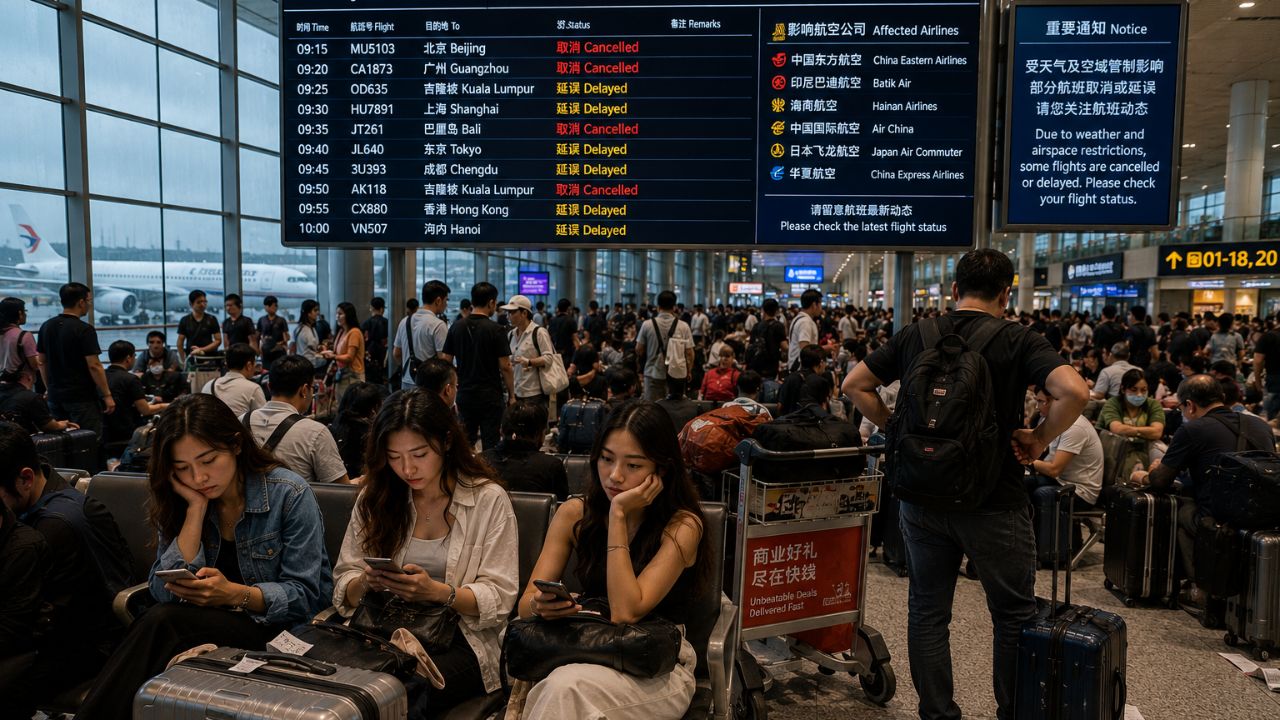
Image generated by AI
Aviation Updates: Massive Travel Chaos Engulfs Asia as 90 Flight Cancellations and 796 Delays Strike China, Indonesia, and Japan
As severe weather patterns and collapsing aircraft rotations paralyze major Asian transit corridors, top regional carriers including China Eastern and Batik Air have triggered an unprecedented wave of severe airport disruptions, leaving thousands of passengers stranded in a massive logistical meltdown.
Image generated by AI
As high-impact airline news platforms rapidly disseminate urgent aviation updates, a terrifying wave of operational failure is actively tearing through Asia’s most critical travel corridors. Six prominent regional airlines have officially recorded an astonishing 90 flight cancellations and 796 severe delays, creating a combined total of 886 flight disruptions tearing across China, Indonesia, and Japan. The extreme severity of this breakdown is actively threatening onward passenger flows into massive international transit hubs in Malaysia and Singapore. The sheer scale of this logistical collapse was spearheaded by China Eastern Airlines, which single-handedly generated 20 cancellations and 339 delays, completely fracturing domestic and regional schedules. As Air China, China Express Airlines, Batik Air, Hainan Airlines, and Japan Air Commuter frantically attempt to recover their grounded fleets, passengers are currently trapped in absolute travel chaos, navigating agonizing delays, missed cruise transfers, and catastrophic airport disruptions that are rapidly overwhelming terminal infrastructure.
Expanded Overview: A Systemic Regional Collapse
Aviation economists consistently emphasize that the tightly interwoven nature of the Asian aviation network means isolated delays instantly trigger massive regional contamination.
When heavy cancellation pressure strikes core domestic hubs, the damage violently cascades outward. The current crisis is not a localized event; it is a structural failure spanning three separate national networks simultaneously. In China, immense aircraft rotation failures at massive hubs are destroying same-day onward bookings. In Indonesia, the collapse of island-to-hub connections is stranding business travelers and tourists alike. In Japan, isolated island communities are completely severed from the mainland due to severe weather. Because regional carriers heavily depend on rapid aircraft turnaround times, this combined total of 886 disruptions guarantees that passenger recovery will take days, actively degrading the operational integrity of the entire Asia-Pacific airspace.
Section-Wise Breakdown: The Massive Meltdown in China
The absolute epicenter of this catastrophic disruption was solidly concentrated across mainland China's primary aviation infrastructure.
Carrying the sharpest and most brutal burden, China absorbed a staggering 58 cancellations and 748 delays across China Eastern, Hainan Airlines, Air China, and China Express Airlines—accounting for over 90 percent of the total regional disruption. The most intense operational pressure violently struck the absolute backbone of China's domestic network. Major international hubs, including Beijing Capital, Beijing Daxing, Guangzhou Baiyun, Shanghai Hongqiao, Shanghai Pudong, Xi’an Xianyang, Hangzhou Xiaoshan, Shenzhen Bao’an, Chongqing Jiangbei, Nanchang Changbei, Taiyuan Wusu, Xiamen Gaoqi, and Wuhan Tianhe, all reported severe gridlock. For passengers, delays at Beijing, Guangzhou, and Shanghai instantly destroy critical aircraft rotations, crew schedules, and complex baggage connections, ensuring that short delays rapidly morph into overnight strandings.
Section-Wise Breakdown: Indonesia's Domestic Network Fractures
Simultaneously, Indonesia’s incredibly vital domestic aviation network suffered a catastrophic fracture under extreme cancellation pressure.
Batik Air recorded a massive 20 cancellations and 39 delays, tying for the highest number of absolute cancellations in the region. This severe disruption aggressively attacked services linked with Jakarta-Soekarno-Hatta and Halim Perdanakusuma, alongside massive regional gateways including Sultan Hasanuddin (Makassar), Sam Ratulangi (Manado), Sultan Mahmud Badaruddin II (Palembang), Ahmad Yani (Semarang), Adisumarmo, Sultan Thaha (Jambi), Lombok, Mutiara (Palu), Bubung (Luwuk), and Radin Inten II (Lampung). Because Indonesian tourism and commerce are entirely dependent on same-day domestic island-to-hub connections through Jakarta or Makassar, these cancelled inbound flights forced massive hotel losses, missed business events, and ruined cruise transfers.
Section-Wise Breakdown: Japan's Island Communities Severed
While the raw numbers appear smaller, the impact of the disruption across Japan’s regional island network is incredibly sensitive and highly severe.
Japan Air Commuter was forced into 12 cancellations and nine delays as severe weather attacked the archipelago. Affected critical airports included Kagoshima, New Tanegashima, Okinoerabu, Naha, Amami, Kikai, Yakushima, and Tokunoshima. In island aviation operations, a single cancelled flight often means no alternative replacement exists for 24 hours. Compounding the chaos, Japan Airlines issued an official domestic operation update for 29 June, explicitly warning that airports like Kushiro, Tanegashima, Yakushima, and Amamioshima could suffer further delays, cancellations, or diversions due to severe bad weather and extremely poor visibility.
Flight Details: Asian Aviation Disruption Matrix
To fully comprehend the sheer scale of the airline failures, the exact cancellation metrics, and the severe operational breakdown across the three nations, the critical data has been consolidated into the mandatory operational matrix below.
| Airline | Country Focus | Cancelled Flights | Delayed Flights | Total Disrupted Flights | Main Impact |
|---|---|---|---|---|---|
| China Eastern Airlines | China | 20 | 339 | 359 | Highest overall disruption |
| Batik Air | Indonesia | 20 | 39 | 59 | Heavy cancellation pressure |
| Hainan Airlines | China | 18 | 59 | 77 | Domestic China route disruption |
| Air China | China | 15 | 230 | 245 | Major hub delays |
| Japan Air Commuter | Japan | 12 | 9 | 21 | Island route cancellations |
| China Express Airlines | China | 5 | 120 | 125 | Regional delays across western/northern China |
| Grand Total | Asia | 90 | 796 | 886 | Major regional travel disruption |
Passenger Impact: Stranded Baggage and Missed Connections
For the thousands of passengers trapped in these collapsing terminals, the initial delay is merely the first stage of the crisis.
The secondary impact is devastating: missed international onward connections to Malaysia and Singapore, stranded baggage stuck in massive hub backlogs, and lost hotel reservations. Travelers flying through Beijing, Guangzhou, Shanghai, Jakarta, or Kagoshima are urged to entirely rebook full itineraries rather than single sectors to avoid being stranded mid-journey. Passengers are strongly advised to aggressively pursue their rights; as per IATA guidelines, disruptions falling directly within airline control (such as crew rotation failures) often mandate care, assistance, or refund support, though weather-related delays in Japan may be treated under different regulatory frameworks.
Industry Analysis: Weather vs. Systemic Flow Failure
Aviation experts explicitly highlight that this 886-flight disruption is a lethal combination of unyielding weather and systemic operational failure.
In Japan, poor visibility and high winds were the identified, unavoidable triggers forcing island cancellations, as narrow-body aircraft simply cannot operate into small airfields without visual clearance. However, in China, the disruption was aggressively systemic. China’s strict flight regularity rules constantly enforce air traffic flow control and complex dispatch updates; when delays strike massive hubs like Shanghai or Beijing, the sheer density of the network rolls the delay across multiple sectors. For Indonesia’s Batik Air, the collapse was heavily driven by aircraft and crew rotation pressure, where a single delayed inbound aircraft from the outer islands causes subsequent outbound departures from Jakarta to completely collapse.
Conclusion: A Highly Fragile Aviation Network
Ultimately, this massive wave of 90 flight cancellations and 796 delays definitively exposes the extreme fragility of the Asian aviation network. With China Eastern Airlines and Air China suffering massive systemic delays, Batik Air fracturing Indonesian domestic connectivity, and Japan Air Commuter battling severe weather, the region is currently engulfed in absolute travel chaos. As passengers desperately attempt to salvage missed connections and recover stranded baggage, airlines are fighting a grueling battle to reset their aircraft rotations. For travelers navigating these highly sensitive transit corridors, absolute vigilance regarding live flight status and aggressive, proactive rebooking are the only defenses against the devastating impact of these massive airport disruptions.
Key Takeaways
- Massive Regional Collapse: Six airlines suffered a combined 90 cancellations and 796 delays, generating 886 total flight disruptions across China, Indonesia, and Japan.
- China Bears the Brunt: China Eastern, Air China, Hainan Airlines, and China Express generated 58 cancellations and 748 delays, devastating major hubs like Beijing and Shanghai.
- Indonesia's Island Network: Batik Air tied for the highest cancellations (20), fracturing critical domestic connections through Jakarta and Makassar.
- Japan Weather Crisis: Japan Air Commuter was forced to cancel 12 flights, isolating sensitive island airports like Kagoshima, Yakushima, and Amami due to poor visibility.
- Cascading Threat: The massive delays in these core markets heavily threaten onward connections to major Southeast Asian transit hubs in Malaysia and Singapore.
FAQ: Asian Flight Disruptions (June 29)
Which airline suffered the most flight disruptions? China Eastern Airlines recorded the highest overall disruption, suffering an incredible 20 flight cancellations and 339 severe delays across its dense domestic network.
How bad was the flight disruption in China? China absorbed over 90 percent of the total regional impact, with four major airlines combining for 58 cancellations and 748 delays, severely crippling massive hubs like Beijing, Shanghai, and Guangzhou.
Why were Indonesian domestic flights cancelled? Batik Air suffered 20 cancellations and 39 delays largely due to severe aircraft and crew rotation pressure, significantly disrupting island-to-hub connections via Jakarta and Makassar.
What caused the cancellations in Japan? Japan Air Commuter was forced to cancel 12 flights and delay nine others primarily due to severe bad weather and extremely poor visibility across the highly sensitive island routes.
Related Travel Guides
Guangzhou Baiyun Airport AI Border Travel Chaos 2026
Asia Pacific Regional Flight Disruption Survival Guide 2026
Middle East Airspace Ceasefire Travel Chaos 2026
Disclaimer: This article is strictly for informational and aviation crisis response analysis purposes. The specific flight disruption statistics (90 cancellations, 796 delays, 886 total disruptions), airline breakdown (China Eastern 359, Air China 245, Batik Air 59, Hainan Airlines 77, Japan Air Commuter 21, China Express 125), and affected airport lists are based on manually collected operational telemetry available for June 29, 2026. Asian aviation networks, weather conditions, air traffic flow control measures, and airline recovery schedules are highly dynamic and incredibly volatile; flight status and rebooking policies are subject to immediate, unannounced modification by the operating carrier. Passengers traveling through China, Indonesia, Japan, or onward to Southeast Asia must explicitly monitor live flight updates directly with their airline and proactively manage all connection risks prior to arrival at the airport.
Disclaimer
This article is for informational and educational purposes only. It does not constitute legal, financial, or professional advice. While we strive to provide accurate and up-to-date information, travel policies, regulations, and conditions change rapidly. Always verify information with official sources before making travel decisions. Nomad Lawyer makes no representations about the accuracy, reliability, completeness, or suitability of the information provided. Readers should consult qualified professionals for advice specific to their circumstances. The views expressed in this article are those of the author and do not necessarily reflect the views of Nomad Lawyer.
Raushan Kumar
Founder & Lead Developer
Full-stack developer with 11+ years of experience and a passionate traveller. Raushan built Nomad Lawyer from the ground up with a vision to create the best travel and law experience on the web.
Learn more about our team →