
Amsterdam Schiphol Leads European Aviation Chaos with Nearly 2,000 Flight Delays in 2026
Amsterdam Schiphol emerged as the epicenter of European air travel disruption on September 1, 2026, as 12 major hubs recorded 1,953 delays and 70 cancellations.

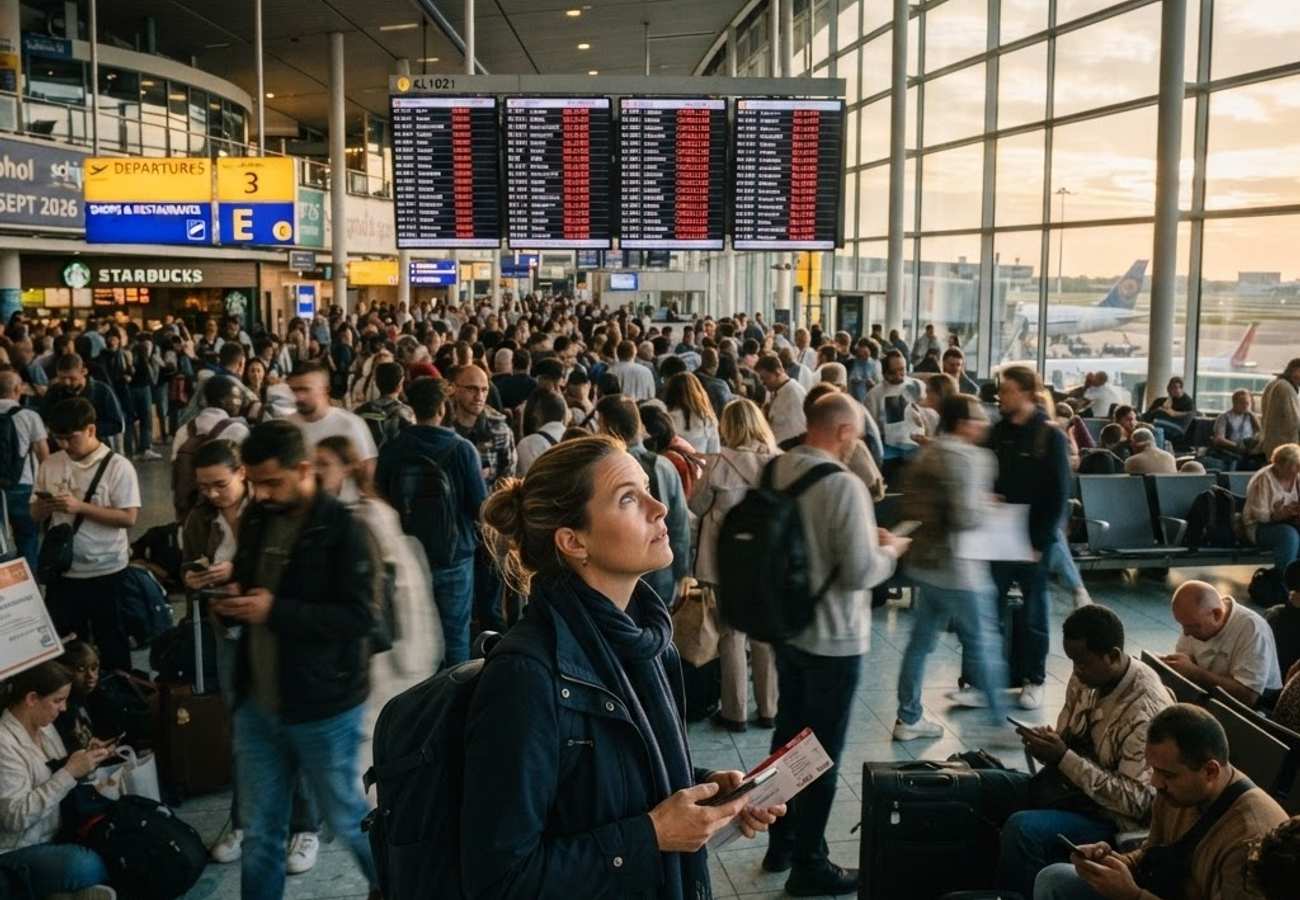
Image generated by AI
Air travel across Europe suffered severe instability on September 1, 2026, as Amsterdam and 11 other primary hubs reported 1,953 delays and 70 cancellations in a single 24-hour window.
The disruption hit during the closing stages of the peak summer season, placing immense pressure on airport infrastructure and airline crew rotations. Amsterdam Schiphol emerged as the most impacted gateway, recording over 300 combined delayed departures and arrivals.
The volatility was not isolated to the Netherlands. Real-time monitoring indicates widespread operational failures across a network of critical hubs, including Paris Charles de Gaulle, London Gatwick, Frankfurt, and Barcelona. Additional disruptions were logged at airports in Italy, Portugal, Denmark, and Norway, with Oslo reporting one of the highest cancellation rates among the monitored sites.
Operational Breakdown: September 1, 2026
The scale of the disruption created a cascade effect across the continent. Because these hubs serve as primary transit points for intercontinental traffic to North America, Asia, and Africa, a delay in Amsterdam or Frankfurt frequently triggered missed connections thousands of miles away.
- Total Delays: 1,953 flights across 12 major airports.
- Total Cancellations: 70 flights.
- Primary Epicenter: Amsterdam Schiphol (>300 delays).
- High-Impact Hubs: Paris CDG, London Gatwick, Frankfurt, Barcelona, and Oslo.
- Scope: Affected both national flag carriers and low-cost operators on short-haul and long-haul routes.
Primary Drivers of Systemic Failure
Our analysis of the operational data suggests a convergence of three specific pressure points:
- Capacity Saturation: Late-summer demand has pushed air traffic management systems to their absolute limit. With runways operating at near-maximum capacity, there is zero margin for error.
- Environmental Volatility: Small-scale weather events—specifically low cloud ceilings and thunderstorms—triggered immediate traffic flow restrictions, leading to takeoff and landing queues.
- Resource Bottlenecks: Ground handling shortages and strict crew duty-time restrictions meant that once a flight was delayed, the airline could not easily recover the schedule, pushing delays into the late evening.
Flight Disruption Summary: Major European Hubs (Sept 1, 2026)
| Metric | Data Point |
|---|---|
| Total Monitored Airports | 12 |
| Total Flight Delays | 1,953 |
| Total Flight Cancellations | 70 |
| Most Impacted Hub | Amsterdam Schiphol |
| Amsterdam Specific Delays | 300+ |
| High Cancellation Rate Hub | Oslo |
Why This Matters: The Logistics Perspective
For travelers and corporate nomads, this event confirms that the "recovery" of European aviation post-pandemic is still fragile. From a logistical perspective, the concentration of delays at Schiphol and Frankfurt proves that the hub-and-spoke model is currently a liability during peak windows.
The real impact for the passenger is the "rotation collapse." When a plane arriving from New York is delayed by three hours in Amsterdam, that same aircraft cannot perform its next three short-haul legs on time. This means travelers who weren't even flying into Amsterdam on September 1 likely felt the ripple effects of Schiphol's instability.
Furthermore, this highlights a critical legal window. Passengers departing from or arriving at EU airports on EU-based carriers are likely eligible for compensation under EU air passenger rules, provided the delays weren't caused by "extraordinary circumstances."
Forward Outlook
We expect continued volatility through the remainder of the 2026 transition period. Travelers should adopt the following strategies to mitigate risk:
- Buffer Zones: Increase minimum connection times at Schiphol, CDG, and Frankfurt to at least 3-4 hours.
- Document Preservation: Retain all boarding passes and receipts; these are non-negotiable for filing EU compensation claims.
- Segment Monitoring: Use live tracking for every leg of a multi-carrier itinerary rather than relying on a single booking confirmation.
The European aviation network remains in a state of high-tension equilibrium where a single thunderstorm can paralyze an entire continent's transit.
Related Travel Guides
Disclaimer
This article is for informational and educational purposes only. It does not constitute legal, financial, or professional advice. While we strive to provide accurate and up-to-date information, travel policies, regulations, and conditions change rapidly. Always verify information with official sources before making travel decisions. Nomad Lawyer makes no representations about the accuracy, reliability, completeness, or suitability of the information provided. Readers should consult qualified professionals for advice specific to their circumstances. The views expressed in this article are those of the author and do not necessarily reflect the views of Nomad Lawyer.
Raushan Kumar
Founder & Lead Developer
Full-stack developer with 11+ years of experience and a passionate traveller. Raushan built Nomad Lawyer from the ground up with a vision to create the best travel and law experience on the web.
Learn more about our team →