
American Airlines Executes High-Risk Caribbean Expansion, Launching Sensitive Flights to Venezuela and Haiti Amidst Complex Security Protocols: Latest Airline News
American Airlines is aggressively expanding its massive Miami hub, launching highly controlled, sensitive flight operations to Maracaibo, Venezuela, and Cap-Haitien, Haiti, while navigating severe State Department travel advisories.

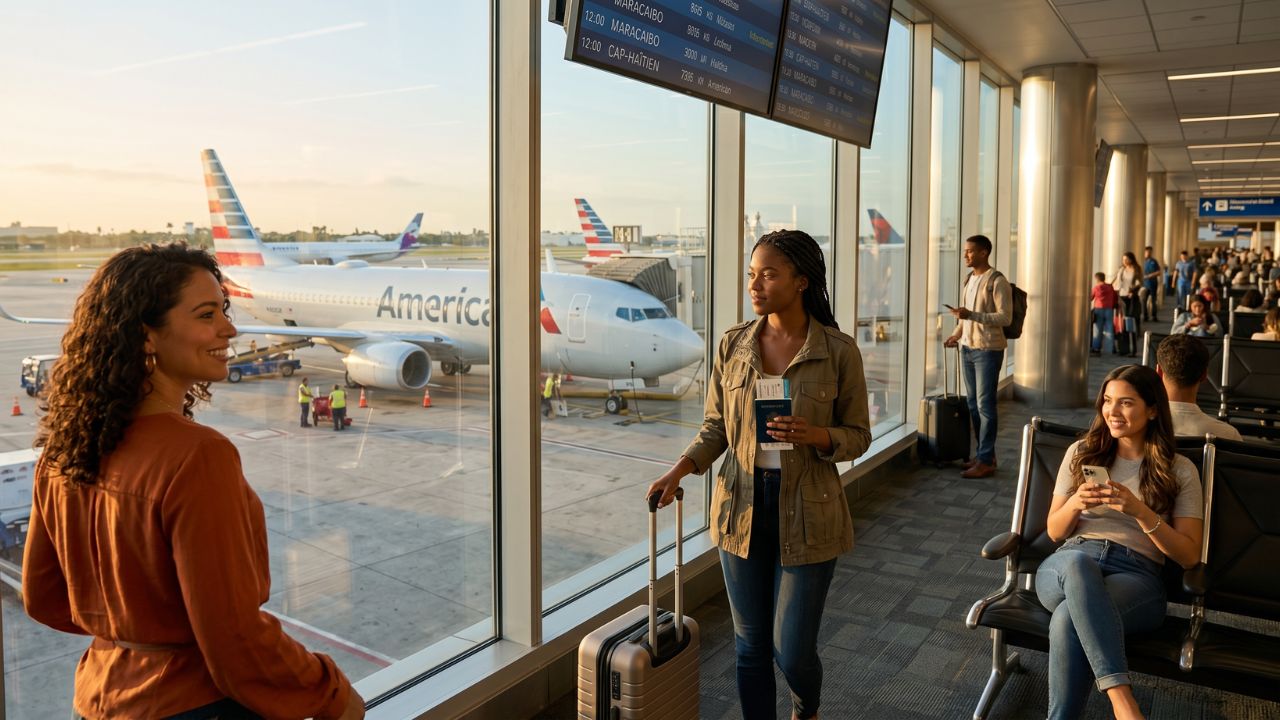
Image generated by AI
In a massive, highly complex operational maneuver that signals a critical shift in United States aviation policy, American Airlines is aggressively expanding its Miami International Airport (MIA) hub to restore vital Caribbean and Latin American connectivity. In a move that blends high-stakes corporate strategy with intense diplomatic maneuvering, the carrier has officially announced the launch of daily flights to Maracaibo, Venezuela and the resumption of highly sensitive service to Cap-Haitien, Haiti. These route announcements are far from standard network updates; they represent the delicate reopening of aviation corridors heavily restricted by geopolitical instability and severe travel chaos. As American Airlines pushes toward an unprecedented 100-destination footprint across the region, this strategic navigation of State Department advisories and potential airport disruptions represents the premier headline in today's breaking airline news and essential aviation updates.
By introducing direct passenger coordination and dynamic scheduling backups, the regional aviation hubs target growing passenger demand across vital commerce sectors. The choice to coordinate flight departures in phases helps to manage gate capacity, supporting the country's broader regional transportation network.
Context: Navigating the Geopolitics of Flight
For the global travel industry, adding new routes is typically a simple exercise in supply and demand. However, operating flights into Venezuela and Haiti requires navigating a minefield of federal security mandates.
In 2019, the U.S. government completely suspended all direct commercial passenger and cargo flights between the United States and Venezuela citing profound security concerns. That suspension has finally been formally rescinded, heavily monitored by the Transportation Security Administration (TSA). Similarly, following catastrophic instability, the FAA prohibited U.S. carriers from flying into Port-au-Prince, Haiti. American Airlines' decision to bypass the Haitian capital and restore service exclusively through the northern gateway of Cap-Haitien demonstrates a highly tactical, risk-adjusted approach to aviation. The airline is effectively acting as an essential lifeline for massive diaspora communities in South Florida while operating under severe Level 3 and Level 4 State Department advisories. This is not mass-market leisure tourism; this is critical, controlled corporate and humanitarian mobility.
To view live flight schedules, real-time terminal maps, or strict security rules at the Miami gateway, travelers can consult the official Miami International Airport (MIA) directory. For direct booking access, specific passport documentation requirements, and detailed travel advisories, passengers must check the official American Airlines portal and the U.S. State Department. To explore live flight tracking and monitor the exact routing of these sensitive Caribbean deployments, passengers can consult the official FlightAware tracking service.
Section-Wise Breakdown of the Caribbean Expansion
Miami International Airport (MIA): The Unrivaled Anchor
Miami is the absolute operational fortress for this expansion. Processing a staggering 55.3 million passengers and 3.4 million tons of freight in 2025, MIA is America's busiest airport for international cargo. American Airlines relies entirely on MIA's massive connecting infrastructure to funnel passengers from New York, Chicago, and Dallas onto these specialized Latin American flights. During the peak Winter 2026 season, American will execute more than 410 daily departures from Miami alone, solidifying its total dominance over Caribbean routing.
The Venezuelan Reconnection: Maracaibo
Building upon its already resumed twice-daily service to Caracas, American Airlines is deploying the Embraer 175 to launch daily flights to Maracaibo on July 14, 2026. This establishes the only direct U.S. link to Venezuela’s second-largest city. Utilizing the smaller-gauge Embraer 175 is a highly disciplined capacity strategy, allowing the airline to carefully probe demand in western Venezuela while mitigating the extreme financial risk of operating a half-empty wide-body jet into a Level 3 advisory zone.
The Haitian Alternative: Cap-Haitien
On November 1, 2026, American Airlines will resume daily service to Haiti utilizing a Boeing 737. Critically, this route connects Miami exclusively to Cap-Haitien in the north. Because the FAA prohibition on Port-au-Prince remains firmly intact due to severe unrest, Cap-Haitien serves as the solitary, high-security bridge between the massive Haitian-American diaspora in Florida and their homeland, facilitating essential family and humanitarian travel while bypassing the volatile capital entirely.
Technical Roster: American Airlines Miami Expansion Matrix
To ensure absolute factual accuracy regarding the deployment of these sensitive routes, the following table details the core operational metrics, aircraft types, and critical State Department travel advisory contexts:
| Route / Destination | Launch Date | Aircraft & Frequency | Current U.S. Travel Advisory Context |
|---|---|---|---|
| Miami (MIA) to Maracaibo (MAR) | July 14, 2026 | Embraer 175 (Daily) | Level 3 (Reconsider Travel); flight suspension rescinded |
| Miami (MIA) to Cap-Haitien (CAP) | Nov 1, 2026 | Boeing 737 (Daily) | Level 4 (Do Not Travel); Port-au-Prince remains prohibited |
| Miami (MIA) to Caracas (CCS) | Currently Active | Embraer 175 (2x Daily) | Base of Venezuela return; TSA assessments ongoing |
| Wider Miami Network | Winter 2026 | Mixed Fleet (>410 Daily) | Normal U.S. operations; dominant Latin American hub feed |
Passenger Impact: Essential Mobility and Risk Mitigation
For the everyday passenger, booking these specific American Airlines flights requires a fundamentally different mindset than booking a vacation to Cancun.
This expansion directly targets VFR (Visiting Friends and Relatives) traffic, specialized corporate logistics, and humanitarian NGO deployments. Passengers traveling to Cap-Haitien or Maracaibo must understand that they are flying into highly complex environments with severe diplomatic constraints. If a passenger misses a connection or experiences a delay in Miami, rebooking is standard. However, if a flight is canceled while the passenger is on the ground in Venezuela or Haiti, the lack of robust U.S. consular support and limited alternative routing can result in extreme, prolonged travel chaos. Passengers are heavily advised to secure comprehensive medical evacuation insurance and register their itineraries with the U.S. embassy via the STEP (Smart Traveler Enrollment Program) prior to boarding.
Industry Analysis: The First-Mover Advantage in Volatile Markets
Aviation industry analysts view American Airlines' push into Maracaibo and Cap-Haitien as a masterclass in calculated first-mover strategy.
While competing legacy carriers completely avoid these turbulent nations, American Airlines is leveraging its massive Miami dominance to monopolize the diaspora and essential-travel markets. The margins on these flights can be incredibly high; because there is zero nonstop competition on the MIA-MAR route, American Airlines possesses total pricing power. Furthermore, utilizing the belly space of these passenger aircraft for high-value cargo and critical medical shipments out of Miami generates immense ancillary revenue. Analysts note that by safely operating the Cap-Haitien and Caracas routes today, American Airlines positions itself to totally dominate the massive, lucrative rebuild efforts in both Haiti and Venezuela once geopolitical stability eventually returns and broader travel sanctions are lifted.
Actionable Advice for High-Risk Travel Planning
If you are a travel agent, corporate manager, or individual passenger planning an itinerary to Maracaibo or Cap-Haitien in 2026, execute this strict survival checklist:
- Strict Documentation Verification: Do not assume standard passport validity is sufficient. Venezuelan visa requirements and Haitian entry protocols fluctuate violently based on diplomatic relations. Verify all documentation with official consular services a minimum of 30 days prior to your flight.
- Acknowledge the Port-au-Prince Prohibition: Travel agents must explicitly warn clients that the Cap-Haitien flight does not provide safe or easy ground transit to Port-au-Prince. The capital remains restricted, and overland travel in Haiti carries extreme security risks.
- Purchase Specialized Evacuation Insurance: Standard travel insurance will frequently void coverage if you travel to a destination currently under a U.S. State Department Level 4 (Do Not Travel) advisory. You must secure specialized, high-risk geopolitical and medical evacuation insurance.
- Monitor the TSA and FAA Directives: The U.S. government can instantly ground these flights if security conditions in Maracaibo or Cap-Haitien deteriorate. Always have a financial contingency plan and maintain flexible, refundable ticketing.
FAQ: American Airlines Caribbean & Latin America Expansion
When does American Airlines launch its new flights to Venezuela and Haiti?
The daily service from Miami to Maracaibo, Venezuela, launches on July 14, 2026. The daily service to Cap-Haitien, Haiti, resumes on November 1, 2026.
Why is American Airlines flying to Cap-Haitien instead of Port-au-Prince?
Due to severe ongoing instability in the capital, the FAA currently prohibits U.S. commercial flights to Port-au-Prince. Cap-Haitien provides a safe, northern alternative for essential travel.
What aircraft will operate these new international routes?
The Miami to Maracaibo route will utilize an Embraer 175, while the Miami to Cap-Haitien flights will operate using a larger Boeing 737.
Mastering the Geopolitics of Aviation
The highly calculated launch of American Airlines' flights to Maracaibo and Cap-Haitien proves definitively that the carrier is willing to execute complex, high-risk operations to maintain its absolute dominance over the Latin American market. By leveraging the massive infrastructure of its Miami hub, American is providing a critical, monopolistic lifeline to massive diaspora communities while navigating the severe restrictions of U.S. aviation policy. As these Embraer and Boeing jets touch down in Venezuela and northern Haiti, they do more than simply expand a route map; they aggressively demonstrate how commercial aviation can safely thread the needle of geopolitical instability to reconnect the most isolated regions of the Caribbean.
Key Takeaways
- High-Stakes Expansion: American Airlines is aggressively expanding its Miami hub to nearly 100 Latin American destinations, launching sensitive routes to Venezuela and Haiti.
- Maracaibo Launch: Daily flights from Miami to Maracaibo utilizing Embraer 175s will launch on July 14, 2026, capitalizing on rescinded U.S. flight suspensions.
- Haiti Rerouting: Daily Boeing 737 service to Cap-Haitien resumes November 1, 2026, deliberately bypassing Port-au-Prince due to severe FAA prohibitions.
- Miami Dominance: Miami International Airport's massive scale (55.3 million passengers in 2025) provides the critical connecting feed required to sustain these complex routes.
- Travel Advisory Warnings: Both routes operate under severe U.S. State Department advisories (Level 3 and Level 4), demanding intense risk management and specialized insurance from travelers.
Related Travel Guides
Global Corporate Travel Chaos: CFOs Unleash Massive Budgets
Emirates Obliterates Inflight Boredom With Live World Cup Broadcasts
American Airlines Haiti & Venezuela Expansion Discussion on Reddit
Disclaimer
This article is for informational and educational purposes only. It does not constitute legal, financial, or professional advice. While we strive to provide accurate and up-to-date information, travel policies, regulations, and conditions change rapidly. Always verify information with official sources before making travel decisions. Nomad Lawyer makes no representations about the accuracy, reliability, completeness, or suitability of the information provided. Readers should consult qualified professionals for advice specific to their circumstances. The views expressed in this article are those of the author and do not necessarily reflect the views of Nomad Lawyer.
Kunal K Choudhary
Co-Founder & Contributor
A passionate traveller and tech enthusiast. Kunal contributes to the vision and growth of Nomad Lawyer, bringing fresh perspectives and driving the community forward.
Learn more about our team →