
Global Corporate Travel Chaos: CFOs Unleash Massive Flight Budgets Across London, Tokyo, and Dubai as Geopolitical Risks Shatter Virtual Meeting Reliance: Latest Airline News
Multinational CFOs are aggressively expanding corporate aviation budgets in July 2026, driving a massive surge in business flight bookings across London, Tokyo, Singapore, Dubai, and Hong Kong to combat global supply chain instability.

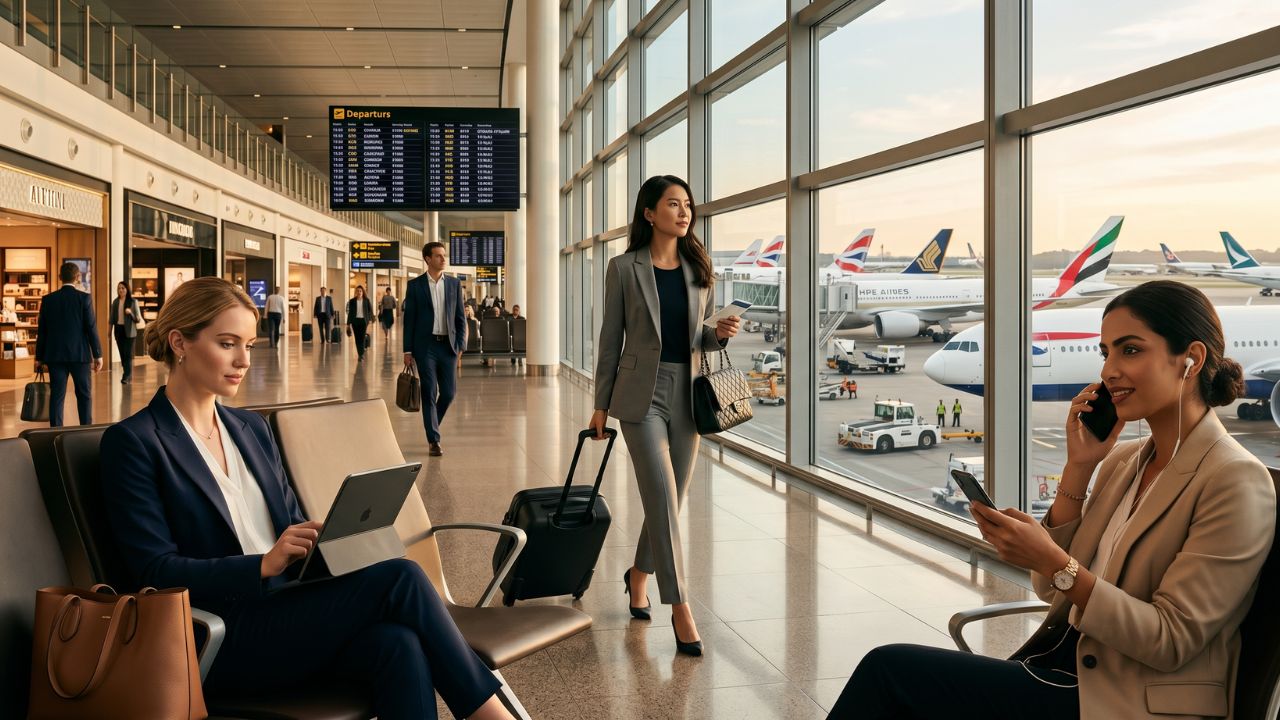
Image generated by AI
In a massive, unprecedented reversal of the remote-work era, multinational Chief Financial Officers (CFOs) are aggressively deploying record-breaking travel budgets, triggering a historic surge in corporate flight bookings across the globe's premier financial mega-hubs. As London joins Tokyo, Singapore, Dubai, and Hong Kong in absorbing this massive influx of premium business traffic, it is blatantly clear that virtual meetings have failed to secure complex international deals. Driven by escalating geopolitical tensions, brutal currency volatility, and catastrophic supply chain travel chaos, corporations are being forced to put executives physically on the ground. This ferocious scramble for business class seats, risk-hedging insurance, and seamless cross-border mobility is completely overwhelming legacy airport disruptions and represents the premier headline in today's breaking airline news and global aviation updates.
By introducing direct passenger coordination and dynamic scheduling backups, the regional aviation hubs target growing passenger demand across vital commerce sectors. The choice to coordinate flight departures in phases helps to manage gate capacity, supporting the country's broader regional transportation network.
Context: The Collapse of the Virtual Boardroom
For years, the aviation industry feared that corporate travel would never recover from the widespread adoption of digital communication tools.
Official surveys executed in 2026 completely destroy that narrative. While remote work initially reduced some travel, 48% of businesses reported they only partially replaced travel, and an astounding 33% replaced absolutely none. In a highly volatile, fragmented global business environment characterized by sanctions and regulatory hurdles, trust cannot be built over a screen. Exhibitions, site inspections, and high-stakes audits demand physical presence. Consequently, CFOs are no longer treating corporate travel as a discretionary expense; it is now viewed as critical strategic infrastructure. To secure contracts and preserve market presence amidst global unpredictability, finance leaders are hoarding premium seats, chartering private jets, and purchasing massive fuel hedges. This "flight frenzy" perfectly illustrates the aggressive lengths to which modern corporations will go to maintain face-to-face diplomacy.
To view live flight schedules, real-time terminal maps, or check-in rules at the leading European business gateway, travelers can consult the official London Heathrow Airport (LHR) directory. For direct booking access, specific baggage rules, and APEC Business Travel Card eligibility, passengers can check their respective official government portals. To explore live flight tracking, check delay maps, or monitor the exact routing of corporate business jets across Asia and the Middle East, passengers can consult the official FlightAware tracking service.
Section-Wise Breakdown: The Global Business Hub Surge
London: Europe's Resilient Gateway
Despite immense continental regulatory pressures, London remains the undisputed epicenter for European corporate transit. Official figures confirm that an overwhelming 90% of UK companies rely on air travel. Specifically, 84% send employees to Europe, 43% deploy teams to North America, and 23% execute missions to the Middle East. London CFOs are aggressively booking refundable fares and premium cabins to insulate their executives against persistent European ATC strikes.
Tokyo: The Business Jet Adaptation
In Japan, privacy and punctuality are paramount. Corporate travelers are increasingly abandoning commercial first-class in favor of dedicated business jets. However, Japanese transport authorities recognize a critical "second-line" logistics gap. To bypass paralyzing ground traffic, CFOs are aggressively funding helicopter transfers and luxury chauffeured vehicles, forcing investments into new urban heliports to ensure executives arrive at boardrooms utterly unencumbered.
Singapore: The High-Performing Hub
Singapore has experienced a violent rebound in corporate hospitality. From January to September 2025, tourism receipts exploded to S$23.9 billion (a 6.5% increase), processing 16.9 million international visitors. With hotel occupancy holding at a massive 81.9%, CFOs are engaged in a brutal budget arms race, scrambling to secure exorbitant hotel blocks and conference centers before prices escalate further.
Dubai: The Record Arrival Spree
Driven by mega-exhibitions and free-zone expansion, Dubai recorded a massive 15.70 million visitors between January and October 2025. Because the Middle East poses a paradox of massive financial reward against severe geopolitical risk, CFOs are drastically expanding budgets to include route diversions, premium insurance, and contingency evacuation charters.
Hong Kong: Cross-Boundary Finance
Driven by integration with Mainland China, Hong Kong logged a staggering 49.9 million visitor arrivals in 2025 (a 12% increase). To target high-value corporate segments, the Hong Kong Tourism Board received a massive HK$1.66 billion subvention. CFOs are deploying huge budgets here for bilingual compliance training, hospitality suites, and complex cross-border financial deal-making.
Technical Roster: Global Corporate Travel Metrics
To ensure absolute factual accuracy regarding the immense scale of this corporate travel surge, the following table details the verified economic and operational data driving this flight frenzy:
| Global Mega-Hub | Confirmed Economic / Travel Metric | Strategic Corporate Impact |
|---|---|---|
| London (UK) | 90% of UK companies use air travel | Proves total reliance on aviation; 84% European travel |
| Tokyo (Japan) | Stable business jet demand | Drives massive investment in helicopter/ground logistics |
| Singapore | S$23.9 Billion Receipts / 81.9% Hotel Occupancy | Triggers massive budget arms race for corporate venues |
| Dubai (UAE) | 15.70 Million Visitors (Jan-Oct 2025) | Forces CFOs to hedge geopolitical risk while booking |
| Hong Kong | 49.9 Million Arrivals (32.7M Overnight) | Solidifies status as the premium cross-boundary gateway |
Passenger Impact: The Era of Seamless Mobility
For the corporate executive executing these high-stakes global missions, the travel experience is becoming simultaneously more luxurious and significantly more complex.
Because CFOs are deploying unprecedented capital to ensure executives remain productive, corporate travelers are being shielded from the brutal realities of commercial airport congestion. The utilization of the APEC Business Travel Card is a prime example; CFOs are eagerly paying the membership fees so their high-frequency travelers can utilize special service lanes and bypass agonizing immigration queues across the Asia-Pacific. Furthermore, digital infrastructure is heavily funded. Executives are equipped with integrated mobile apps for digital health certificates and biometric boarding. However, the pressure to perform is massive. With the company paying exorbitant rates for fuel-hedged premium flights, helicopter transfers, and 81.9% occupancy hotel rooms, the expectation to close the deal upon arrival is absolute.
Industry Analysis: Large vs. Small Enterprise Divide
Aviation industry analysts view this global corporate travel surge as a stark indicator of the growing divide between massive multinational conglomerates and small enterprises.
Official survey data reveals that large firms anticipate 61% of their staff will travel to North America, whereas small firms expect only 31%. While massive corporations possess the treasury depth to purchase jet fuel futures, secure political risk insurance, and charter private jets, smaller enterprises are forced to battle for standard commercial economy seats. Analysts predict this financial disparity will fundamentally reshape airline revenue models. Legacy carriers like British Airways, Emirates, and Singapore Airlines will increasingly cater their entire cabin architecture and scheduling networks specifically to capture the massive, price-insensitive budgets of Fortune 500 CFOs, potentially leaving smaller businesses struggling with restricted global access and inflated commercial fares.
Actionable Advice for Corporate Travel Planners
If you are a corporate travel manager or CFO attempting to navigate this highly volatile, high-cost global aviation environment, execute this tactical survival checklist:
- Leverage the APEC Business Travel Card: If your executives travel frequently to Hong Kong, Singapore, or Tokyo, immediately enroll them in the APEC Business Travel Card scheme. The ability to utilize special service lanes and bypass visa friction is the highest ROI (Return on Investment) mobility asset currently available in the Asia-Pacific.
- Pre-Book Second-Line Transport: Do not assume your executive can easily secure a taxi at Tokyo Haneda or London Heathrow during peak season. Budget heavily for "second-line" logistics, pre-booking verified luxury chauffeurs or helicopter transfers to guarantee seamless door-to-door mobility.
- Secure Block Bookings in Mega-Hubs: With Singapore hotel occupancy at 81.9% and Dubai processing 15.7 million visitors, booking a corporate suite two weeks prior to a major expo is mathematically impossible. You must secure block hotel bookings a minimum of six months in advance.
- Execute Aggressive Risk Hedging: Corporate travel in 2026 requires treasury-level risk management. Diversify your booked carriers to avoid single points of failure due to strikes, and utilize financial derivatives to lock in jet fuel surcharges and foreign exchange rates before massive geopolitical shifts inflate your travel budget.
FAQ: The 2026 Corporate Travel Surge
Why are CFOs suddenly increasing corporate travel budgets?
CFOs are deploying unprecedented budgets to combat rising global complexity—including geopolitical tensions and supply chain disruptions—recognizing that virtual meetings cannot replace critical face-to-face dealmaking.
Which global mega-hubs are experiencing the highest corporate flight demand?
London, Tokyo, Singapore, Dubai, and Hong Kong are all securing record-high corporate flight bookings, driven by mega-events, cross-border finance, and resilient international business operations.
How are Japanese corporate travelers adapting to ground transit issues?
In Tokyo, executives heavily utilize business jets but are increasingly relying on expensive "second-line" transport, such as helicopter transfers and luxury cars, to bypass ground congestion.
The Absolute Necessity of Flight
The historic surge in premium corporate bookings across London, Tokyo, Singapore, Dubai, and Hong Kong proves definitively that the global economy cannot function over a webcam. By aggressively deploying unprecedented travel budgets to secure business class seats, charter helicopters, and acquire APEC travel cards, multinational CFOs have publicly acknowledged that physical presence is the ultimate business currency. As corporations battle extreme geopolitical volatility and supply chain friction, the aviation sector remains the absolute, non-negotiable backbone of international commerce, guaranteeing that the high-stakes world of global dealmaking will always remain airborne.
Key Takeaways
- Massive Budget Expansion: Multinational CFOs are deploying record travel budgets to combat geopolitical risks and secure critical face-to-face meetings globally.
- London Dominance: An astounding 90% of UK companies continue to rely on air travel, firmly cementing London as Europe's resilient business gateway.
- Asian Hub Surges: Singapore (81.9% hotel occupancy) and Hong Kong (49.9 million arrivals) are experiencing massive, budget-straining corporate tourism rebounds.
- Dubai's Record Influx: Dubai processed 15.7 million visitors in late 2025, forcing corporations to aggressively hedge risks while booking in the Middle East.
- APEC Mobility Asset: The APEC Business Travel Card has become a critical, highly funded asset for corporate finance teams seeking to eliminate border friction across the Asia-Pacific.
Related Travel Guides
Emirates Executes Massive 2,139-Flight A380 Capacity Reset
United Airlines Deploys Massive 'Stars and Stripes' America250 Livery
Disclaimer
This article is for informational and educational purposes only. It does not constitute legal, financial, or professional advice. While we strive to provide accurate and up-to-date information, travel policies, regulations, and conditions change rapidly. Always verify information with official sources before making travel decisions. Nomad Lawyer makes no representations about the accuracy, reliability, completeness, or suitability of the information provided. Readers should consult qualified professionals for advice specific to their circumstances. The views expressed in this article are those of the author and do not necessarily reflect the views of Nomad Lawyer.
Kunal K Choudhary
Co-Founder & Contributor
A passionate traveller and tech enthusiast. Kunal contributes to the vision and growth of Nomad Lawyer, bringing fresh perspectives and driving the community forward.
Learn more about our team →