
Alaska Airlines, Southwest, Delta, American, and United Flight Attendants Reveal 7 Passenger Behaviors That Make Every Flight Smoother — Essential Tips for U.S. Air Travelers in 2026
Flight attendants from Alaska Airlines, Southwest, Delta, American, and United have identified 7 key passenger behaviors — from greeting the crew to staying calm during delays — that dramatically improve boarding efficiency and in-flight service quality.

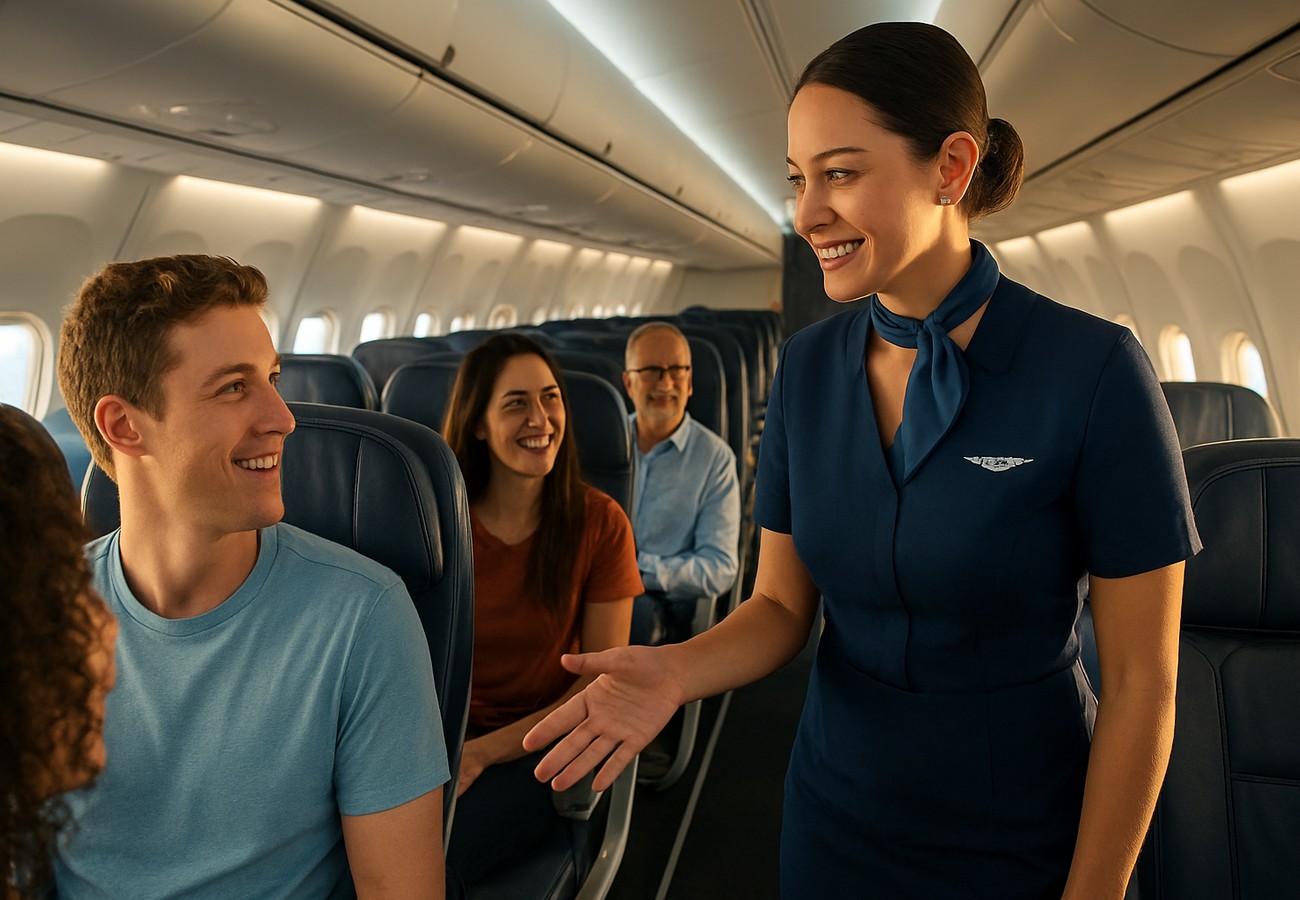
Image generated by AI
Flight attendants from five of America's largest carriers — Alaska Airlines, Southwest Airlines, Delta Air Lines, American Airlines, and United Airlines — have collectively identified seven passenger behaviors that make the difference between a smooth, efficient boarding and a chaotic, delay-prone one, offering a candid look at what cabin crew across thousands of daily flights wish every traveler understood before stepping onto the jet bridge.
Why Passenger Behavior Has Become a Defining Issue for U.S. Airlines
The boarding door is not just a threshold between the terminal and the cabin. It is the first, highest-stakes moment of interaction between a passenger and the crew responsible for their safety and comfort for the next several hours. Flight attendants from major U.S. carriers are consistent on this point: the tone set in the first 90 seconds of boarding rarely changes for the duration of the flight.
This is not a marginal issue. According to Federal Aviation Administration (FAA) incident data, unruly passenger reports have remained elevated compared to pre-2020 baselines, placing additional cognitive and emotional load on cabin crew already managing complex safety and service responsibilities. The five airlines — whose combined domestic and international networks cover routes from Seattle to Tokyo (Alaska), Los Angeles to Mexico City (Southwest), Atlanta to London (Delta), Dallas to Tokyo (American), and San Francisco to Frankfurt (United) — have each invested in updated crew training programs to address escalating in-flight behavior issues. But the consensus among flight attendants is clear: training only does so much. Passenger behavior is the variable they cannot control, and the one that matters most.
The 7 Behaviors Flight Attendants Say Make All the Difference
Crew members across all five airlines converge on the same short list. These are not abstract principles — they are specific, observable actions that cabin crews can identify in the first moments of boarding and that set the pattern for the entire flight.
1. Greet the crew when you board. A simple "hello" or eye contact and a nod signals that a passenger sees the crew as people, not service infrastructure. Flight attendants across Alaska, Southwest, and Delta consistently cite this as the single highest-impact micro-behavior a passenger can display.
2. Stay patient during delays. Delays — gate holds, ground stops, late aircraft arrivals — are largely outside the crew's control. Passengers who direct frustration at flight attendants add stress without changing the outcome. Those who remain visibly calm allow the crew to focus on solutions rather than managing passenger emotions.
3. Follow boarding instructions the first time. Whether it is a request to move to the back of the plane, check a bag at the gate, or take an assigned seat, compliance without negotiation dramatically reduces boarding time for everyone. American Airlines crew members specifically note that overhead bin disputes are among the most common catalysts for boarding delays.
4. Say thank you. It costs nothing and shifts the interpersonal dynamic immediately. United Airlines crew members report that acknowledged service interactions are measurably less likely to escalate if a problem arises later in the flight.
5. Respect the aisle. Standing in the aisle to retrieve items from overhead bins while other passengers are still boarding creates cascading delays. Crew members from all five airlines flag aisle blocking as a top source of preventable boarding slowdowns.
6. Communicate needs proactively and calmly. Passengers who quietly flag a medical need, a seat issue, or a connection concern early in the boarding process allow the crew to address it efficiently. Those who wait until the door closes and the situation is time-critical create far more difficult problem-solving environments.
7. Help when it's reasonable to do so. Assisting a fellow passenger with a bag, allowing someone in the wrong row to pass, or simply being spatially aware of others around you are behaviors that reduce the need for crew intervention — freeing up flight attendants for passengers who genuinely need them.
How the Airlines Are Responding Beyond Passenger Tips
The airlines are not simply issuing guidance and hoping for cultural change. All five have taken concrete operational steps:
Alaska Airlines has expanded customer service training specifically focused on de-escalation tools for crew members dealing with difficult boarding situations, equipping flight attendants with structured verbal frameworks for high-tension moments.
Southwest Airlines, whose open seating model has historically generated boarding-specific friction points, has worked on clearer pre-boarding communication to set passenger expectations before the door even opens.
Delta Air Lines has implemented more proactive passenger communication on delays — earlier and more specific updates — reducing the anxiety that often precedes unruly behavior. The airline has found that information asymmetry, not the delay itself, is the primary trigger for passenger frustration.
American Airlines has introduced clearer boarding zone communication, reducing the ambiguity that produces the gate crowding and aisle-blocking behaviors that crew members cite most frequently.
United Airlines crew training now includes early-identification protocols for stress indicators in passengers, allowing flight attendants to intervene with de-escalating gestures — a drink offer, a conversation — before situations reach a confrontation threshold.
The Routes Where This Matters Most
The operational impact of passenger behavior is not evenly distributed. It is concentrated on specific route types where the stakes are highest:
| Route Type | Example Routes | Primary Friction Point |
|---|---|---|
| Domestic high-frequency | Chicago–New York (Southwest), Atlanta–Miami (Delta) | Speed boarding, overhead bin pressure |
| Transcontinental | Los Angeles–New York (American, United) | Seat disputes, early overnight fatigue |
| International long-haul | Seattle–Tokyo (Alaska), Dallas–Tokyo (American) | Cultural expectations, long service windows |
| Cross-border leisure | LA–Mexico City (Southwest), Miami–Buenos Aires (American) | Vacation groups, first-time flyers |
Long-haul international routes — where crew members spend 14+ hours in close contact with the same passengers — are where boarding tone has the most sustained downstream impact on service quality and crew wellbeing.
What This Means for Travelers: Actionable Advice
The guidance from crew members across all five airlines translates into a compact pre-flight checklist for any passenger who wants a smoother experience:
- Arrive early enough to board without urgency — rushed passengers are the most likely to skip the behaviors that make boarding efficient
- Greet the crew at the door — it takes one second and changes the entire interaction register
- Store your bag and sit down — every minute you spend standing in the aisle while boarding delays the door-close by roughly that amount
- Check the airline's app for real-time delay updates before arriving at the gate — informed passengers are calmer passengers
- If your flight is disrupted, ask for rebooking options, meal vouchers, or compensation at the gate — don't wait until you're back in the terminal to discover your options
FAQ: Passenger Behavior and the U.S. Airline Boarding Experience 2026
Q: What is the single most effective thing a passenger can do to make boarding smoother? According to crew members across Alaska, Southwest, Delta, American, and United: greet the crew when you board. It is the fastest behavioral signal that a passenger is cooperative and engaged, and it resets the crew's interaction baseline immediately.
Q: Do flight attendants actually remember passengers who are rude during boarding? Yes. Cabin crews operate in close proximity for extended periods, and early impressions persist. Passengers who create friction during boarding are more likely to receive minimum-threshold service — not punitive, but the natural result of crew members prioritizing attentive passengers.
Q: What compensation is available if my flight is delayed or canceled? Under U.S. DOT passenger protection rules, passengers are entitled to refunds for canceled flights and significant delays. Airlines may also offer meal vouchers and hotel accommodation for delays beyond their control. Ask at the gate proactively — waiting until the terminal is crowded reduces your options.
Key Takeaways
- Flight attendants from Alaska Airlines, Southwest, Delta, American, and United have identified 7 specific passenger behaviors that measurably improve boarding efficiency and in-flight service quality
- The highest-impact single behavior: greet the crew when you board — cited consistently across all five airlines
- Patience during delays, first-time compliance with boarding instructions, and thanking crew members are the next three most impactful behaviors
- All five airlines have updated crew training programs to address escalating in-flight behavior patterns
- Delta focuses on early, specific delay communication; United trains crew in early stress identification; Alaska expands de-escalation frameworks; Southwest improves pre-boarding expectation-setting; American clarifies boarding zone communication
- Unruly passenger incidents have remained elevated versus pre-2020 baselines according to FAA data, making passenger self-awareness more consequential than ever
Related Travel Guides
The Ultimate Guide to U.S. Airline Passenger Rights: Refunds, Delays, and Compensation in 2026
Disclaimer
This article is for informational and educational purposes only. It does not constitute legal, financial, or professional advice. While we strive to provide accurate and up-to-date information, travel policies, regulations, and conditions change rapidly. Always verify information with official sources before making travel decisions. Nomad Lawyer makes no representations about the accuracy, reliability, completeness, or suitability of the information provided. Readers should consult qualified professionals for advice specific to their circumstances. The views expressed in this article are those of the author and do not necessarily reflect the views of Nomad Lawyer.
Kunal K Choudhary
Co-Founder & Contributor
A passionate traveller and tech enthusiast. Kunal contributes to the vision and growth of Nomad Lawyer, bringing fresh perspectives and driving the community forward.
Learn more about our team →