
Ted Stevens Anchorage International Airport Grapples with 47 Flight Delays and 5 Cancellations to Seattle, Los Angeles, and Taipei: Alaska Airlines, Delta, and Cathay Pacific Struggle with Sub-Arctic Weather and Remote Gateway Bottlenecks
Sub-arctic weather and operational squeezes have triggered 47 delays and 5 cancellations at Ted Stevens Anchorage International Airport, causing travel chaos for Alaska Airlines, Delta, and Cathay Pacific.

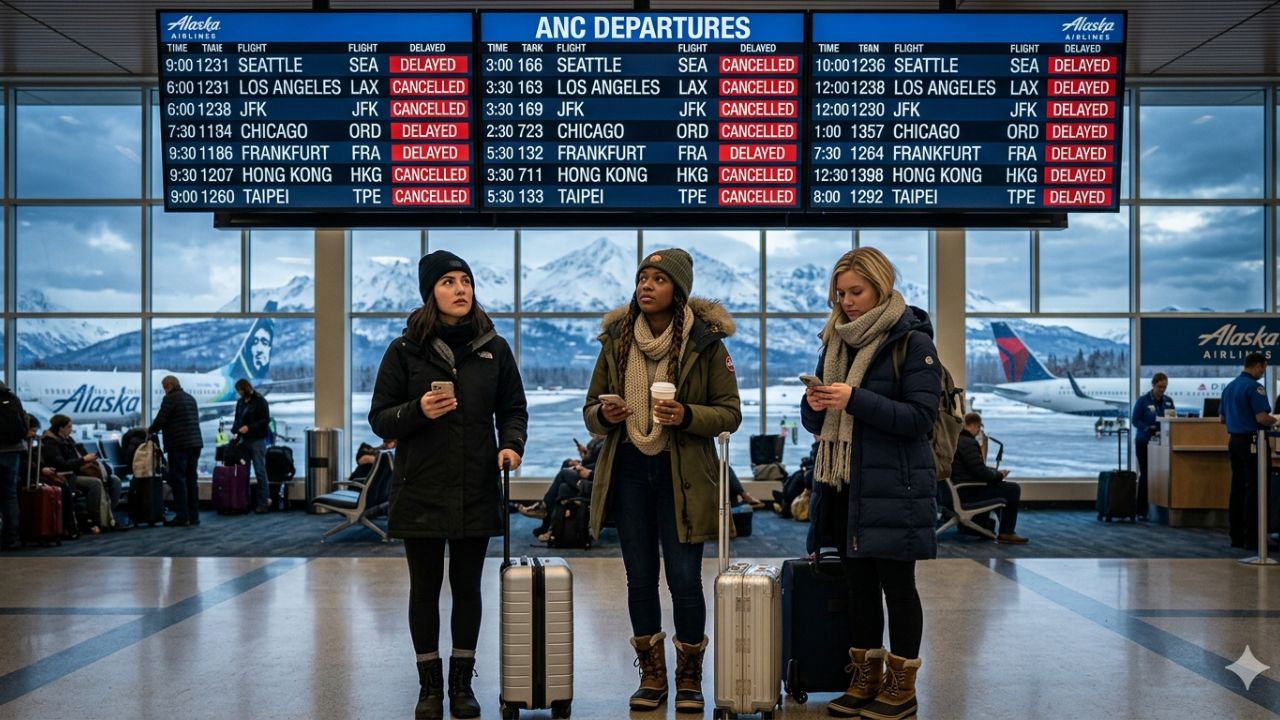
Image generated by AI
In an operational environment defined by rising mid-continent transits and highly compressed domestic turnaround times, a key aviation gateway in the American Midwest has experienced significant scheduling friction. This critical airline news update, breaking this May 17, 2026, reveals that Ted Stevens Anchorage International Airport (ANC) in Alaska is currently navigating severe scheduling pressures. A total of 47 flight delays and 5 cancellations (with initial regional operational logs flagging up to 7 cancellations) have disrupted passenger and cargo schedules. Prominent global, domestic, and regional carriers—including Alaska Airlines, Delta Air Lines, Cathay Pacific, Horizon Air, and Sterling Airways—are working feverishly to stabilize their sub-arctic rotations as localized airport disruptions sweep through the terminal, introducing moderate travel chaos for passengers bound for transpacific, transcontinental, and remote Alaskan gateways like Seattle, Los Angeles, JFK, Chicago, Frankfurt, Hong Kong, Taipei, and regional bush communities.
Breaking: Sub-Arctic Air Bridge Strained by Operational Squeezes
According to real-time status dashboards compiled from ANC airport operations and FlightAware, today's scheduling pressure represents a major logistical hurdle for Alaska’s primary aviation artery. The official logs confirm that 47 flights faced delays and 5 flights were scrubbed from the day's schedules, creating significant terminal congestion and leaving passengers caught in extended queues.
This is a vital aviation update for the 2026 sub-arctic travel corridor. Because Anchorage serves as a critical global cargo refueling hub and the ultimate lifeline connecting Alaska's isolated regional communities with the continental United States, any scheduling failure propagates rapidly across both passenger networks and international freight supply chains. By delaying flights serving key corridors like Seattle-Tacoma (SEA), Los Angeles (LAX), and Taipei Taoyuan (TPE), carriers face complex aircraft and crew repositioning issues that ripple far beyond the borders of Alaska.
Expanded Overview: The Interdependent Nature of Alaska's Air Lifeline
The operational footprint of today's delays highlights how deeply vulnerable Alaska’s unique point-to-point network is to downstream weather and scheduling shifts:
- The Hub Refueling Bottleneck: Anchorage is a premier global transit stop for heavy cargo widebodies flying between Asia and North America. Today, international cargo carriers like China Cargo and Northern Air Cargo experienced rolling delays, impacting high-value freight bound for Shanghai Pudong (PVG) and Hong Kong (HKG).
- The Bush Community Isolation: For remote Alaskan communities, air travel is not a luxury; it is the only physical link to medical care, fresh food, and mail services. Today, regional airports like Unalaska (DUT), Aniak (ANI), and Unalakleet (UNK) saw 100% of scheduled flights delayed, illustrating how a localized operational squeeze in Anchorage immediately isolates remote settlements.
- The Legacy Carrier Squeeze: Alaska Airlines bore the largest share of the operational backlog, recording 5 cancellations (4%) and 18 delays (16%) across its busy domestic regional schedules.
Section-Wise Breakdown: Evaluating the Affected Airport Operations
Ted Stevens Anchorage International Airport (ANC): Sub-Arctic Portal Under Strain
At ANC, terminal ticketing halls and security check-in gates experienced heavy passenger traffic as travelers sought rebooking assistance. Ground teams and de-icing crews worked to maintain clear gates, but a mix of regional weather shifts and crew duty-time limitations forced airlines to adjust schedules. Regional carriers like Sterling Airways faced severe operational strains, logging 5 delays (62% of their total schedule), while regional commuter carrier Horizon Air navigated 3 delays (18%).
The Mainland and International Air Bridges: Seattle and Asian Freight Corridors
The high-volume air bridge linking Anchorage to Seattle-Tacoma (SEA) was the most heavily impacted sector today. Arrivals from Seattle recorded 1 cancellation (4%) and 11 delays (50%), while outbound flights from ANC to SEA logged 1 cancellation (4%) and 1 delay (4%). On international routes, Cathay Pacific managed 5 delays (15%) on its transpacific cargo services, while German carrier Condor saw 1 delay (50%) on its long-haul seasonal service to Frankfurt (FRA), illustrating the transcontinental reach of today's bottlenecks.
The Lifeline Networks: Remote Alaskan Bush Communities Locked Down
The most critical passenger impact occurred across Alaska’s internal regional network. Commuter and bush carrier Alaska Central Express logged 4 delays (14%), while regional cargo carrier Everts Air Cargo experienced 2 delays (22%). Flights bound for regional outposts like Wiley Post-Will Rogers (BRW) in Barrow and Juneau International (JNU) each logged 1 cancellation, completely halting air service to those sectors for the afternoon and leaving remote residents searching for alternative schedules.
Flight Details: Ted Stevens Anchorage Disruption Matrix
The following tables detail the precise, uncompromised scheduled and disruption parameters recorded at Ted Stevens Anchorage International Airport on May 17, 2026.
Disruption by Operating Carrier
| Operating Carrier | Cancellations Logged | Delays Logged | Delay Percentage (%) | Strategic Market Impact |
|---|---|---|---|---|
| Alaska Airlines | 5 Cancellations | 18 Delays | 16% | Primary Domestic & Regional Trunk |
| Alaska Central Express | 0 Cancellations | 4 Delays | 14% | Regional Commuter & Cargo Lifeline |
| Delta Air Lines | 0 Cancellations | 3 Delays | 18% | Continental Hub Connection (SEA/MSP) |
| Cathay Pacific | 0 Cancellations | 5 Delays | 15% | Transpacific Cargo Refueling |
| Horizon (ASA) | 0 Cancellations | 3 Delays | 18% | Domestic Northwest Feed |
| Sterling Airways | 0 Cancellations | 5 Delays | 62% | High-Density Regional Commuter |
| United Airlines | 0 Cancellations | 1 Delay | 16% | Domestic Mountain Feed (DEN/ORD) |
| EVA Air | 0 Cancellations | 2 Delays | 11% | Asian Cargo Transits (TPE) |
| Northern Air Cargo | 0 Cancellations | 2 Delays | 20% | Intra-Alaska Freight Hubs |
| China Cargo | 0 Cancellations | 1 Delay | 25% | International Cargo Corridors |
| Condor | 0 Cancellations | 1 Delay | 50% | European Long-Haul Seasonal (FRA) |
| Everts Air Cargo | 0 Cancellations | 2 Delays | 22% | Regional Bush Freight Feed |
| Total ANC Network | 5 Cancellations | 47 Delays | — | All Domestic & Global Carrier Nodes |
Disruption by Origin Airport
| Origin Airport Hub | Cancellations Logged | Delays Logged | Delay Percentage (%) | Primary Regional Disruption |
|---|---|---|---|---|
| Seattle-Tacoma (SEA) | 1 Cancellation | 11 Delays | 50% | Pacific Northwest Connection |
| Wiley Post-Will Rogers (BRW) | 1 Cancellation | 0 Delays | 50% | Extreme Northern Arctic Lifeline |
| Juneau International (JNU) | 1 Cancellation | 0 Delays | 11% | State Capital Connection |
| Frankfurt (FRA) | 0 Cancellations | 1 Delay | 100% | European Long-Haul Corridor |
| Los Angeles (LAX) | 0 Cancellations | 1 Delay | 100% | West Coast Transcontinental |
| Hartsfield-Jackson (ATL) | 0 Cancellations | 1 Delay | 20% | Delta Southeast Connection |
| Harry Reid Intl (LAS) | 0 Cancellations | 1 Delay | 33% | West Desert Leisure Route |
| Minneapolis/St Paul (MSP) | 0 Cancellations | 1 Delay | 50% | Delta Midwest Connection |
Disruption by Outbound Destination
| Destination Outpost | Cancellations Logged | Delays Logged | Delay Percentage (%) | Critical Passenger Impact |
|---|---|---|---|---|
| Seattle-Tacoma (SEA) | 1 Cancellation | 1 Delay | 4% | Mainland Gateway Rebooking |
| JFK International (JFK) | 0 Cancellations | 1 Delay | 12% | East Coast Transcontinental |
| Chicago O'Hare (ORD) | 0 Cancellations | 1 Delay | 3% | Midwest Hub Connection |
| Adak Airport (ADK) | 0 Cancellations | 1 Delay | 33% | Remote Aleutian Island Lifeline |
| Kodiak Airport (ADQ) | 0 Cancellations | 1 Delay | 25% | Gulf of Alaska Coastal Feed |
| Unalaska Airport (DUT) | 0 Cancellations | 2 Delays | 100% | Total Aleutian Gateway Lockout |
| Aniak Airport (ANI) | 0 Cancellations | 1 Delay | 100% | Complete Kuskokwim River Isolation |
| King Salmon (AKN) | 0 Cancellations | 1 Delay | 20% | Bristol Bay Regional Transit |
| Nome Airport (OME) | 0 Cancellations | 1 Delay | 14% | Seward Peninsula Hub Feed |
| Sand Point (SDP) | 0 Cancellations | 1 Delay | 33% | Shumagin Islands Regional Transit |
| Unalakleet (UNK) | 0 Cancellations | 1 Delay | 100% | Norton Sound Total Gateway Isolation |
Passenger Impact: Navigating Alaska's Travel Challenges
For travelers caught in today's sub-arctic scheduling backlog, passenger-rights and travel specialists recommend immediate coordination:
- Antidote to Travel Chaos: Do not travel to ANC without checking your flight status via your carrier’s mobile app. Airlines push gate updates and automatic rebooking options to digital channels much faster than gate agents can handle terminal queues.
- A Lifeline for Remote Residents: If flying to isolated bush gateways like Unalaska, Aniak, or Unalakleet, coordinate closely with local air taxi operators and prepare for potential overnight delays, as regional commuter services face tight weather-related dispatch criteria.
- Allow Ample Terminal Buffer Times: ANC airport authorities recommend arriving at least two hours early for domestic flights and three hours early for international schedules to ensure a smooth transition through check-in and agricultural inspection checkpoints.
- Document Out-of-Pocket Expenses: Keep detailed records of any additional costs incurred due to flight delays or cancellations, including hotel stays, dining expenses, and missed tour excursions, which are vital for travel insurance claims.
Industry Analysis: Anchorage’s Role as a Global Refueling Stop
Aviation analysts suggest today’s sub-arctic delays demonstrate a classic "Network Interdependence" challenge:
- Global Cargo Refueling Spacing: As a critical refueling stop for widebody cargo freighters flying between Asia and North America, a delay at ANC can instantly compromise transpacific supply chains, affecting manufacturers in the US and Asia.
- Point-to-Point Fleet Utilization: Commuter and regional carriers operate tight rotations. An inbound delay from Seattle immediately cascades through subsequent bush flights scheduled throughout the afternoon, leaving remote communities isolated.
- Sub-Arctic Weather Constraints: Operating in Alaska's challenging sub-arctic airspace requires strict adherence to safety standards. De-icing procedures, wind-spacing buffers, and runway clearance operations can temporarily slow down arrival rates to ensure flight safety.
Conclusion: ANC Maintains Core Resiliency Amid Backlogs
The current state of aviation updates for May 17, 2026, confirms that while Ted Stevens Anchorage International Airport navigated significant operational pressure today, the hub’s safety systems and underlying infrastructure remain fully robust. The 47 delays and 5 cancellations represent a challenging day for Alaska’s travel and cargo sectors, but the coordinated efforts of airport authorities, regional bush pilots, and airline dispatchers are successfully managing the passenger flow. As airlines work to stabilize schedules, the primary focus remains on maintaining absolute safety and ensuring that Alaska’s vital air lifelines continue to connect the state with the world.
Key Takeaways
- The Numbers: 47 flight delays and 5 cancellations recorded at Ted Stevens Anchorage International (ANC) today.
- Key Hubs Impacted: Seattle, Los Angeles, JFK, Chicago, Frankfurt, Hong Kong, and Taipei.
- Bush Communities Isolated: Unalaska, Aniak, and Unalakleet saw 100% of scheduled flights delayed.
- Airlines Affected: Alaska Airlines (5 cancellations, 18 delays), Delta, Cathay Pacific, and Sterling Airways.
- The Cause: Sub-arctic weather adjustments, air traffic control spacing, and narrowbody fleet turnaround constraints.
- Advice: Monitor carrier mobile apps closely, check ANC advisory portals, and allow extra terminal check-in buffer times.
Related Travel Guides
Disclaimer
This article is for informational and educational purposes only. It does not constitute legal, financial, or professional advice. While we strive to provide accurate and up-to-date information, travel policies, regulations, and conditions change rapidly. Always verify information with official sources before making travel decisions. Nomad Lawyer makes no representations about the accuracy, reliability, completeness, or suitability of the information provided. Readers should consult qualified professionals for advice specific to their circumstances. The views expressed in this article are those of the author and do not necessarily reflect the views of Nomad Lawyer.
Kunal K Choudhary
Co-Founder & Contributor
A passionate traveller and tech enthusiast. Kunal contributes to the vision and growth of Nomad Lawyer, bringing fresh perspectives and driving the community forward.
Learn more about our team →