
Lufthansa 787 Executes Emergency Go-Around Over Bogotá After Near-Miss With Qatar Cargo Aircraft
Breaking airline news and aviation industry updates for 2026.

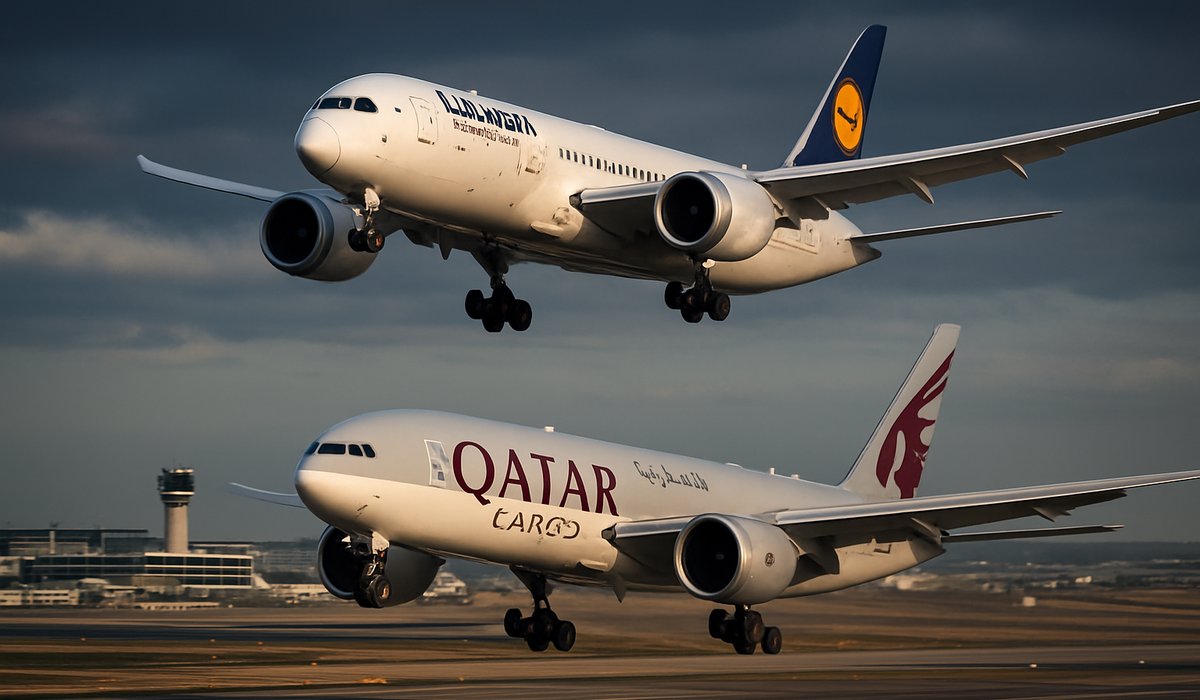
Image generated by AI
Lufthansa 787 Executes Emergency Go-Around Over Bogotá After Near-Miss With Qatar Cargo Aircraft
A separation of mere hundreds of feet triggers safety protocol as two major carrier aircraft converge on final approach
Critical Airspace Incident in South American Skies
A tense moment unfolded in Colombian airspace on Sunday, April 19, when a Lufthansa Boeing 787 Dreamliner and a Qatar Airways Cargo Boeing 777F came dangerously close to one another during simultaneous approach procedures into Bogotá's El Dorado International Airport. With vertical separation reducing to only a few hundred feet, the Lufthansa pilot initiated an immediate go-around maneuver, pulling the wide-body jet back into a holding pattern as the Qatar Cargo freighter continued its descent directly beneath the German carrier's aircraft.
How the Incident Unfolded
The close-call incident occurred as both aircraft were executing final approach sequences into one of South America's busiest aviation hubs. Traffic convergence during peak landing windows has become an increasingly complex challenge at major international airports, particularly as post-pandemic travel recovery continues to strain air traffic control systems across the region.
The Lufthansa 787, likely operating a scheduled passenger service from Europe, was forced to abort its landing sequence and climb to a safer altitude when air traffic control detected the dangerous spatial proximity to the Qatar Airways freighter. The separation margin—described as "just a few hundred feet"—falls well within aircraft detection thresholds but raises critical questions about procedural adherence and radar spacing protocols.
Rising Safety Concerns in Global Aviation
This incident underscores persistent vulnerabilities in air traffic management systems, particularly at major South American airports that handle simultaneous operations from international carriers. While modern aircraft are equipped with Traffic Collision Avoidance Systems (TCAS) designed to prevent such encounters, the incident highlights the importance of ground-based radar separation standards and controller coordination.
Neither the Lufthansa nor Qatar Airways Cargo aircraft reported injuries or structural damage. The Lufthansa 787 successfully executed its approach on a subsequent attempt. However, the event adds to a growing registry of close-call incidents at major international airports, prompting aviation authorities to evaluate procedural gaps.
Industry-Wide Implications
The encounter reflects broader operational pressures facing global aviation as airline networks expand and cargo operations intensify. Qatar Airways Cargo has significantly increased freight movements through South American hubs, capitalizing on surging demand for air cargo services. Meanwhile, Lufthansa continues aggressive scheduling across its international route network.
Air traffic control authorities in Colombia have not yet issued formal statements regarding the incident, though aviation safety organizations monitor such occurrences closely to identify systemic improvements needed across Latin American airspace.
Frequently Asked Questions
What causes near-miss incidents between commercial aircraft? Near-misses typically result from air traffic control separation errors, pilot deviations, or equipment malfunctions. Bogotá's busy airspace, combined with simultaneous approach procedures, can strain coordination between multiple aircraft.
How do TCAS systems prevent aircraft collisions? Traffic Collision Avoidance Systems use radar and transponder signals to detect nearby aircraft and automatically alert pilots or command evasive maneuvers when separation minimums are breached.
Is the Boeing 787 Dreamliner considered safe for long-haul operations? Yes, the 787 is one of aviation's most advanced wide-body aircraft with multiple redundant safety systems, though no aircraft is immune to procedural or control tower errors.
How frequently do go-around maneuvers occur in commercial aviation? Go-arounds are routine procedures executed several times daily at major airports for weather, traffic, or spacing reasons. Emergency go-arounds due to safety threats are less common but not unprecedented.
What protocols exist to prevent simultaneous approach conflicts? Air traffic control maintains strict vertical, horizontal, and longitudinal separation standards, with radar monitoring and radio coordination ensuring safe spacing between arriving aircraft at all times.
Related Travel Guides
Flight Delay Compensation Guide 2026
Understanding Airline Route Changes
Airport Security Process Updated (2026)
External Resources
Disclaimer
This article is for informational and educational purposes only. It does not constitute legal, financial, or professional advice. While we strive to provide accurate and up-to-date information, travel policies, regulations, and conditions change rapidly. Always verify information with official sources before making travel decisions. Nomad Lawyer makes no representations about the accuracy, reliability, completeness, or suitability of the information provided. Readers should consult qualified professionals for advice specific to their circumstances. The views expressed in this article are those of the author and do not necessarily reflect the views of Nomad Lawyer.
Raushan Kumar
Founder & Lead Developer
Full-stack developer with 11+ years of experience and a passionate traveller. Raushan built Nomad Lawyer from the ground up with a vision to create the best travel and law experience on the web.
Learn more about our team →