
Wildfire Strands Amtrak Silver Meteor for 20+ Hours in North Florida
In April 2026, a fast-moving wildfire in north Florida stranded hundreds of Amtrak Silver Meteor passengers for over 20 hours. The incident underscores how climate-driven fires increasingly disrupt long-distance rail service across vulnerable transportation corridors.

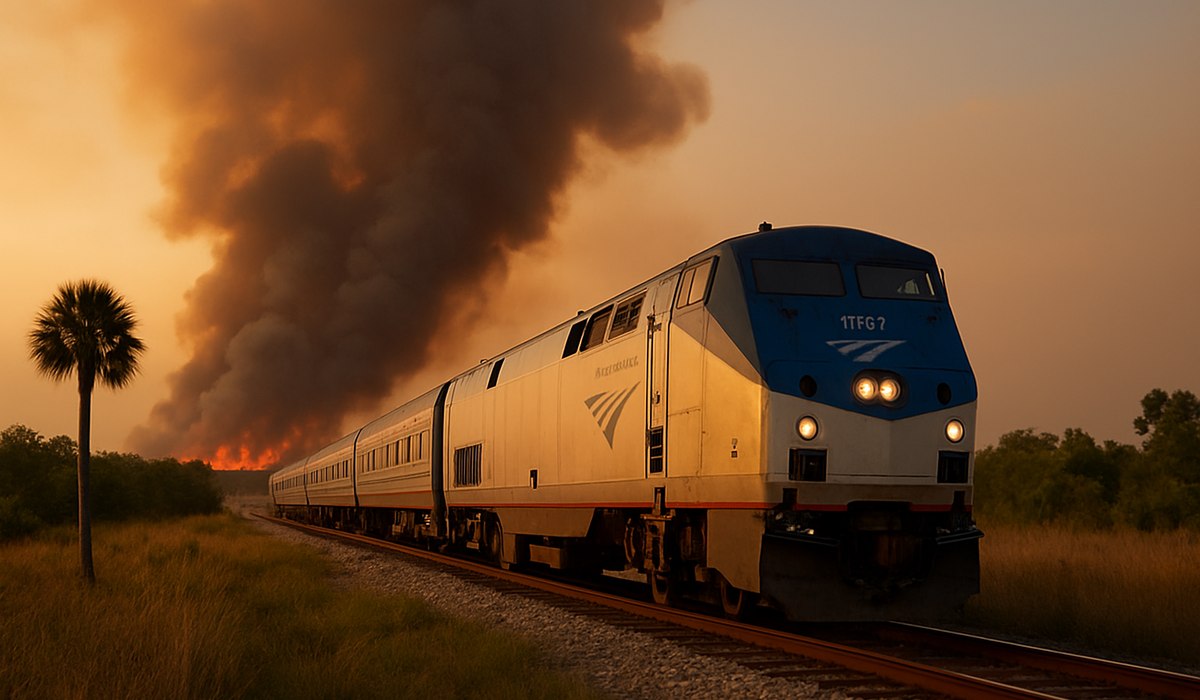
Image generated by AI
Wildfire Strands Amtrak Silver Meteor Across North Florida
Hundreds of passengers aboard Amtrak's Silver Meteor experienced an unprecedented 20-hour stranding in north Florida during late April 2026 after a fast-moving wildfire forced the iconic New York–Miami rail service to halt. The Railroad Fire, which scorched over 4,000 acres across Clay and Putnam counties, burned dangerously close to the Silver Meteor's main rail corridor, triggering immediate service suspensions and operational slowdowns throughout the region. The incident demonstrates how climate-driven wildfires now pose a genuine threat to long-distance passenger rail networks, particularly in drought-stricken areas where fuel loads remain high and fire behavior becomes increasingly unpredictable. Passengers faced extended delays, limited onboard supplies, and unclear communication about when service would resume—exposing critical gaps in emergency protocols for extreme weather disruptions.
Railroad Fire Halts Silver Meteor Service Across North Florida
The Railroad Fire erupted over the weekend and rapidly expanded along the border between Clay and Putnam counties, an area where the Silver Meteor's north-south corridor closely parallels active wildfire zones. State wildfire tracking systems documented the blaze growing to more than 4,000 acres within days, prompting immediate rail closures and mandatory operational slowdowns. Smoke, shifting wind patterns, and ongoing firefighting operations made conditions unsafe for train traffic, forcing Amtrak dispatchers to order the Silver Meteor to halt on or near the main line.
The stranded train remained immobilized for much of a full day and night as crews monitored fire behavior and rail managers assessed options for safely moving equipment and passengers. Containment efforts continued through midweek, with fire managers reporting higher containment percentages but acknowledging persistent hot spots near critical transportation corridors. This operational pause represented one of the longest single-incident rail disruptions in recent Florida history, amplifying concerns about how long-distance rail infrastructure remains vulnerable to climate-related disasters. For real-time updates on Amtrak service status and route information, travelers should consult the operator's official website before booking trips through fire-prone regions.
How Wildfires Are Disrupting Long-Distance Rail Travel
Extreme drought conditions across the American Southeast have created perfect conditions for rapid wildfire propagation, and rail corridors—often running through rural, densely vegetated areas—sit directly in harm's way. Unlike highways, which offer emergency vehicles multiple alternate routes, rail lines follow fixed right-of-way easements that cannot be quickly rerouted. When wildfires approach or cross these corridors, dispatchers face limited options: halt trains immediately to avoid smoke inhalation and equipment damage, or attempt dangerous transit through active fire zones.
The Silver Meteor incident reveals how climate change compounds operational challenges for heritage rail services that depend on predictable schedules. Long-distance trains carry 200–300+ passengers per consist, and stranding that many travelers without adequate contingency supplies, communication protocols, or nearby alternatives creates humanitarian and logistical crises. Amtrak's onboard inventory of food, water, and restroom capacity is designed for normal operations—not multi-hour emergency halts in remote track sections far from stations or resupply points. Industry analysts warn that as wildfire seasons intensify and extend, rail operators must invest in enhanced emergency protocols, real-time fire monitoring integration, and pre-positioned supply caches along vulnerable corridors.
Amtrak's Response and Operational Adjustments
In response to the cascading disruptions caused by wildfire strands affecting Amtrak service, the company implemented network-wide schedule modifications to limit passenger exposure to the worst-affected north Florida zones. The Auto Train service between Sanford (near Orlando) and Lorton, Virginia, was temporarily canceled, while certain Silver Meteor trips were truncated to originate or terminate in Jacksonville rather than Miami or Fort Lauderdale. The Miami-to-Chicago Amtrak service was also rerouted to begin and end at stations farther north, reducing operational risk during peak fire conditions.
Amtrak deployed replacement motor coach service on highway segments where track closures persisted but road infrastructure remained passable. These ad-hoc bus substitutions, while logistically complex, allowed passengers to maintain connectivity between major population centers without waiting for rail infrastructure to reopen. However, motorcoach travel introduces additional delays, passenger discomfort on longer routes, and increased operational costs. Amtrak's crisis response highlighted both the flexibility of modern rail networks and their inherent fragility when climate disasters disrupt core infrastructure. Passengers planning Florida rail travel should check Amtrak's official service advisories and consider purchasing flexible tickets that permit date changes at no penalty.
Climate Change and Transportation Infrastructure Vulnerability
The 2026 wildfire strands affecting Amtrak represent a canary-in-the-coal-mine warning for rail operators, transportation planners, and climate policy advocates. Rising temperatures extend fire seasons and amplify drought severity, transforming seasonal fire risk into year-round operational liability. Rail corridors, which serve as critical transportation arteries for passenger and freight movement, increasingly face disruption from climate-driven hazards—wildfires in the South and Southwest, flooding in river valleys, and extreme heat that buckles tracks.
Long-distance rail services like the Silver Meteor depend on reliable, predictable schedules to justify ridership and compete with air and automotive travel. When wildfire strands delay trains for 20+ hours, passengers lose confidence in rail reliability and revert to carbon-intensive alternatives. This creates a perverse feedback loop: climate change increases wildfire frequency, wildfire disruptions undermine rail ridership, reduced ridership undermines investment in climate-resilient rail infrastructure, and transportation emissions continue rising.
Transportation infrastructure investment must now prioritize climate adaptation alongside capacity expansion. This includes fuel-reduction programs along rail corridors, real-time fire detection systems linked to automated dispatch protocols, hardened communication networks that function during power outages, and pre-positioned emergency supplies at strategic locations. Forward-thinking rail operators are also exploring alternative routing options and speed management strategies that allow safe transit through regions experiencing active fire activity. The Trainline and similar booking platforms can help passengers research service reliability and check real-time status before purchasing tickets on climate-vulnerable routes.
Passenger Experience: What Travelers Faced During the Stranding
Accounts from stranded passengers reveal significant gaps in onboard emergency preparedness. Social media posts and passenger forums documented shortages of food and bottled water as the 20-hour delay extended well beyond original timetables. Restroom capacity—designed for normal eight- to fourteen-hour journeys—became severely strained. Multiple travelers reported deteriorating air quality inside passenger cars as wildfire smoke from nearby burning zones drifted across the immobilized consist.
Train crews, while professionally trained for routine mechanical delays and minor schedule disruptions, struggled to manage an extended emergency halt in a semi-rural track section far from resupply stations or major towns. The difficulty of delivering supplies to a stopped train that cannot reach a platform—especially when nearby roads were congested with emergency vehicles responding to active firefighting—exposed painful operational realities. Passengers juggling tight connections, work obligations, and medical needs faced hours of vague communication about when the train might resume movement, forcing them to improvise by arranging ride-share rides or private pickups at accessible road crossings.
A small number of travelers ultimately abandoned the train at intermediate locations and completed their journeys via motorcoach or personal vehicle. While most passengers remained onboard until the route partially reopened and service resumed north toward Jacksonville and beyond, the experience reinforced how vulnerable long-distance rail passengers become when infrastructure fails under extreme weather stress.
Key Data Table: The Wildfire Strands
Disclaimer
This article is for informational and educational purposes only. It does not constitute legal, financial, or professional advice. While we strive to provide accurate and up-to-date information, travel policies, regulations, and conditions change rapidly. Always verify information with official sources before making travel decisions. Nomad Lawyer makes no representations about the accuracy, reliability, completeness, or suitability of the information provided. Readers should consult qualified professionals for advice specific to their circumstances. The views expressed in this article are those of the author and do not necessarily reflect the views of Nomad Lawyer.
Raushan Kumar
Founder & Lead Developer
Full-stack developer with 11+ years of experience and a passionate traveller. Raushan built Nomad Lawyer from the ground up with a vision to create the best travel and law experience on the web.
Learn more about our team →