
Trump Signs EO 14415 Mandating 'Inaccuracy' Signage at National Museum of American History 2026
President Trump has issued Executive Order 14415, requiring the Department of the Interior to install signage labeling exhibits at the National Museum of American History as inaccurate.

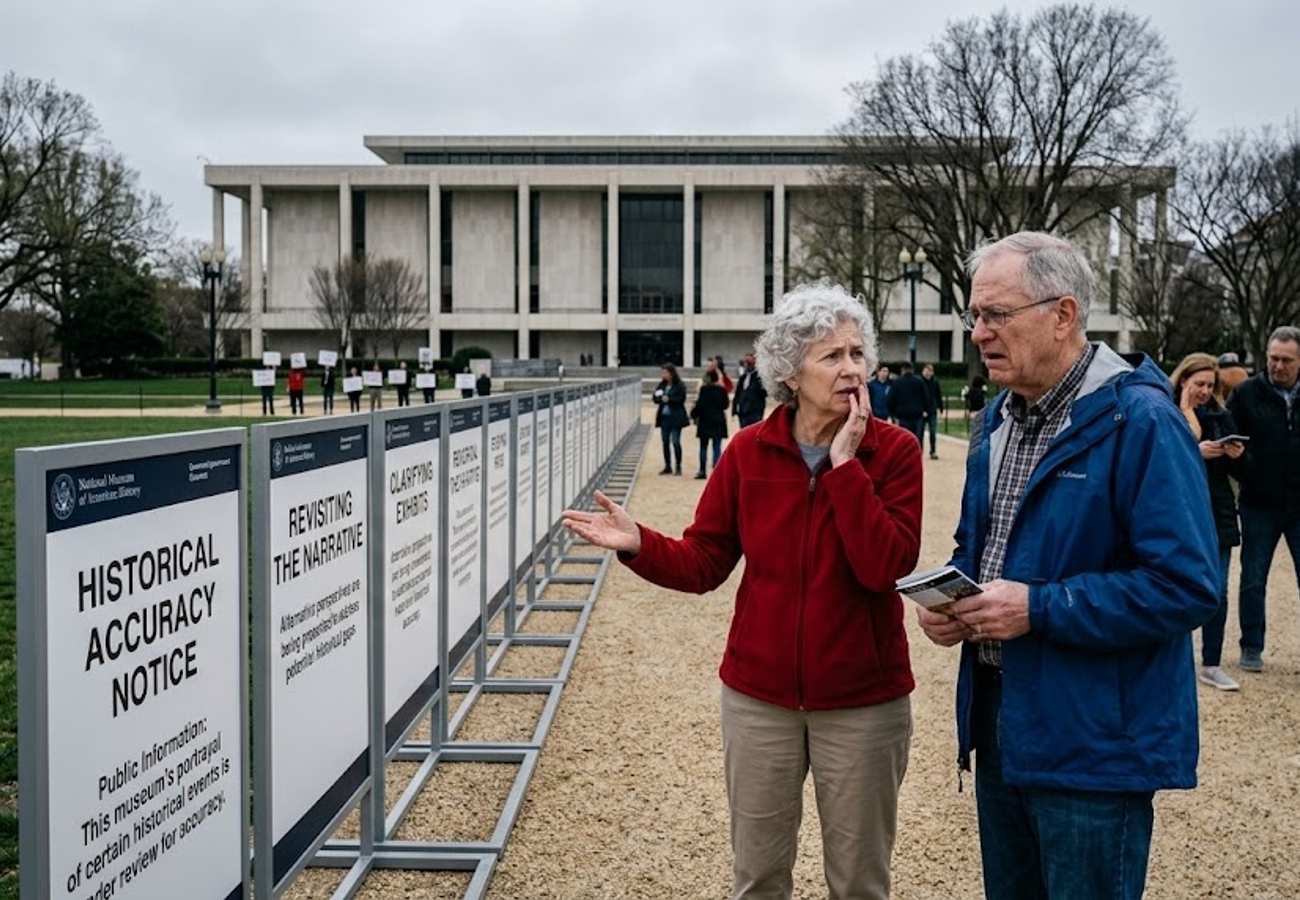
Image generated by AI
Visitors to the National Mall will soon encounter government-mandated signage challenging the historical accuracy of the Smithsonian National Museum of American History. This directive follows a series of federal investigations into the institution's curatorial framework.
The Disruption Details
President Trump has signed Executive Order 14415, titled "Restoring Trust in the Smithsonian Institution." The order mandates the installation of temporary exhibits and signage on public walkways and sidewalks leading to the National Museum of American History. These signs are designed to decry the museum's current programming and label specific exhibits as "inaccurate."
The move follows a 160-page report by the Domestic Policy Council titled "Saving America’s Story: How Ideological Capture at the Smithsonian Institution’s National Museum of American History Erases Our Heritage." This report alleged that the museum adopted an ideological framework that fails to treat American history as a shared national inheritance.
Flight & Airport Impact Breakdown
While this is a ground-based administrative disruption rather than an aviation event, it impacts the tourism infrastructure of the U.S. capital:
- Affected Location: The National Mall, Washington, D.C.
- Managing Agency: The Department of the Interior (DOI) and the National Park Service (NPS).
- Specific Target: Walkways and sidewalks surrounding the National Museum of American History.
- Financial Impact: Installation costs are borne by the DOI, amidst a period where NPS funds have been redirected to "Freedom 250" and reflecting pool rehabilitation.
- Timeline: No specific deadline for installation was detailed in the order; the DOI will determine the schedule.
Passenger & Visitor Advisory
For the traveler visiting Washington D.C., this means the physical environment surrounding the Smithsonian may now include political commentary and "corrective" signage provided by the federal government.
Our analysis of the current legal standing suggests the following for visitors:
- Exhibit Content: Despite the outdoor signage, the internal exhibits remain unchanged. Because the Smithsonian is managed by a private Board of Regents and directorial staff, the executive branch currently lacks the authority to censor the actual contents inside the building.
- Visitor Experience: Expect potential crowds or protests around the National Mall walkways as these signs are installed.
- Navigational Changes: Be aware that the DOI may implement "temporary exhibits" on the sidewalks, which could alter standard pedestrian flow toward the museum entrance.
Industry Analyst View
This development highlights a unique jurisdictional conflict. While the White House controls the National Park Service (which manages the land the museum sits on), it does not control the Smithsonian Institution itself.
The administration is utilizing "peripheral censorship"—influencing the visitor's mindset before they enter the building—since it cannot legally dictate the internal curation. This creates a fragmented visitor experience where the "official" government narrative on the sidewalk contradicts the "curated" historical narrative inside the museum.
The broader trend indicates a shift toward using federal land management as a tool for cultural signaling, which may lead to increased volatility and unpredictable site management at other National Park Service-managed landmarks.
The intersection of federal land policy and private curation continues to reshape the American tourist experience.
Related Travel Guides
Disclaimer
This article is for informational and educational purposes only. It does not constitute legal, financial, or professional advice. While we strive to provide accurate and up-to-date information, travel policies, regulations, and conditions change rapidly. Always verify information with official sources before making travel decisions. Nomad Lawyer makes no representations about the accuracy, reliability, completeness, or suitability of the information provided. Readers should consult qualified professionals for advice specific to their circumstances. The views expressed in this article are those of the author and do not necessarily reflect the views of Nomad Lawyer.
Preeti Gunjan
Contributor & Community Manager
A passionate traveller and community builder. Preeti helps grow the Nomad Lawyer community, fostering engagement and bringing the reader experience to life.
Learn more about our team →