
Western Fighter Jets Get Extended Service Life Through 2026 with Advanced Upgrades
Decades-old Western fighter jets including the Eurofighter Typhoon receive unexpected lifecycle extensions and next-generation sensor upgrades in 2026, keeping aging aircraft operational across NATO air forces and reshaping military aviation timelines.

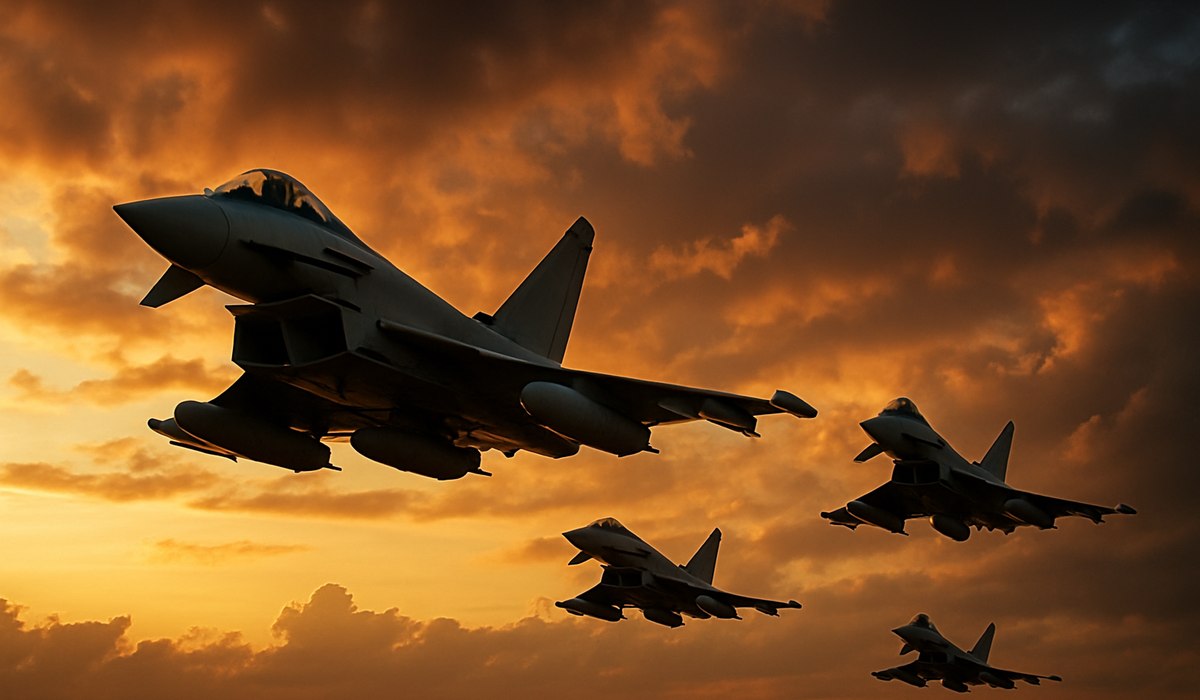
Image generated by AI
Four Decades of Service: Western Fighter Jets Defy Retirement Expectations
Western military aviation reached an unexpected inflection point in 2026 as the Eurofighter Typhoon, F-15, F-16, and F/A-18 Super Hornet—aircraft designed between the 1970s and 1990s—secured extended operational lifespans through modernization initiatives. What began as temporary stopgaps evolved into permanent doctrine shifts across NATO member states, fundamentally altering predictions about fighter aircraft retirement timelines. These airframes, originally expected to exit service decades ago, now carry sensor suites and targeting systems their original designers never anticipated.
The crossroads facing Western air forces reflects both budget constraints and geopolitical realities. Rather than retiring legacy platforms, military planners accelerated upgrade programs to keep proven airframes operational through 2026 and potentially beyond. This strategy affects civil aviation corridors, airspace management protocols, and military training operations that share European and Middle Eastern skies with commercial traffic.
Legacy Fighter Jets Face Unexpected Extended Service Life
The Eurofighter Typhoon fighter jet comparison reveals a surprising narrative: a platform introduced to the RAF in 2003 now operates alongside much older F-16s that first flew in 1974. This generational overlap creates unique operational and logistical challenges. The RAF's Typhoon fleet received Phase 3 Enhancement upgrades in 2025-2026, adding advanced radar capabilities and electronic warfare systems originally scheduled for retirement-era platforms.
F-16 operators across seventeen nations chose continued modernization over planned replacement programs. The Block 70/72 variants represent the latest iteration, yet even these newer F-16s compete with newly-upgraded Eurofighter units for training sorties and operational missions. Germany's Luftwaffe initiated the Typhoon ECR (Electronic Combat and Reconnaissance) variant modernization, extending operational life well into the 2030s. Belgium and the Netherlands similarly committed to Typhoon upgrades rather than immediate retirement pathways.
The economic calculus proved compelling. A complete fighter jet replacement program costs 60-80 billion euros across a typical NATO member's service life. Upgrading existing airframes costs 15-25 percent of that total while maintaining immediate operational capability. This fiscal reality transformed military aviation procurement decisions across the continent.
Eurofighter Typhoon Specifications and Upgraded Capabilities
The Eurofighter Typhoon entered service as a multi-role combat aircraft with a maximum speed of Mach 2.0+ and operational range exceeding 2,000 kilometers. The 2026 upgrade cycle introduced the Captor-E active electronically scanned array radar, dramatically expanding surveillance and targeting capabilities from the earlier Captor mechanically scanned variant. These sensor improvements allow real-time data sharing across NATO air defense networks through standardized Link 16 protocols.
Current Typhoon configurations carry nine external hardpoints supporting air-to-air missiles, air-to-ground ordnance, electronic warfare pods, and reconnaissance packages. The aircraft's thrust-vectoring Eurojet EJ200 engines remain competitive with contemporary powerplants, maintaining sustained turn rates that advantage the platform in contested airspace scenarios. Internal fuel capacity of 4,750 kilograms supports extended patrol missions without mid-flight refueling, a critical advantage for Baltic air policing operations that require rapid response to unannounced incursions.
The 2026-era Typhoon represents a capability jump compared to earlier variants. Enhanced infrared search and track systems, improved helmet-mounted cueing systems, and integration with next-generation air-to-air missiles create a platform substantially more capable than the aircraft that first entered RAF service two decades earlier. These upgrades cost approximately 8-12 million euros per aircraft yet extend service life by 15-20 years.
Comparative Analysis: Typhoon Versus F-15, F-16, and F/A-18
The F-15 Strike Eagle, continuously upgraded since the 1970s, remains the most advanced air-to-air platform in Western arsenals. Its twin engines and superior altitude performance provide strategic advantages in certain scenarios, yet higher operating costs and maintenance demands drive some operators toward the more economical F-16 platform. The F-15EX variant, introduced to the U.S. Air Force in 2023, represents the first genuinely new-build F-15 in decades, directly competing with Eurofighter and Typhoon upgrade pathways.
The aircraft performance comparison reveals nuanced tradeoffs. The F-16's smaller footprint, lower acquisition cost (approximately 60-80 million dollars per unit), and global training ecosystem make it the world's most numerous modern fighter. Seventeen NATO members operate F-16s, creating unmatched pilot training compatibility and spare parts availability. However, the F-16's single engine and more limited growth potential compared to multi-role platforms affect long-term strategic planning.
The F/A-18 Super Hornet bridges tactical and strategic missions through modular design philosophy. Boeing's Block III upgrade program extends Super Hornet viability through the 2040s, effectively competing with Typhoon and Gripen platforms for export markets and service life extension contracts. Australia, Canada, and Finland increasingly view Super Hornet upgrades as viable alternatives to Eurofighter procurement, influencing NATO standardization discussions.
Speed, range, and payload capacity favor the Eurofighter and F-15 across most metrics. However, aircraft performance in contested electromagnetic environments increasingly depends on sensor fusion, network integration, and electronic warfare capabilities rather than raw speed specifications. The 2026 upgrade cycle emphasized these asymmetric advantages, allocating resources toward software, sensors, and networking rather than engine performance improvements.
Modern Upgrades and Contemporary Deployment Missions
The 2025-2026 upgrade cycle fundamentally transformed how Western air forces deploy legacy fighters. Baltic air policing missions, historically resource-intensive quick-reaction commitments, evolved into routine operations as upgraded Typhoons and F-16s seamlessly integrated with NATO air defense networks. The RAF's Cyprus-based Typhoon detachment now coordinates directly with Polish, Lithuanian, and Estonian ground-based radar systems through modern Link 16 architecture.
Red Sea operations, escalating sharply after 2023, demonstrated unexpected operational relevance for platforms designed for Cold War scenarios. Upgraded F/A-18 Super Hornets and newly-modified F-16s successfully conducted sustained strike operations alongside modern Super Hornets and carrier-based assets. The mission profile—extended loiter times, precision targeting against maritime threats, and coordinated defense suppression—favored aircraft with recent avionics modifications.
Electronic warfare capabilities received disproportionate attention in 2026-era upgrade programs. Integrated electronic warfare pods, advanced countermeasure dispensers, and software-defined radio systems transformed aircraft vulnerability profiles. The Eurofighter Typhoon equipped with upgraded DASS (Defensive Aids Sub-System) packages achieved near-parity with dedicated electronic warfare platforms in certain contested environments.
Pilot training pipelines adapted to accommodate the unexpected service life extensions. Advanced simulators for upgraded F-16 and Typhoon variants entered service across NATO, with virtual reality integration accelerating proficiency timelines. The shift toward older airframes with newer avionics created unique training demands, as experienced pilots adapted to revised sensor interfaces while newer pilots learned on unfamiliar platforms.
Impact on Air Traffic and Civilian Aviation
Military aviation operations directly affect civilian airspace efficiency and commercial routing. Extended fighter operations in European corridors occasionally require civilian air traffic rerouting, adding flight time and fuel consumption to commercial operations. However, the predictability introduced by formalized 2026 operating agreements between NATO air forces and Eurocontrol mitigated disruption compared to previous years.
Noise pollution concerns intensified around military bases hosting upgraded fighters. The Eurofighter's higher thrust-to-weight ratio generates sustained sound levels exceeding 100 decibels during combat training sorties. Communities surrounding RAF
Disclaimer
This article is for informational and educational purposes only. It does not constitute legal, financial, or professional advice. While we strive to provide accurate and up-to-date information, travel policies, regulations, and conditions change rapidly. Always verify information with official sources before making travel decisions. Nomad Lawyer makes no representations about the accuracy, reliability, completeness, or suitability of the information provided. Readers should consult qualified professionals for advice specific to their circumstances. The views expressed in this article are those of the author and do not necessarily reflect the views of Nomad Lawyer.
Kunal K Choudhary
Co-Founder & Contributor
A passionate traveller and tech enthusiast. Kunal contributes to the vision and growth of Nomad Lawyer, bringing fresh perspectives and driving the community forward.
Learn more about our team →