
Water Shortages Hit Barbados and the Rest of the Caribbean Countries During Peak Tourism Demand Prompting Visitor Caution
Water Shortages Hit Barbados and the Rest of the Caribbean Countries During Peak Tourism Demand Prompting Visitor Caution

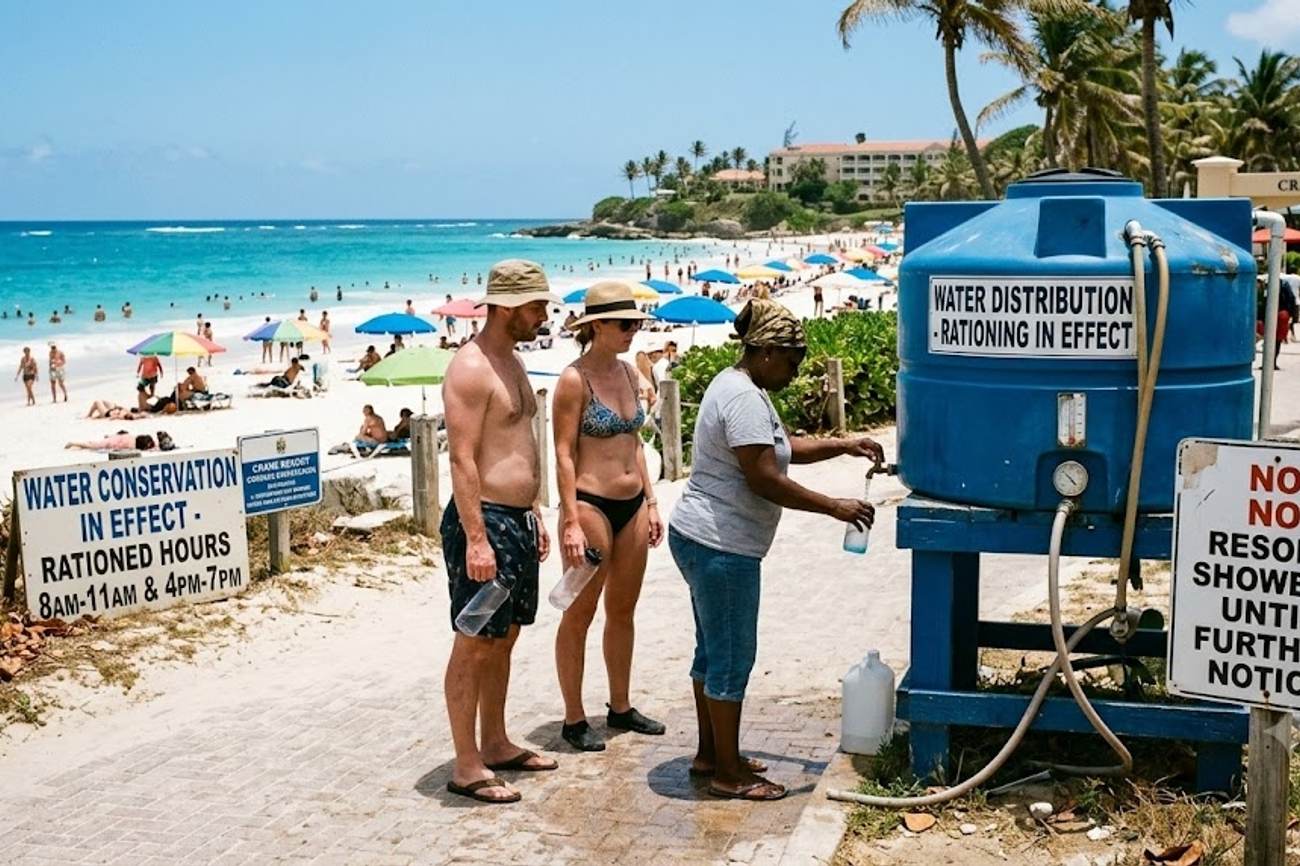
Image generated by AI
[Bridgetown, October 2023] — Multiple Caribbean nations are issuing urgent water conservation warnings and disaster declarations as prolonged drought and climate variability strain freshwater infrastructure across the region.
Government authorities in Barbados, Jamaica, Trinidad and Tobago, and several other island territories report that reduced rainfall and surging demand during peak tourism windows are pushing reservoirs to critical lows. The crisis is forcing a shift in how the region manages its most vital resource, with official guidance now urging international travelers to verify water security with their accommodation providers before departing for the region.
Climate and Infrastructure Failure
The current crisis is triggered by a combination of prolonged dry seasons and an inability of existing infrastructure to keep pace with population growth and tourism spikes. While some islands rely on natural rainfall, others are heavily dependent on desalination plants that are under increasing pressure.
The Government of Barbados and other regional bodies indicate that the volatility of rainfall patterns—driven by broader climate variability—has made traditional water management obsolete. This has led to a cycle of disaster declarations where governments must implement emergency supply measures to prevent total system collapse in both residential and commercial sectors.
Regional Impact Assessment
The severity of the water shortage varies by geography, with rural areas and smaller islands facing higher risks than major urban hubs or luxury resorts with private desalination systems.
| Destination | Primary Driver | Government Response | Tourism Risk Level |
|---|---|---|---|
| Barbados | Rainfall variability | Public restrictions & awareness campaigns | Moderate (Resorts have contingencies) |
| Jamaica | Prolonged dry periods | Drought monitoring & emergency supplies | Variable (High in specific parishes) |
| Trinidad & Tobago | Reservoir depletion | Conservation advisories & restrictions | Moderate (Urban centers prioritized) |
| Saint Lucia | Seasonal drought | Public advisories & supply management | Moderate (Intermittent disruptions) |
| Grenada | Seasonal pressure | Resource monitoring & conservation | High for rural/small providers |
| Dominica | Dry spells | Conservation guidance | Low to Moderate (Eco-lodges at risk) |
| Antigua & Barbuda | Limited natural water | Supply scheduling & desalination focus | Variable (High reliance on private systems) |
| St. Vincent & Grenadines | Extended dry seasons | Monitoring & conservation notices | High for outer islands |
| The Bahamas | Geography & growth | Resource management & guidance | Variable by island |
| Curaçao | Arid climate | Public conservation campaigns | Low to Moderate |
Practical Traveler Advisory and Strategic Insights
For the average tourist, these warnings do not necessarily mean a cancellation of travel plans, but they do signal a change in the expected luxury experience. Travelers should expect "conservation mode" to be the standard across the Caribbean.
Immediate Passenger Impact:
- Accommodation Verification: You can no longer assume a hotel has a guaranteed 24/7 water supply. Guests must explicitly ask if their hotel or villa has backup storage tanks or independent desalination plants.
- Service Reductions: High-water-usage amenities—such as oversized soaking tubs, laundry services, and expansive swimming pool refills—may be restricted or suspended during peak shortage periods.
- Behavioral Shifts: Visitors are expected to adhere to local conservation rules. This includes shorter showers and reduced water usage in villas.
- Location Risk: Those booking eco-lodges in Dominica or remote rentals in the Grenadines face a higher probability of total water outages compared to those staying in major resort complexes.
Travelers are encouraged to consult the Jamaica Tourist Board or the Barbados Tourism Marketing Inc. for real-time updates on regional conditions.
Resource Management Timeline
Moving forward, Caribbean nations are shifting toward a permanent model of "responsible tourism." This involves integrating water-saving technology into hotel infrastructure and implementing stricter regulations on water-intensive developments.
In the short term, the National Water Commission of Jamaica and the Water and Sewerage Authority (WASA) in Trinidad and Tobago will continue to monitor reservoir levels. If rainfall does not increase during the next expected wet season, further restrictions on non-essential water use—including the filling of private pools—are likely to be mandated by law across several territories.
The long-term strategy involves a regional push toward increased desalination capacity and the modernization of aging pipe networks to reduce "non-revenue water" (water lost to leaks), which currently exacerbates the shortage during drought emergencies.
FAQ: Caribbean Water Crisis 2023
Do I need to bring my own bottled water? While hotels generally provide drinking water, travelers visiting rural areas or smaller islands (like the Grenadines) should carry a supply of bottled water or a high-quality filtration system to ensure safety during supply interruptions.
Will this affect my hotel booking or flight? Water shortages rarely trigger flight cancellations. However, some smaller guesthouses or Airbnbs may struggle to maintain services. Always confirm "water reliability" with your host before paying a non-refundable deposit.
Are the beaches and pools still open? Yes, but pool maintenance may be reduced. Some resorts may limit the frequency of pool cleaning or restrict the use of water-heavy water sports to preserve freshwater for drinking and sanitation.
Which islands are most at risk right now? Antigua and Barbuda, and the smaller islands of Saint Vincent and the Grenadines, face the highest inherent risk due to limited natural freshwater sources and a heavy reliance on desalination.
Travelers are urged to prioritize sustainability over luxury as the Caribbean navigates this environmental crisis.
Related Travel Guides
- Oshima Joins Chiba and More as Typhoon Dujuan Unleashes a Powerful Rain and Travel Crisis Across Japan
- Niagara Falls Travel Revolution Begins as New Aerial Experience Adds Stunning Views Above The Falls
- USA Autumn Travel Upgrade As Tacoma Pierce County Introduces A Three Day Family Adventure Experience
Disclaimer
This article is for informational and educational purposes only. It does not constitute legal, financial, or professional advice. While we strive to provide accurate and up-to-date information, travel policies, regulations, and conditions change rapidly. Always verify information with official sources before making travel decisions. Nomad Lawyer makes no representations about the accuracy, reliability, completeness, or suitability of the information provided. Readers should consult qualified professionals for advice specific to their circumstances. The views expressed in this article are those of the author and do not necessarily reflect the views of Nomad Lawyer.
Raushan Kumar
Founder & Lead Developer
Full-stack developer with 11+ years of experience and a passionate traveller. Raushan built Nomad Lawyer from the ground up with a vision to create the best travel and law experience on the web.
Learn more about our team →