
Uzbekistan Opens Historic China-to-Iran Rail Corridor Reducing Transit to 14 Days in 2026
Uzbekistan has launched a landmark 6,000-kilometre rail gateway connecting China to Iran, slashing delivery times to 14–16 days and establishing a strategic Eurasian land bridge for international freight.

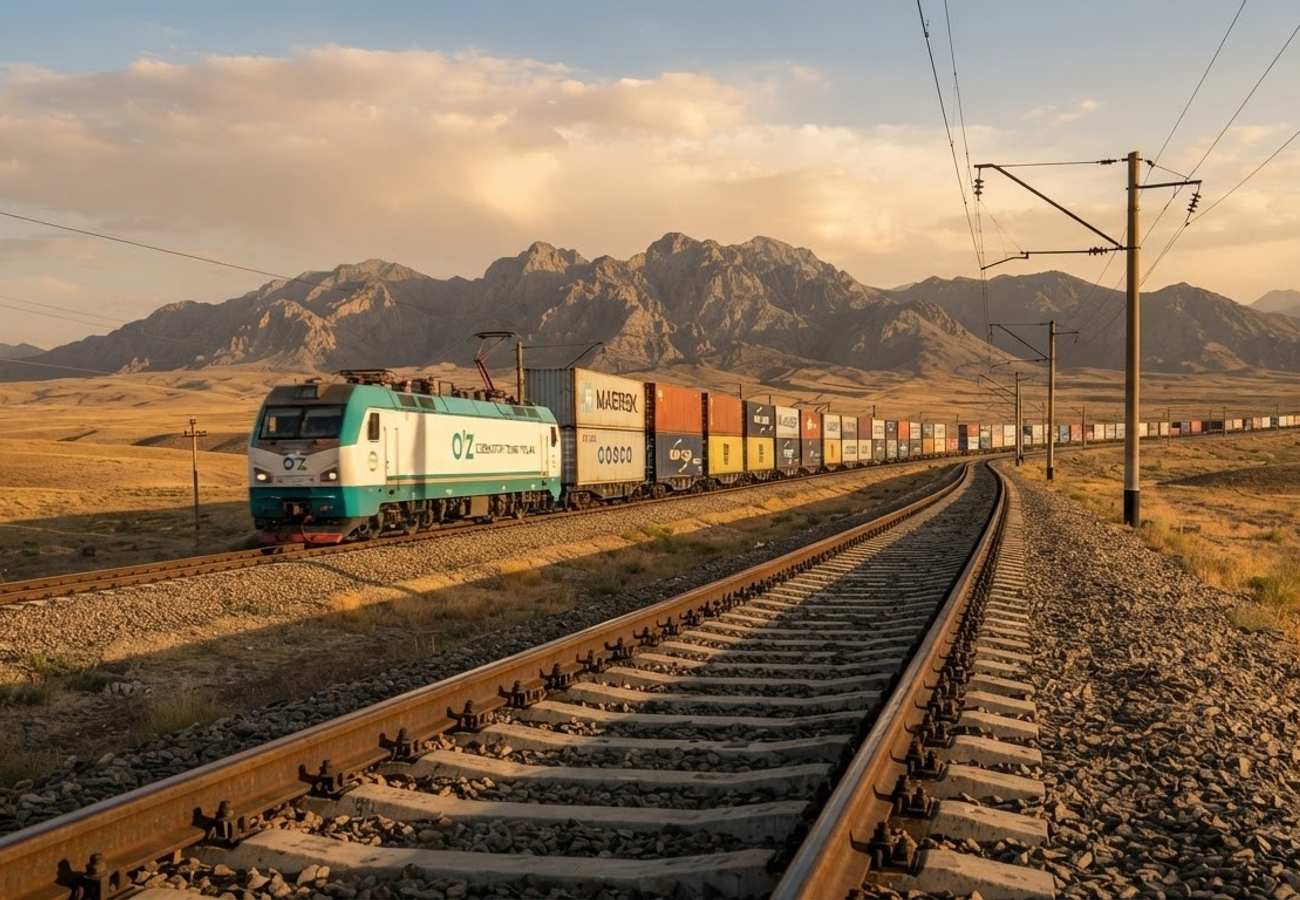
Image generated by AI
[Tashkent, September 13, 2026] — Uzbekistan has officially activated a transformative Eurasian rail gateway with the passage of the first block train running from China to Iran. This new 6,000-kilometre freight corridor is designed to bypass traditional maritime bottlenecks, reducing door-to-door delivery times to a window of 14 to 16 days.
The initiative marks a strategic shift in regional connectivity, positioning Uzbekistan as the primary logistics bridge between East Asia and the Middle East. By establishing a direct overland link, the corridor provides a viable alternative to sea routes that are often subject to delays or geopolitical instability, specifically those passing through the Strait of Hormuz.
The Trigger for the Eurasian Gateway
The launch was triggered by a coordinated effort to diversify global supply chains and reduce reliance on maritime shipping. The inaugural freight service departed from Chengxiang Station in China, moving westward toward Central Asia.
The operational flow of the first shipment involved a critical transfer at the Khorgos-Altynkol border crossing. On September 7, the cargo was integrated into the Kazakhstan railway system at Altynkol Station before proceeding through Uzbekistan and Turkmenistan. The final leg of the journey terminates at the Sarakhs border crossing in Iran.
This corridor is not merely a transit route but a calculated move by the Government of Uzbekistan to leverage its landlocked geography into a competitive advantage. By integrating with the China Railway network and Iranian rail infrastructure, Tashkent is creating a high-speed land bridge that serves as a hedge against the volatility of ocean freight.
Markets and Routes Impacted
The new corridor fundamentally alters the logistics map for several key regions. The following table outlines the specific flow of the new rail link:
| Segment | Key Transit Point / Country | Role in Corridor |
|---|---|---|
| Origin | Chengxiang Station, China | Primary loading hub for East Asian exports |
| Transition | Khorgos-Altynkol, Kazakhstan | Gauge transfer and customs integration |
| Transit Hub | Uzbekistan | Central logistics coordination and routing |
| Transit | Turkmenistan | Southern corridor passage |
| Destination | Sarakhs Crossing, Iran | Gateway to Middle Eastern and Mediterranean markets |
Beyond the China-Iran link, Uzbekistan is testing other multimodal experiments to expand its reach:
- Southeast Asia Link: A trial shipment of palm oil from Malaysia to Tajikistan was completed in 32 days, combining sea and rail.
- North American Link: A freight operation connected the United States to Kazakhstan via the Chinese port of Qingdao and rail transit to Almaty.
What This Means for Travelers and Shippers
While this is primarily a freight-driven development, the infrastructure upgrades have direct implications for the broader movement of goods and services across Central Asia.
For Business Travelers and Logistics Firms: The shift toward "block trains"—where a full train of containers moves from origin to destination without being broken up—means significantly higher reliability. Companies booking shipments no longer have to account for the 30- to 45-day windows typical of sea freight. The reduction to 14–16 days allows for leaner inventory management and faster market response times.
For Regional Infrastructure: The investment in "high-cube" containers—specifically the addition of 250 new 40-foot units by Uztemiryulkonteyner—indicates that the region is preparing for higher-volume, bulkier cargo. This expansion is part of a larger 2025–2030 strategy to add 1,000 modern containers to the fleet.
For the General Public: Increased rail efficiency typically leads to a more stable supply of consumer electronics, textiles, and industrial parts from China entering the Middle Eastern market, potentially lowering costs by reducing the "transit risk" premium associated with the Strait of Hormuz.
The Future of Central Asian Logistics
Uzbekistan is currently executing a long-term strategy to evolve from a landlocked nation into a "land-linked" hub. The current success of the China-Iran corridor is the first step in a broader plan to integrate the region with the International Union of Railways (UIC) standards to ensure seamless cross-border movement.
The operational backbone of this expansion is Uztemiryulkonteyner, which has been active since 2002. With over 20 logistics centers already in place, the company is scaling its operations to handle the projected increase in block train frequency. If these services become regular, Uzbekistan will likely see a surge in foreign direct investment (FDI) focused on warehousing and "dry port" development along the route.
The timeline for the 2025–2030 development strategy suggests that the current 250-container boost is only the beginning. As more high-capacity equipment arrives, the frequency of trains from Chengxiang to Sarakhs is expected to increase, further cementing the corridor's role as a permanent fixture of Eurasian trade.
FAQ: Uzbekistan Rail Gateway 2026
How much faster is the new rail route compared to sea freight? The rail corridor completes door-to-door delivery in 14 to 16 days. Traditional maritime routes often take significantly longer and are subject to delays at major chokepoints like the Strait of Hormuz.
What are "block trains" and why do they matter? Block trains consist of a group of wagons moving together from a single origin to a single destination. This eliminates the need for intermediate sorting, which drastically reduces transit time and the risk of cargo damage.
Which countries are involved in the China-to-Iran corridor? The route involves China, Kazakhstan, Uzbekistan, Turkmenistan, and Iran.
What is a "high-cube" container? High-cube containers are taller than standard shipping containers, allowing for a greater volume of cargo to be transported per unit, which increases the overall efficiency of each train journey.
The era of the land-linked economy has arrived in Central Asia.
Related Travel Guides
Disclaimer
This article is for informational and educational purposes only. It does not constitute legal, financial, or professional advice. While we strive to provide accurate and up-to-date information, travel policies, regulations, and conditions change rapidly. Always verify information with official sources before making travel decisions. Nomad Lawyer makes no representations about the accuracy, reliability, completeness, or suitability of the information provided. Readers should consult qualified professionals for advice specific to their circumstances. The views expressed in this article are those of the author and do not necessarily reflect the views of Nomad Lawyer.
Naina Thakur
Contributor & Travel Specialist
Travel enthusiast and legal writer covering visa regulations, responsible tourism, and cultural journeys across global destinations.
Learn more about our team →