
Uzbekistan Pivots from Cotton to Super-Intensive Orchards to Fuel Fergana Agritourism Boom
Uzbekistan transforms 50,000 hectares of cotton fields into super-intensive orchards in Fergana to boost agritourism and fruit exports to $500 million.

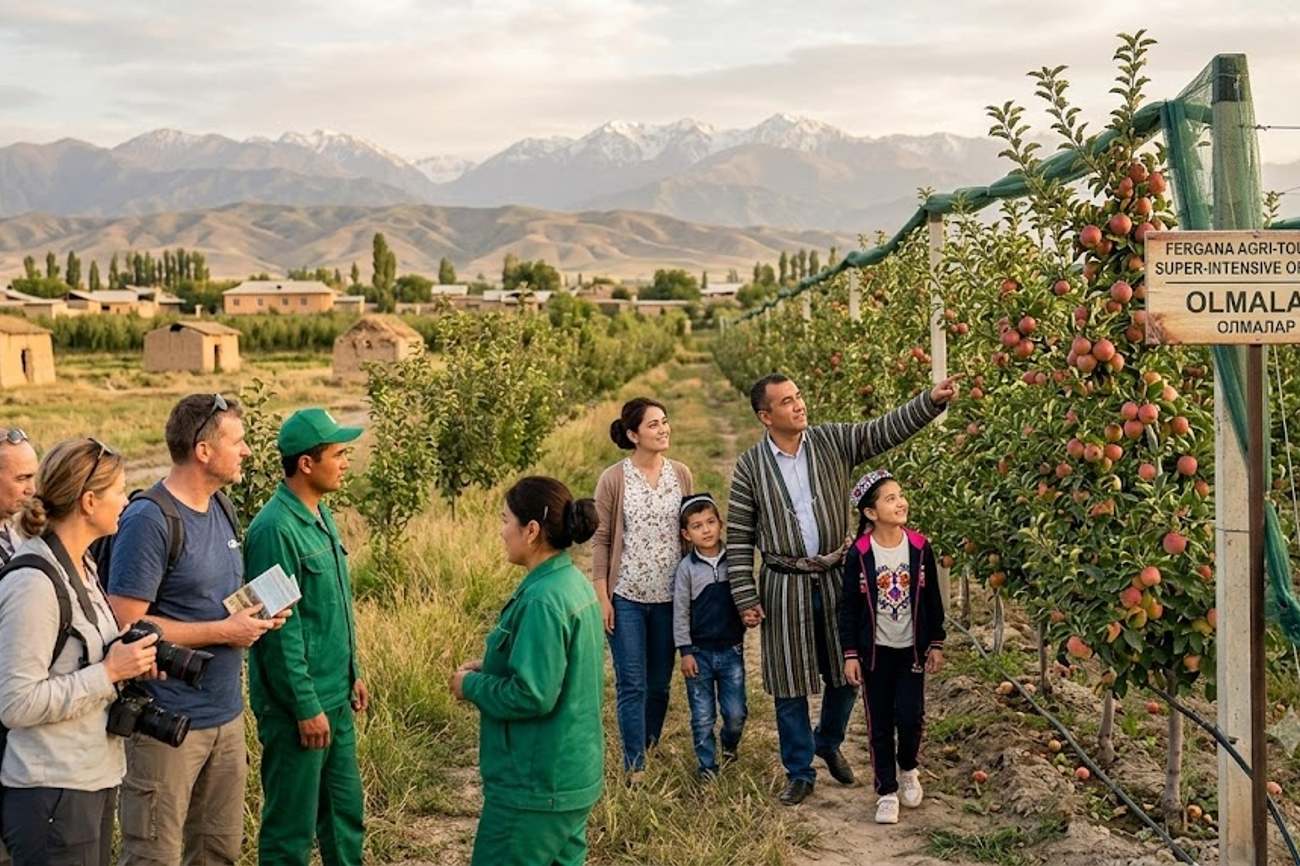
Image generated by AI
Fergana Valley Transitions Toward High-Value Agriculture
[Tashkent, September 8, 2026] — The Uzbek government is executing a sweeping overhaul of land use in the Fergana Valley, moving away from a historic reliance on low-efficiency cotton and grain production. In a directive issued in April 2026, President Shavkat Mirziyoyev ordered the conversion of 50,000 hectares of underperforming agricultural land into super-intensive orchards. This initiative is designed to unlock new economic potential by blending industrial agricultural output with a burgeoning agritourism sector.
The shift is not a total abandonment of cotton, which remains a cornerstone of the national textile industry. Instead, the state is targeting land where current yields are inefficient. Alongside the new orchard developments, the government has mandated the renewal of 5,500 hectares of obsolete orchards to modernize the region's botanical infrastructure.
According to data from the presidential administration, the Fergana region manages 370,000 hectares of irrigated land, of which 55,000 hectares are currently dedicated to vineyards and orchards. By optimizing these resources, officials project an additional output of 300,000 tonnes of fruits and vegetables. This productivity spike is expected to inject approximately two trillion soums into the regional economy and increase fruit and vegetable exports by 25%, targeting a total value of US$500 million.
Integration of Agricultural Production and Visitor Experiences
The conversion of the landscape is directly feeding into Uzbekistan's broader tourism strategy. Rather than treating farms as isolated production sites, the government is incorporating raspberry plantations, vineyards, and rural food systems into the official visitor economy. This approach transforms the agricultural landscape into a destination, allowing tourists to engage with the rural economy.
A central piece of this strategy is the Fergana tourist and recreational zone. Established via a presidential resolution on January 12, 2026, this zone spans 2,396 hectares and is slated for a 30-year operational period, with options for extension.
A primary example of this integration is the Vodil raspberry cluster. The state is developing infrastructure within these active plantations to ensure visitors have access to service facilities without disrupting the agricultural workflow. Similar expansions are planned for the Sanoat and Khosilot mahallas. To ensure the project is economically sustainable, the plan includes the construction of deep-processing workshops and refrigeration facilities, effectively linking the tourist experience to the actual agricultural supply chain.
Overcoming the Legacy of the Cotton Industry
The transition in Fergana is the latest chapter in a long-term structural reform of Uzbekistan's agricultural sector. For decades, cotton production was characterized by rigid state control and problematic labor practices. The International Labour Organization (ILO) previously noted that nearly two million people were recruited annually for the harvest under a system that often lacked transparency.
However, significant progress has been recorded. By 2022, the ILO reported that Uzbekistan had successfully eradicated systemic child labor and forced labor during the 2021 production cycle, noting that 99% of the harvest workforce operated voluntarily.
Concurrent with labor reforms, the World Bank has tracked Uzbekistan's movement toward a market-oriented system. This has involved the liberalization of trade, an increase in domestic textile processing to capture more value locally, and a general diversification of crops. The current orchard program in Fergana is a physical manifestation of this economic evolution, moving the region toward a service-and-processing economy rather than a raw-commodity exporter.
Analyzing the Growth of Fergana’s Tourism Market
The push toward agritourism is supported by a rapidly expanding visitor base. Fergana is no longer a niche destination; official data reveals a massive surge in arrivals, growing from 246,000 visitors in 2016 to 3.8 million in 2025. During the 2025 calendar year, tourism-service exports reached US$185 million.
The scale of this growth is further highlighted by the breakdown of visitor demographics. In 2025, foreign arrivals exceeded 500,000 for the first time, while domestic tourism surpassed three million visits. This existing traffic provides a ready-made market for local guesthouses, farm operators, and regional food producers.
The regional strategy distributes tourism across various hubs to prevent overcrowding and spread economic benefits:
- Kokand and Margilan: Focused on cultural heritage and pilgrimage.
- Fergana, Sokh, and Quva: Developed for nature, health, recreation, and rural experiences.
By combining urban heritage sites with the new super-intensive orchards, Uzbekistan aims to extend the average length of stay for tourists and increase per-visitor spending.
Regional Agricultural and Tourism Data
| Metric | Value / Figure | Period/Status |
|---|---|---|
| Land converted to super-intensive orchards | 50,000 hectares | April 2026 Directive |
| Outdated orchards slated for renewal | 5,500 hectares | Ongoing |
| Total irrigated land in Fergana | 370,000 hectares | Current |
| Existing orchards and vineyards | 55,000 hectares | Current |
| Projected additional produce output | 300,000 tonnes | Estimated |
| Projected economic value addition | 2 trillion soums | Estimated |
| Target fruit/vegetable export value | US$500 million | Target |
| Total tourist visits to Fergana (2025) | 3.8 million | 2025 Actual |
| Tourism service exports (2025) | US$185 million | 2025 Actual |
| Foreign tourist arrivals (2025) | 500,000+ | 2025 Actual |
| Domestic tourist visits (2025) | 3 million+ | 2025 Actual |
| Fergana tourist zone area | 2,396 hectares | Established Jan 2026 |
Why This Matters: The Shift to Experiential Travel
For the international traveler, this transition signals a shift in how Uzbekistan is positioned globally. For years, the country was marketed primarily through the "Silk Road" lens—focusing on the blue-tiled mosques of Samarkand and Bukhara. The development of the Fergana orchards introduces a "living landscape" element to the itinerary.
From a logistical standpoint, this creates a new category of travel: the "Farm-to-Table" circuit. Instead of merely visiting a museum, tourists can now participate in the harvest of raspberry clusters or visit deep-processing workshops. This adds a layer of authenticity that generic tour packages lack.
Furthermore, the integration of refrigeration and processing facilities within the tourism zones suggests that Uzbekistan is building a sustainable rural economy. By creating jobs in both agriculture and hospitality, the government is reducing the rural-to-urban migration trend and providing local communities with a direct stake in the tourism industry. This diversification makes the region more resilient to fluctuations in global cotton prices and creates a more sophisticated, multi-layered travel experience.
Related Travel Guides
- Zimbabwe Unveils 8-Night Northern Hwange Walking Safari Connecting Victoria Falls Supported by 25,803 Americas Visitors in 2026
- Thailand Inbound Tourist Arrivals Drop 3% in First Eight Months of 2026 Reaching 20.93 Million Foreign Visitors
- Thailand Indian Tourist Arrivals Fall 12% Following Visa Exemption Policy Confusion Threatening 2026 Visitor Target
Disclaimer
This article is for informational and educational purposes only. It does not constitute legal, financial, or professional advice. While we strive to provide accurate and up-to-date information, travel policies, regulations, and conditions change rapidly. Always verify information with official sources before making travel decisions. Nomad Lawyer makes no representations about the accuracy, reliability, completeness, or suitability of the information provided. Readers should consult qualified professionals for advice specific to their circumstances. The views expressed in this article are those of the author and do not necessarily reflect the views of Nomad Lawyer.
Kunal K Choudhary
Co-Founder & Contributor
A passionate traveller and tech enthusiast. Kunal contributes to the vision and growth of Nomad Lawyer, bringing fresh perspectives and driving the community forward.
Learn more about our team →