
United Airlines Boeing 737-900 Flight UA 776 Diverted From Newark to Richmond International Airport After Orlando Departure, Passengers Face Three-Hour Delay and Emergency Landing on May 21, 2026
United Airlines Flight UA 776, a Boeing 737-900 from Orlando to Newark, diverts to Richmond International Airport, landing at 11:29 PM after a delay exceeding three hours due to operational issues.

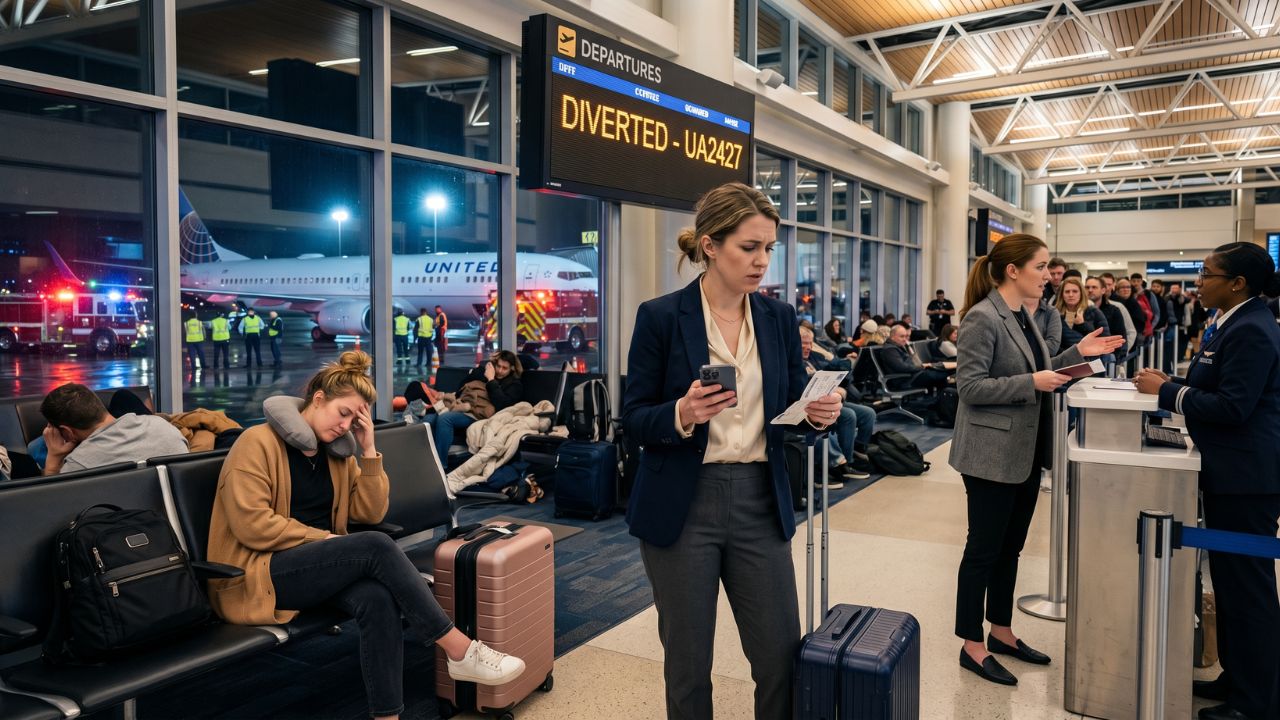
Image generated by AI
United Airlines Flight UA 776, a Boeing 737-900 operating the Orlando-to-Newark route, was diverted from its scheduled destination and executed an emergency landing at Richmond International Airport (RIC) on May 21, 2026 — touching down at 11:29 PM, more than three hours after its originally scheduled arrival at Newark Liberty International Airport (EWR), and leaving a planeload of passengers stranded in Virginia with no immediate onward connection to New York or New Jersey.
What Happened: The UA 776 Diversion
Passengers who boarded Flight UA 776 at Orlando International Airport expected a routine 5 hour and 50 minute domestic flight to Newark, with an anticipated arrival time of approximately 8:00 PM. What they received instead was a mid-flight operational decision that rerouted their aircraft away from Newark entirely, diverting the Boeing 737-900 southward to Richmond International Airport — a regional hub in Virginia with full ground services, but one that sits roughly 300 miles from the passengers' intended destination.
The aircraft landed at Richmond at 11:29 PM, confirming a delay that exceeded three hours beyond the originally scheduled arrival. While United Airlines has not publicly disclosed the specific cause of the diversion, operational data indicates that the aircraft was unable to land at Newark Liberty International Airport at the originally scheduled time. Diversions of this nature are standard safety procedures governed by FAA regulations, executed when conditions at the destination airport — whether weather, air traffic congestion, or technical constraints — prevent a safe and timely arrival.
Richmond International Airport was selected as the diversion point because of its proximity to the original flight path, its full-length commercial runway, and its ability to support passenger disembarkation, aircraft servicing, and ground transportation coordination on short notice.
Why Newark: A Destination Prone to Congestion
The diversion of UA 776 did not occur in a vacuum. Newark Liberty International Airport — one of three major airports serving the New York metropolitan area — is among the most congestion-prone hubs in the entire U.S. domestic network. Peak-time traffic density at Newark regularly pushes arrival sequencing to its limits, and when weather events, air traffic flow restrictions, or runway configuration changes coincide with high-volume evening arrival banks, diversions become a statistically predictable outcome rather than an exceptional event.
On the evening of May 21, multiple operational factors may have converged at Newark to create conditions under which air traffic controllers and United's dispatch team determined that diverting UA 776 to Richmond was the safest course of action. While specific airline operational notes remain confidential, the broader pattern of Newark congestion — particularly during peak evening hours — has been well documented by the Bureau of Transportation Statistics (BTS), which consistently ranks Newark among the airports with the highest delay rates in the country.
Passenger Impact: Stranded in Richmond, 300 Miles Short
For the families, business travelers, and first-time flyers aboard UA 776, the diversion transformed a routine domestic flight into a logistical ordeal. Instead of arriving at Newark at 8:00 PM and clearing the terminal within the hour, passengers found themselves deplaning at Richmond at 11:29 PM — late at night, in an unfamiliar city, with no pre-arranged ground transportation to their actual destinations in New Jersey or New York.
The practical consequences were immediate and compounding:
- Connecting passengers who had onward flights booked out of Newark or the wider New York area faced near-certain missed connections, with rebooking options limited by the late hour and high load factors on next-day departures.
- Ground transportation from Richmond to the Newark/New York metro area — a distance of approximately 300 miles — required travelers to arrange rental cars, buses, or trains at close to midnight, with limited availability and elevated pricing.
- Hotel accommodation in the Richmond area became an immediate necessity for passengers unable or unwilling to undertake a multi-hour overnight drive, adding unplanned lodging costs to an already disrupted itinerary.
- Business travelers with morning meetings in New York or New Jersey faced the prospect of either an exhausting overnight drive or a missed commitment — both carrying professional and financial consequences that no airline rebooking policy fully compensates.
Airlines typically provide support for diverted passengers, including meal vouchers, hotel accommodations, and rebooking assistance when delays are prolonged. United Airlines' operational guidelines encourage proactive passenger communication during such disruptions, and affected travelers were advised to use the airline's customer service channels for updates and guidance.
Flight Diversion Data: United Airlines UA 776
| Flight Detail | Verified Data |
|---|---|
| Flight Number | UA 776 |
| Airline | United Airlines |
| Aircraft Type | Boeing 737-900 |
| Origin | Orlando International Airport (MCO) |
| Scheduled Destination | Newark Liberty International Airport (EWR) |
| Actual Landing | Richmond International Airport (RIC) |
| Scheduled Flight Duration | 5 hours 50 minutes |
| Scheduled Arrival (Newark) | Approximately 8:00 PM |
| Actual Arrival (Richmond) | 11:29 PM |
| Total Delay | Exceeding 3 hours |
| Diversion Cause | Operational issues (specific details not publicly disclosed) |
Common Causes of Flight Diversions
Flight diversions are triggered by a range of factors, all governed by the overarching principle that passenger safety takes absolute priority over schedule adherence. The most common causes include:
- Weather events — thunderstorms, fog, or high winds that compromise safe landing conditions at the destination airport.
- Air traffic congestion — particularly at high-density hubs like Newark, where arrival slot saturation can prevent additional aircraft from entering the approach sequence.
- Mechanical or technical issues — identified either pre-flight or mid-air, requiring immediate attention at the nearest capable airport.
- Medical emergencies — on-board medical situations necessitating an unscheduled landing for passenger care.
In each case, pilots, air traffic controllers, and airline operations centers coordinate in real time to identify the nearest suitable diversion airport and execute the rerouting with minimal risk. These procedures are a core component of FAA air traffic management protocols and reflect the commercial aviation system's design philosophy: when in doubt, land safely and sort the logistics afterward.
What This Means for Travelers: Actionable Advice
- Check flight status obsessively when flying into Newark — EWR's congestion profile means that evening arrivals are statistically more likely to experience delays or diversions than departures from less constrained airports.
- Build connection buffer into Newark itineraries — passengers booking onward connections through Newark should allow at least 2-3 hours of buffer time, particularly for evening arrivals during peak travel seasons.
- Keep contact details updated in your airline profile — United and other carriers push diversion notifications via text and app, but only if your contact information is current.
- Consider travel insurance for trips routing through high-congestion airports, particularly policies that cover unplanned accommodation, ground transportation, and missed connections arising from diversions.
- Download the United Airlines app before departure — real-time rebooking and customer service chat features are significantly faster than phone queues during active disruption events.
FAQ: United Airlines Flight UA 776 Diversion 2026
Q: Why was United Airlines Flight UA 776 diverted to Richmond? Flight UA 776, a Boeing 737-900 from Orlando to Newark, was diverted to Richmond International Airport due to operational issues that prevented the aircraft from landing at Newark Liberty International Airport at its scheduled time. The specific cause has not been publicly disclosed, but diversions are standard safety procedures under FAA regulations.
Q: How long was the delay for passengers on UA 776? Passengers experienced a delay exceeding three hours. The flight was originally scheduled to arrive at Newark at approximately 8:00 PM but landed at Richmond International Airport at 11:29 PM, leaving travelers approximately 300 miles from their intended destination.
Q: What support does United Airlines provide to passengers on diverted flights? United Airlines typically provides rebooking assistance, meal vouchers, and hotel accommodations for passengers on diverted flights when delays are prolonged. Travelers are advised to contact United's customer service channels directly for real-time updates, rebooking options, and compensation eligibility.
Industry Analysis: Newark Congestion and the Diversion Calculus
The UA 776 diversion is a data point in a much larger pattern. Newark Liberty International Airport's structural congestion — driven by high traffic density, runway configuration constraints, and its role as a major United Airlines hub — creates conditions where evening arrival diversions are not anomalies but recurring features of the operational landscape. When weather overlays combine with peak-hour traffic density, the probability of diversion increases sharply for flights arriving in the final approach window of the evening rush.
For United Airlines specifically, Newark serves as one of its most critical East Coast hubs, carrying enormous volumes of domestic, transatlantic, and Latin American traffic through a physical infrastructure that was not originally designed for current demand levels. The airline's operational teams face a nightly calculus: accept increasing holding patterns and fuel burn over the New York metropolitan area, or divert to a nearby airport where passengers can be safely landed and supported. On May 21, for the passengers of UA 776, that calculus resolved in favor of Richmond.
The broader implication for airline news watchers and frequent travelers is clear: routing through the most congested airports in the U.S. system carries inherent diversion risk that no amount of schedule planning can fully eliminate. Travel chaos at mega-hubs like Newark, JFK, and LaGuardia is a structural feature of the current aviation system, not a temporary condition.
Key Takeaways
- United Airlines Flight UA 776 (Boeing 737-900, Orlando → Newark) was diverted to Richmond International Airport on May 21, 2026.
- The aircraft landed at 11:29 PM — more than three hours after its scheduled 8:00 PM Newark arrival.
- Passengers were stranded approximately 300 miles from their intended destination, facing overnight ground transportation or hotel stays.
- Newark Liberty International Airport's peak-hour congestion is a recurring driver of evening flight diversions for carriers operating high-density arrival banks.
- Diversion procedures are standard FAA-regulated safety protocols — not emergency responses, but precautionary measures that prioritize passenger safety over schedule adherence.
- United Airlines provides rebooking, meal vouchers, and accommodation support for diverted passengers, accessible through the airline's customer service channels and mobile app.
- Travelers routing through congested hubs should build connection buffers, maintain updated contact information, and consider travel insurance covering diversion-related costs.
Related Travel Guides
LaGuardia Airport Sinkhole Shuts Runway 4/22: New York Flight Disruption Report May 2026
Canada Flight Cancellations: Toronto, Vancouver, Montreal Disruptions May 21, 2026
Newark Airport Diversion and Delay Survival Guide for United Airlines Passengers 2026
Disclaimer
This article is for informational and educational purposes only. It does not constitute legal, financial, or professional advice. While we strive to provide accurate and up-to-date information, travel policies, regulations, and conditions change rapidly. Always verify information with official sources before making travel decisions. Nomad Lawyer makes no representations about the accuracy, reliability, completeness, or suitability of the information provided. Readers should consult qualified professionals for advice specific to their circumstances. The views expressed in this article are those of the author and do not necessarily reflect the views of Nomad Lawyer.
Kunal K Choudhary
Co-Founder & Contributor
A passionate traveller and tech enthusiast. Kunal contributes to the vision and growth of Nomad Lawyer, bringing fresh perspectives and driving the community forward.
Learn more about our team →