
UAE Ignites a “Dubai-it” Mega Mobility Revolution With High-Speed Metro Expansion, Autonomous Taxi Breakthrough, Air Taxi Launch by 2026 and Multi-Layer Transport Grid Redefining Global Travel, Tourism Flow and Smart City Movement
Dubai is launching a "Dubai-it" mobility revolution featuring air taxis by 2026, Metro Blue and Golden line expansions

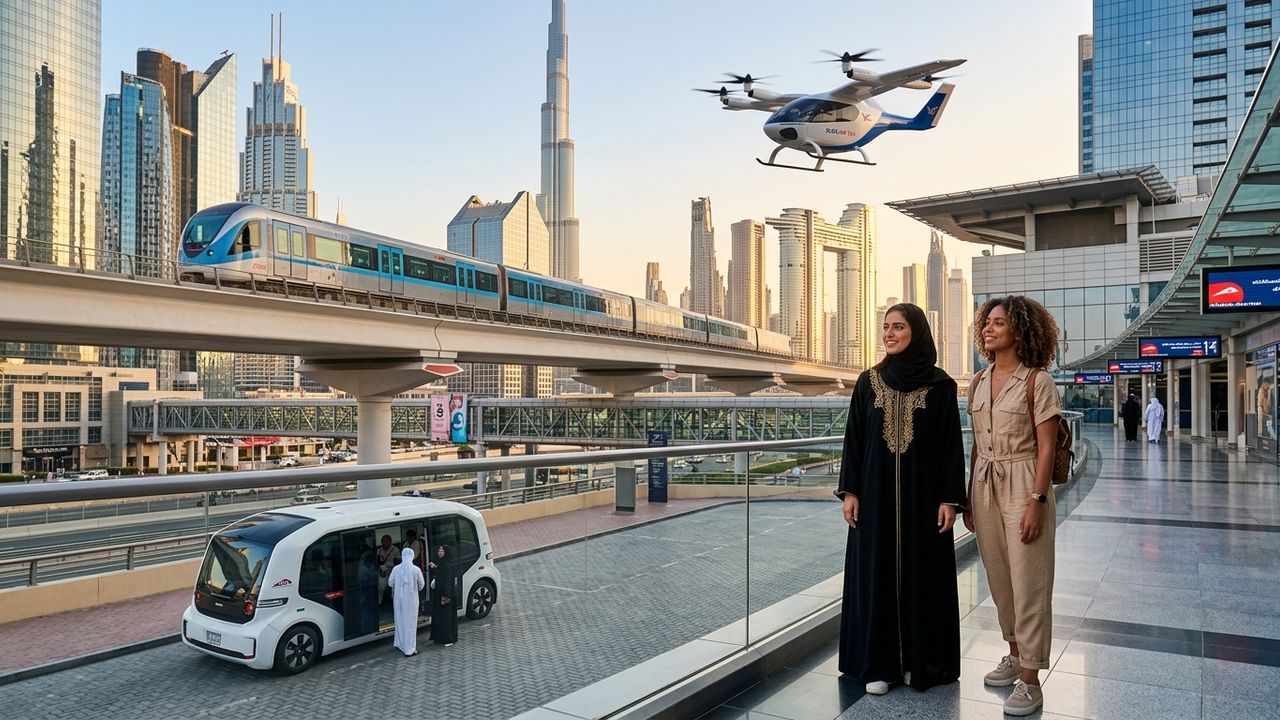
Image generated by AI
[Dubai, June 23, 2026] — The United Arab Emirates is currently implementing a massive overhaul of its urban transport infrastructure under the "Dubai-it" mobility framework, a high-velocity strategy designed to integrate autonomous vehicles, expanded rail networks, and commercial air taxis by 2026. This systemic re-engineering, led by the Roads and Transport Authority (RTA), aims to transition the city from traditional transit models to a fully connected, multi-layered smart mobility ecosystem.
A New Paradigm in Urban Infrastructure Execution
The "Dubai-it" philosophy marks a departure from conventional urban planning, which often suffers from protracted development cycles. Instead, the UAE is adopting a model of rapid execution and immediate conversion, where futuristic concepts are moved directly into the construction pipeline. This approach prioritizes the swift delivery of megaprojects and the seamless integration of smart technology from the earliest stages of development.
Industry observers note that this strategy transforms the city into a living laboratory for next-generation movement. By replacing reactive planning with predictive mobility management, the RTA is ensuring that infrastructure grows in lockstep with the city's expanding population and tourism demands.
Expanding the Dubai Metro Rail Network
The backbone of this mobility revolution is the evolution of the Dubai Metro. Moving beyond a simple linear system, the network is being redesigned as a dense, multi-directional grid to maximize urban connectivity. Following the successful completion of the Route 2020 extension, which maintained its delivery schedule despite global disruptions, the city is now focusing on two critical expansions.
The Blue Line expansion is specifically engineered to bridge the gap between the city core and rapidly growing knowledge and residential hubs. Key areas such as Mirdif, International City, and Dubai Silicon Oasis will gain direct, high-capacity rail access, significantly lowering the city's reliance on road-based transport.
Simultaneously, the development of the Golden Line is adding a deeper layer of systemic complexity. This line is intended to optimize interchange efficiency and streamline the flow of passengers between major business districts, residential zones, and primary tourism landmarks. Together, these initiatives shift the metro from a point-to-point service into a comprehensive urban rail ecosystem.
Implementing a Three-Dimensional Mobility Grid
Dubai is no longer viewing urban transport as a two-dimensional challenge. The current strategy involves the simultaneous development of ground, underground, and aerial layers to distribute traffic load and increase transit speeds.
| New Mobility Layers | System Type | Primary Role in Urban Movement |
|---|---|---|
| Ground | Autonomous taxis & buses | Flexible, short-distance urban transit |
| Rail | Metro (Red, Green, Blue, Golden) | High-capacity transit backbone |
| Underground | Dubai Loop | Climate-controlled mobility corridors |
| Air | Air taxis (by 2026) | High-speed, cross-city aerial travel |
This tiered architecture is designed to alleviate surface-level congestion while providing citizens and visitors with a variety of speed and capacity options depending on their destination.
Transitioning to AI-Driven Autonomous Transport
A pivotal component of the "Dubai-it" roadmap is the aggressive shift toward artificial intelligence in transit. The city is moving away from human-operated fleets, with autonomous taxi trials already providing the data necessary for a full-scale commercial rollout.
Central to this operation is the Technology Operation Control Centre (TOCC). This facility allows the RTA to monitor transport networks in real-time and utilize AI to predict passenger demand. By dynamically adjusting the frequency of buses and metro trains, the TOCC can resolve potential congestion zones before they materialize, shifting the city's operational stance from reactive to predictive.
Launching Commercial Air Taxis by 2026
Perhaps the most ambitious goal of the current transformation is the introduction of commercial air taxis by 2026. This initiative represents a leap into vertical urban mobility, utilizing the airspace above the city to bypass ground traffic entirely.
The infrastructure for this service involves the construction of dedicated vertiports located at strategic tourism and business hubs. These aerial corridors will provide direct links between high-density districts and critical transport nodes, including the city's major airports. Reports indicate that this will drastically reduce cross-city travel times and provide international travelers with a seamless, premium transition from the airport to the city center.
Developing the Dubai Loop Underground Corridor
To combat the challenges of extreme desert heat, the UAE is developing the "Dubai Loop." This project consists of a network of climate-controlled underground corridors designed to facilitate uninterrupted movement.
The Dubai Loop is engineered to encourage walking and cycling year-round by providing a protected environment. By integrating these corridors with the existing metro and autonomous vehicle networks, the city is creating a hidden layer of mobility that removes pedestrians and light commuters from the crowded surface roads.
Implications for Global Tourism and City Flow
For the international travel sector, these advancements are expected to eliminate "last-mile" friction. The combination of air taxis, expanded rail, and autonomous shuttles means that tourists can move between hotels, landmarks, and airports with minimal transit time. By making the city more intuitive and accessible, Dubai is positioning itself as a frictionless destination where the logistics of movement no longer hinder the exploration of the city.
The "Dubai-it" initiative represents a fundamental redesign of urban movement. By layering AI-managed ground transport, high-capacity rail, underground climate corridors, and vertical aerial networks, the UAE is establishing a new global benchmark for how a smart city functions in the 21st century.
Related Travel Guides
Disclaimer
This article is for informational and educational purposes only. It does not constitute legal, financial, or professional advice. While we strive to provide accurate and up-to-date information, travel policies, regulations, and conditions change rapidly. Always verify information with official sources before making travel decisions. Nomad Lawyer makes no representations about the accuracy, reliability, completeness, or suitability of the information provided. Readers should consult qualified professionals for advice specific to their circumstances. The views expressed in this article are those of the author and do not necessarily reflect the views of Nomad Lawyer.
Raushan Kumar
Founder & Lead Developer
Full-stack developer with 11+ years of experience and a passionate traveller. Raushan built Nomad Lawyer from the ground up with a vision to create the best travel and law experience on the web.
Learn more about our team →