
Emirates, Etihad, and Riyadh Air Defeat Global Travel Chaos and Airport Disruptions With Massive Direct Flight Route Expansion Across Europe and Asia: Latest Airline News
As severe flight cancellations and transit congestion cripple older aviation networks, massive direct route expansions by Gulf carriers offer travelers a highly efficient bypass around global travel chaos.

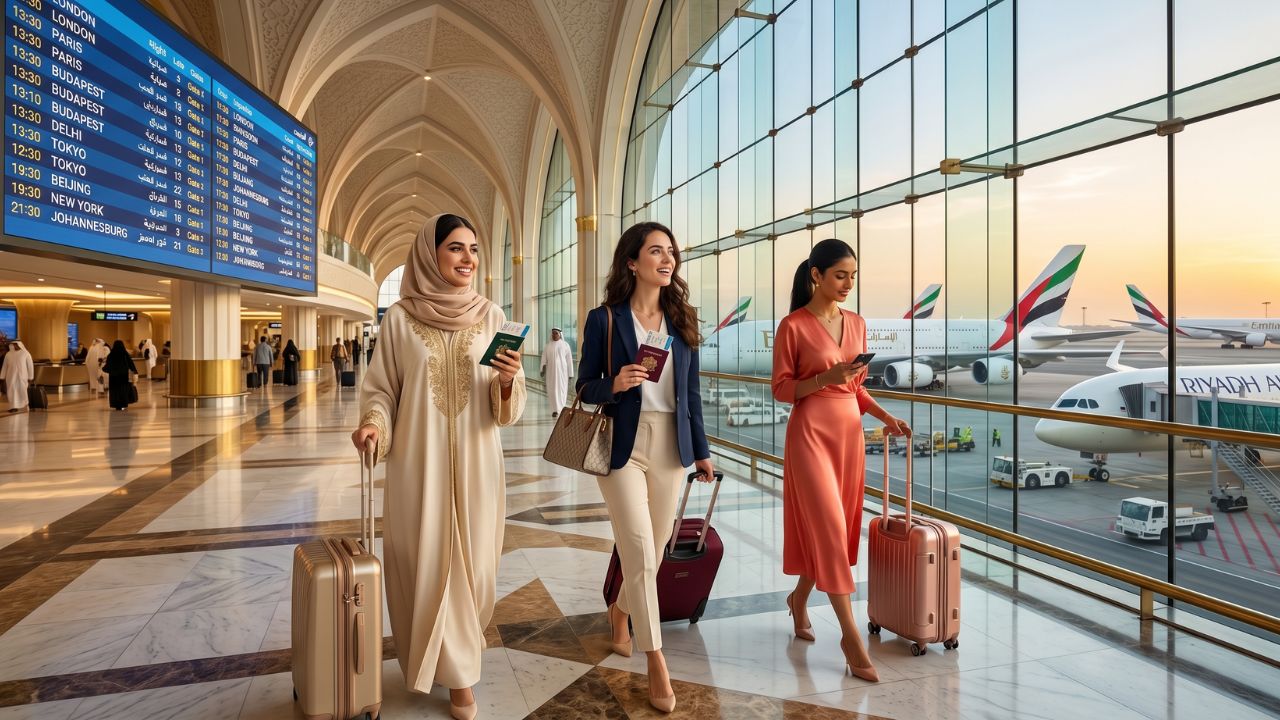
Image generated by AI
In a massive, highly coordinated infrastructure offensive designed to permanently eradicate the severe travel chaos and catastrophic flight cancellations currently plaguing congested transit corridors, the Gulf aviation sector is executing an unprecedented route expansion. As archaic European and Asian transit hubs buckle under surging passenger demand—triggering systemic airport disruptions—leading global titans including Emirates, Etihad Airways, and Saudi Arabia's emerging Riyadh Air are violently expanding their direct flight networks. By deploying fresh direct links across Central Asia, Europe, Africa, and the United States, these carriers are providing desperate passengers with highly efficient, direct bypass routes that completely eliminate the risk of missing connections at overwhelmed legacy airports. This massive structural upgrade, fortified by the integration of the high-speed Etihad Rail network, represents the premier headline in today's breaking airline news and essential global aviation updates.
By introducing direct passenger coordination and dynamic scheduling backups, the regional aviation hubs target growing passenger demand across vital commerce sectors. The choice to coordinate flight departures in phases helps to manage gate capacity, supporting the country's broader regional transportation network.
Context: Eradicating Transit Bottlenecks Through Direct Connectivity
For the millions of business professionals and international tourists navigating the 2026 global grid, relying on outdated multi-stop itineraries has become an absolute recipe for travel chaos.
Historically, reaching emerging markets in Central Asia or secondary cities in Eastern Europe required routing through highly congested, legacy transit hubs. However, due to severe staffing shortages and systemic capacity constraints at these older airports, the standard transit model has collapsed, resulting in rolling flight cancellations and agonizing airport disruptions. The UAE and Saudi aviation sectors have weaponized this vulnerability. By rapidly establishing new, direct long-haul links, carriers like Etihad Airways and Riyadh Air allow passengers to bypass congested intermediary airports entirely. This strategy physically removes the traveler from the highest-risk delay zones. As business travel increasingly demands absolute efficiency, reducing dependency on fragile transit stops is the ultimate defense against the operational meltdowns that define the modern summer travel season.
To view live flight schedules, specific new route activations, or multimodal connection options via Etihad Rail, travelers must consult official Gulf aviation directories. For direct booking access on these newly established, highly efficient bypass routes, travelers should check the official portals of Emirates or Etihad Airways. To explore live flight tracking and monitor the exact severity of the European and Asian airspace bottlenecks they are actively avoiding, passengers can consult the official FlightAware tracking service.
Section-Wise Breakdown of the Global Bypass Strategy
Abu Dhabi: Etihad's Eastern and Western Offensive
Etihad Airways is aggressively expanding its footprint out of Abu Dhabi to actively reduce congestion at major legacy hubs while opening new, highly lucrative tourism corridors. The carrier's 2026 expansion program directly targets critical markets across Central Asia, Europe, and Africa. By establishing fresh, highly reliable connections, Etihad allows passengers to reach fast-growing leisure destinations without subjecting themselves to the travel chaos prevalent at older, intermediate transit facilities. Simultaneously, Etihad's massive push into the Asia-Pacific market provides corporate and leisure travelers with direct arteries into Southeast Asia.
Saudi Arabia: The Rise of Riyadh Air
Riyadh Air is rapidly emerging as a massive, hyper-capitalized competitor designed to reshape Gulf-Europe and Gulf-North America connectivity. Backed by a gargantuan aircraft order program, the Saudi startup is actively decentralizing Middle Eastern transit. By aggressively pushing into the United States and major European financial capitals, Riyadh Air offers global travelers a brand-new, ultra-modern transit alternative specifically engineered to bypass the airport disruptions that currently paralyze older regional networks.
Dubai: The Emirates Mega-Hub
Emirates continues to operate one of the world’s largest and most reliable international networks, serving over 130 destinations globally from Dubai International Airport. By maintaining high-capacity, long-haul operations across six continents, Emirates ensures that regardless of the travel chaos unfolding in peripheral markets, Dubai remains an impenetrable fortress of operational stability and global connectivity.
Technical Roster: Gulf Aviation Expansion Matrix
To ensure absolute factual accuracy regarding the specific routes, fleet acquisitions, and multimodal infrastructure developments driving this massive bypass strategy, the following technical details summarize the 2026 expansion:
Etihad Airways Route Expansions
- Central Asia, Europe, and Africa: New or expanded routes include Bucharest, Tbilisi, Baku, Almaty, Tashkent, and Yerevan.
- Asia-Pacific Markets: New or expanded connections include Chiang Mai, Hong Kong, Hanoi, Phnom Penh, and Krabi.
Riyadh Air Operational Deployment
- Approved Long-Haul Expansion: The airline has officially received approval to operate flights to the United States.
- Current Key Destinations: Services are already launched or aggressively scaling to London, Dubai, Cairo, Madrid, and Manchester.
- Fleet Acquisition Program: Rapid expansion supported by massive orders for Boeing 787s, Airbus A321neos, and Airbus A350 aircraft.
- Strategic Target: Expand to more than 100 global destinations by 2030 to support the Saudi national diversification strategy.
Multimodal Infrastructure: Etihad Rail
- Integration Focus: Improving multimodal connectivity within the UAE to reduce transfer times and bypass airport road congestion.
- Connected Cities: Linking major hubs including Abu Dhabi, Dubai, and Fujairah through advanced high-speed rail infrastructure.
Passenger Impact: Defeating Multi-Stop Anxiety
For the everyday tourist and the high-yield corporate traveler, this massive expansion of direct Gulf routes represents the ultimate logistical victory against travel anxiety.
The immediate passenger impact is the total eradication of transit-induced stress. Previously, a Gulf traveler attempting to reach Krabi or Bucharest faced the terrifying prospect of multiple connections through severely congested airports highly prone to flight cancellations. Today, the expansion of direct flight routes by Etihad entirely neutralizes that risk. Business travelers specifically benefit from these direct links to major financial hubs, completely eliminating their dependency on high-risk transit stops. Furthermore, the integration of Etihad Rail ensures that moving between Abu Dhabi and Dubai is seamlessly executed on high-speed infrastructure, protecting passengers from ground-level travel chaos and ensuring they reach their departure gates with total efficiency.
Industry Analysis: The New Architecture of Global Transit
Aviation industry analysts view the 2026 Gulf expansion as a masterclass in exploiting the operational weaknesses of legacy aviation networks.
Analysts note that as global passenger traffic recovers, older transit hubs in Europe and Asia are buckling under the volume, triggering severe airport disruptions. The UAE and Saudi strategy—deploying massive capital to launch direct flights to secondary cities (like Hanoi or Yerevan)—fundamentally circumvents these bottlenecks. By establishing direct point-to-point links from their ultra-modern, highly efficient mega-hubs, Etihad and Riyadh Air are effectively stealing premium market share from legacy carriers unable to maintain scheduling reliability. Analysts agree that this integration of high-capacity aviation with high-speed rail (Etihad Rail) positions the Gulf not merely as a transit stop, but as the most resilient, disruption-proof logistics corridor on the planet.
Actionable Advice for Bypassing Global Transit Chaos
If you are an international traveler seeking to leverage this massive Gulf expansion to avoid the severe travel chaos currently threatening legacy aviation networks, execute this strategic planning checklist immediately:
- Book Direct Secondary Routes: If your final destination is a secondary city like Tbilisi, Baku, or Chiang Mai, absolutely refuse to transit through a congested European or Asian hub. Book a direct flight on Etihad Airways out of Abu Dhabi to bypass regional flight cancellations entirely.
- Leverage Etihad Rail for UAE Transit: Do not rely on chaotic road transport if you are transferring between flights in Abu Dhabi and Dubai. Utilize the newly integrated Etihad Rail high-speed infrastructure to guarantee you arrive at your terminal efficiently and stress-free.
- Exploit the Riyadh Air Price Wars: As Riyadh Air aggressively scales its operations to London, Madrid, and the United States using its brand-new fleet of Boeing 787s and Airbus A350s, highly lucrative introductory fares will emerge. Book these immediately to secure premium transit at a fraction of the cost of legacy carriers.
- Abandon High-Risk Transit Hubs: Business travelers must prioritize airlines that offer direct links to major financial hubs. The less time you spend connecting in older airports, the lower your statistical probability of falling victim to cascading airport disruptions.
FAQ: Gulf Route Expansion & Travel Chaos 2026
Why are UAE airlines expanding their routes so aggressively in 2026?
To capitalize on rising passenger demand and to actively bypass the severe travel chaos and airport disruptions plaguing older transit networks, carriers like Etihad and Emirates are launching massive direct flight routes to secondary markets.
Which specific new destinations is Etihad Airways targeting?
Etihad has confirmed multiple new destinations designed to bypass transit congestion, including Bucharest, Tbilisi, Baku, Almaty, Tashkent, Yerevan, Chiang Mai, Hong Kong, Hanoi, Phnom Penh, and Krabi.
How does Etihad Rail factor into preventing travel chaos?
Etihad Rail provides high-speed, multimodal connectivity linking Abu Dhabi, Dubai, and Fujairah, completely eliminating ground-level transit delays and drastically reducing transfer times between the UAE's major aviation hubs.
The Supremacy of Direct Connectivity
The explosive expansion of Gulf aviation networks proves definitively that direct, heavily capitalized connectivity is the only viable defense against global travel chaos. By offering corporate and leisure passengers direct bypass routes to emerging markets—sidestepping the brutal flight cancellations and airport disruptions that paralyze older transit hubs—Emirates, Etihad, and Riyadh Air have fundamentally shifted the balance of power in international transit. As legacy airports desperately attempt to manage explosive passenger volumes without buckling into total systemic failure, travelers must accept a critical new reality: avoiding the severe travel chaos of 2026 requires routing through ultra-modern Gulf hubs explicitly designed to never fail.
Key Takeaways
- Direct Bypass Routes: Etihad Airways is launching massive direct flights to Central Asia, Europe, and Asia-Pacific (including Bucharest, Baku, and Chiang Mai) to help travelers bypass congested transit hubs.
- Riyadh Air Dominance: Backed by massive orders of A350s and 787s, Saudi Arabia's Riyadh Air is actively expanding to the US, London, and Madrid, creating a powerful new disruption-proof transit alternative.
- Multimodal Defense: The integration of Etihad Rail links Abu Dhabi, Dubai, and Fujairah, eliminating ground traffic chaos and hyper-accelerating passenger transfers between mega-hubs.
- Protecting Business Travel: New direct links to global financial hubs entirely remove the dependency on fragile, high-risk transit stops, severely reducing the threat of business flight cancellations.
- Emirates Stability: Operating over 130 destinations globally, Emirates ensures Dubai remains the ultimate fortress of operational reliability against rolling global airport disruptions.
Related Travel Guides
Massive World Cup Fleet Repainting Triggers Travel Chaos
Guwahati Terminal 2 Emerges as Transit Chaos Bypass
Gulf Route Expansion Strategies and Flight Booking Hacks on Reddit
Disclaimer
This article is for informational and educational purposes only. It does not constitute legal, financial, or professional advice. While we strive to provide accurate and up-to-date information, travel policies, regulations, and conditions change rapidly. Always verify information with official sources before making travel decisions. Nomad Lawyer makes no representations about the accuracy, reliability, completeness, or suitability of the information provided. Readers should consult qualified professionals for advice specific to their circumstances. The views expressed in this article are those of the author and do not necessarily reflect the views of Nomad Lawyer.
Kunal K Choudhary
Co-Founder & Contributor
A passionate traveller and tech enthusiast. Kunal contributes to the vision and growth of Nomad Lawyer, bringing fresh perspectives and driving the community forward.
Learn more about our team →