
American Airlines Call Sign Duplication Near Phoenix 2026: Safety Risks of Overlapping Flight Numbers
Two American Airlines jets operated under the same call sign, American 2482, near Phoenix on August 14, 2026, highlighting critical vulnerabilities in airline scheduling and ATC communication.

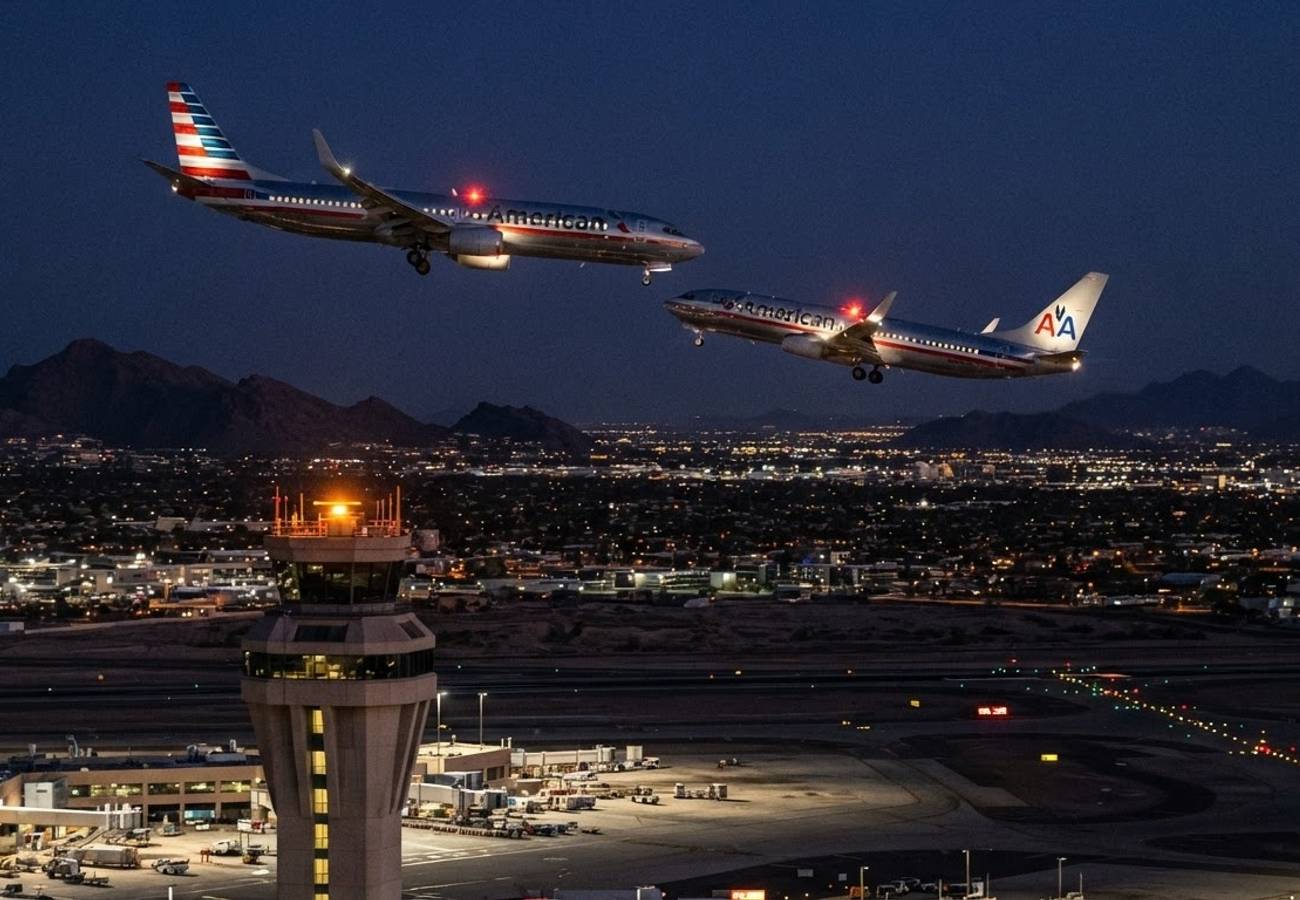
Image generated by AI
Two American Airlines aircraft converged near Phoenix, Arizona, while operating under the identical call sign American 2482. A swift intervention by air traffic controllers prevented a potential mid-air conflict caused by an operational scheduling overlap.
Analysis of the Phoenix Airspace Convergence
Shortly after midnight on August 14, 2026, a high-risk communication anomaly occurred in the Phoenix sector. Two separate American Airlines aircraft were identified in the system as "American 2482." One aircraft was arriving in Phoenix following significant delays on a previous leg, while a second aircraft—assigned to cover the return portion of the route—was departing Phoenix.
The duplication created a scenario where two aircraft shared the same radio frequency and identifier simultaneously. In aviation, call signs are the primary mechanism for issuing clearances; when two aircraft share an ID, there is a heightened risk that a pilot may execute a heading or altitude change intended for the other aircraft.
According to audio recordings and aviation reports, a Phoenix air traffic controller identified the duplication in real-time. To maintain separation, the controller verbally differentiated the aircraft as "American 2482 on the arrival" and "American 2482 on the departure." This manual override ensured that heading and altitude instructions were followed by the correct crews, and both flights continued without further incident.
Operational Root Cause: The "Out-and-Back" Scheduling Quirk
The incident stemmed from a common industry practice where airlines use the same flight number for an inbound and outbound trip between a hub and a destination. Typically, the same physical aircraft performs both legs, meaning the inbound flight must land before the outbound flight departs, preventing any overlap in the airspace.
In this specific instance, weather and operational delays caused the inbound flight from Chicago to arrive significantly behind schedule. To maintain the published departure time for the return leg to Chicago, American Airlines deployed a different aircraft for the outbound flight but retained the original flight number and call sign.
Call Sign Conflict Parameters
| Parameter | Inbound Flight | Outbound Flight |
|---|---|---|
| Call Sign | American 2482 | American 2482 |
| Origin/Destination | Chicago $\rightarrow$ Phoenix | Phoenix $\rightarrow$ Chicago |
| Status | Delayed Arrival | Scheduled Departure |
| Resolution | Verbal distinction by ATC | Verbal distinction by ATC |
| Date of Incident | August 14, 2026 | August 14, 2026 |
Traveler Logistics Guide: Navigating Flight Disruptions
From a ground-level perspective, the best way to navigate the operational chaos that leads to these "aircraft swaps" is to maintain a digital tether to your flight's real-time status. When an airline swaps an aircraft to keep a departure on time despite an inbound delay, passengers often see a change in the aircraft model or gate at the last minute.
Pro Tips for Connection Management:
- Monitor Tail Numbers: Use apps like FlightRadar24 to track the actual aircraft (tail number) assigned to your flight. If the inbound plane is delayed but your departure is listed as "on time," an aircraft swap has likely occurred.
- Digital Transit Policies: Ensure your travel documents are updated via digital portals. While call sign issues are handled by ATC, the resulting gate changes can be abrupt.
- Layover Buffers: In 2026, with increased network density, a minimum of 120 minutes is recommended for domestic connections in major hubs like Phoenix (PHX) or Chicago (ORD) to account for these operational shifts.
Infrastructure and Safety Impact Assessment
This event exposes a gap in the automated safeguards intended to flag duplicate call signs within federal air traffic systems. While modern aircraft are equipped with Traffic Collision Avoidance Systems (TCAS) to provide a final layer of electronic protection, these systems are reactive. The primary defense remains the clarity of communication between the cockpit and the control tower.
Industry observers suggest a systemic shift is required: decoupling the "marketing flight number" (what the passenger sees on the ticket) from the "operational call sign" (what the pilot uses on the radio). By appending unique alphanumeric suffixes to operational call signs during irregular operations, airlines can eliminate the risk of verbal confusion without confusing the traveling public.
The Phoenix incident serves as a critical case study for regulators and safety bodies, highlighting that as airlines reuse flight numbers more aggressively to optimize networks, the margin for human error in communication narrows.
The vigilance of a single controller prevented a systemic scheduling flaw from becoming a catastrophic event.
Related Travel Guides
Disclaimer
This article is for informational and educational purposes only. It does not constitute legal, financial, or professional advice. While we strive to provide accurate and up-to-date information, travel policies, regulations, and conditions change rapidly. Always verify information with official sources before making travel decisions. Nomad Lawyer makes no representations about the accuracy, reliability, completeness, or suitability of the information provided. Readers should consult qualified professionals for advice specific to their circumstances. The views expressed in this article are those of the author and do not necessarily reflect the views of Nomad Lawyer.
Raushan Kumar
Founder & Lead Developer
Full-stack developer with 11+ years of experience and a passionate traveller. Raushan built Nomad Lawyer from the ground up with a vision to create the best travel and law experience on the web.
Learn more about our team →