
Beyond the Classic Circuit: The Insider Expedition Guide to Argentina's Untamed Provinces

While over ninety percent of international travelers visiting Argentina concentrate along the classic Buenos Aires, Iguazú Falls, and Perito Moreno glacier corridor, Moconá Falls in Misiones plunges not across a river canyon, but lengthwise along the Uruguay River for an astonishing 1,900 meters inside an untouched subtropical rainforest biosphere.
South America's second-largest country contains vast wilderness frontiers that remain virtually unvisited by mass commercial tourism. For seasoned explorers seeking raw nature, remote indigenous craft cultures, and stark geological wonders, Argentina's outer provinces offer an extraordinary alternative. From the flooded palm savannas of the Gran Chaco to the high-altitude volcanic pumice fields of the Puna and the Welsh teahouse settlements of northern Patagonia, these remote territories reward slow, respectful exploration.
Subtropical Flooded Savannas and Dry Forest Safaris: Formosa and Chaco
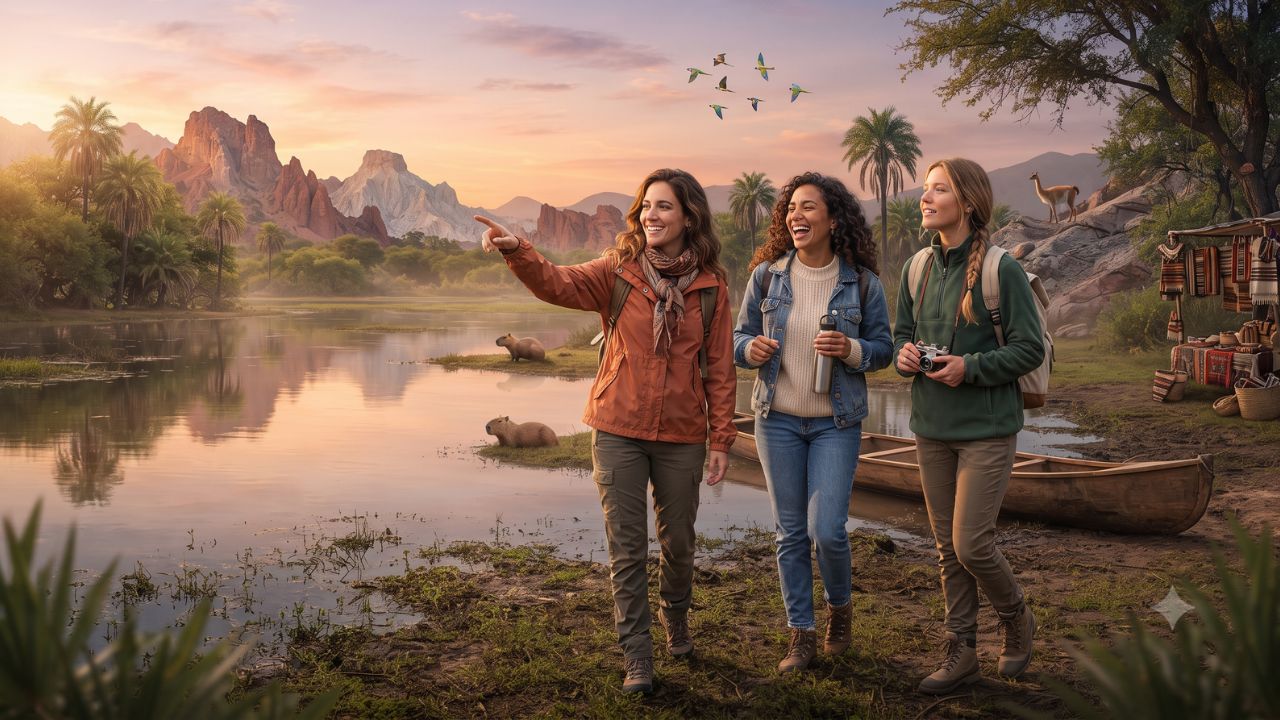
In the northeastern province of Formosa, Bañado La Estrella represents one of the continent's most expansive and biodiverse wetland territories, encompassing more than 400,000 hectares fed by seasonal overflows from the Pilcomayo River. Navigating by wooden canoe through flooded hardwood forests known as champales, travelers glide past over 500 bird species—including jabiru storks, roseate spoonbills, and southern screamers—alongside native capybaras and broad-snouted caimans.
At Campo del Cielo, visitors can connect with the indigenous Pilagá community, whose master weavers produce intricate geometric baskets and textiles using sustainably harvested carandillo palm fibers and native woods.
Directly south in Chaco Province, El Impenetrable National Park protects approximately 128,000 hectares of dense native dry forest. Unlike typical high-density safari parks, El Impenetrable operates a community-managed riverside campsite equipped to host a maximum of 40 guests. This strict capacity limit preserves the deep natural silence while empowering local Creole and Qom naturalists to lead tracking walks in search of tapirs, giant armadillos, and elusive maned wolves.
Extraterrestrial Geology and Parallel Waterfalls: Catamarca and Misiones
High in the northwestern Andes, the Puna region of Catamarca presents an environment that looks closer to the lunar surface than terrestrial South America. Base yourself in the remote oasis of Antofagasta de la Sierra to embark on four-wheel-drive expeditions into Campo de Piedra Pómez. Here, prehistoric volcanic eruptions and millenia of intense desert gales have sculpted a vast expanse of gleaming white pumice stone into surreal ridges, towering fins, and labyrinthine dunes standing at over 3,000 meters above sea level. Surrounding routes lead to Laguna Blanca's protected flamingo sanctuaries and high-altitude salt flats framed by snow-capped volcanic cones.
Transitioning to the dense interior of Misiones, Moconá Falls offers an extraordinary contrast to the crowded overlooks of nearby Iguazú. Nestled within the Yabotí Biosphere Reserve, these rare parallel waterfalls run lengthwise down the riverbed for 1,900 meters. Boarding specialized river zodiacs allows travelers to view the cascading curtain of water from river level, provided upstream rains haven't submerged the geological fault line.
Ancient Red Canyons and Welsh Patagonian Orchards: San Luis and Chubut
In the central province of San Luis, Sierra de las Quijadas National Park protects 130-million-year-old geological formations where sandstone cliffs rise 250 meters above arid canyon floors. Hiking into the natural amphitheater of Potrero de la Aguada, travelers walk through fossil-rich layers where ancient pterosaur reptiles once nested, spotting wild guanacos, gray foxes, and Andean condors soaring overhead. Located 116 kilometers from San Luis city, the park offers excellent hiking access between April and November.
Far to the south in the Andean foothills of Chubut Province, the town of Trevelin—meaning "mill town" in Welsh—celebrates 19th-century Celtic immigration amid Patagonian mountain valleys. In spring, vibrant red and gold tulip fields bloom against the backdrop of glaciated peaks, while teahouses serve traditional Welsh black cake.
From nearby Esquel, travelers can ride the historic steam-powered La Trochita narrow-gauge railway before entering Los Alerces National Park, a protected sanctuary recognized by UNESCO World Heritage Centre for its thousand-year-old giant alerce trees and turquoise glacial lakes.
Visitor Insider Tips
Traversing Argentina's outer provincial wilderness requires careful preparation regarding elevation, seasonal road conditions, and local guiding protocols.
- Puna Altitude Acclimatization: In Catamarca's high desert, elevations frequently exceed 3,500 meters. Spend at least two nights acclimatizing in lower valleys, drink generous amounts of water and coca tea, avoid heavy evening meals, and travel exclusively with certified local four-wheel-drive drivers who carry emergency oxygen tanks.
- Best Seasons for Northern Deserts vs. Wetlands: Visit San Luis and Catamarca during the southern autumn and winter (April through November) to avoid blistering desert heat. For Formosa's Bañado La Estrella, travel between May and September when floodwaters recede slightly, concentrating wildlife around clear water channels.
- Water Level Monitoring at Moconá: Before driving to the Yabotí Biosphere Reserve in Misiones, verify water levels with the provincial park office; excessive seasonal rainfall can raise the river and temporarily submerge the parallel waterfalls beneath the waterline.
- Cash and Fuel Logistics: In remote outposts like Antofagasta de la Sierra or towns near El Impenetrable, automated teller machines are scarce or frequently offline. Always carry sufficient Argentine pesos in cash and fill vehicle fuel tanks at every opportunity.
Cultural and Environmental Context
Developing community-based tourism in regions like Formosa, Chaco, and Catamarca is central to Argentina's sustainable development strategy promoted by Visit Argentina. By replacing exploitative timber clearing and uncontrolled grazing with low-impact wildlife tourism, protected parks generate sustainable employment for indigenous communities and rural youth.
Respecting local heritage protocols—such as purchasing handicrafts directly from indigenous artisan cooperatives without aggressive bargaining and supporting community-run campsites—ensures that tourism revenue directly protects fragile arid ecosystems and ancient hardwood forests for future generations.
FAQ: Exploring Secret Argentina 2026
What makes Moconá Falls geographically unique? Unlike traditional waterfalls that drop perpendicular to a river, Moconá Falls runs lengthwise along the Uruguay River for 1,900 meters along a sunken underwater canyon fault.
How do I reach Campo de Piedra Pómez in Catamarca? Travelers must hire specialized four-wheel-drive vehicles and experienced mountain drivers in Antofagasta de la Sierra to navigate the remote high-altitude sand tracks.
Can visitors stay inside El Impenetrable National Park in Chaco? Yes, the park features a free community-managed campsite for up to 40 travelers, offering basic tent platforms, bathroom facilities, and local wildlife guides.
What is the best time to see the spring tulip fields in Trevelin? The vibrant tulip fields in Trevelin, Chubut, bloom during the Patagonian spring, typically peaking from early October through early November.
Far beyond the well-trodden tourist corridors, Argentina's wild outer provinces preserve a world of untamed beauty, where silent white stone deserts and living indigenous traditions endure.
Related Travel Guides
Disclaimer
This article is for informational and educational purposes only. It does not constitute legal, financial, or professional advice. While we strive to provide accurate and up-to-date information, travel policies, regulations, and conditions change rapidly. Always verify information with official sources before making travel decisions. Nomad Lawyer makes no representations about the accuracy, reliability, completeness, or suitability of the information provided. Readers should consult qualified professionals for advice specific to their circumstances. The views expressed in this article are those of the author and do not necessarily reflect the views of Nomad Lawyer.
Raushan Kumar
Founder & Lead Developer
Full-stack developer with 11+ years of experience and a passionate traveller. Raushan built Nomad Lawyer from the ground up with a vision to create the best travel and law experience on the web.
Learn more about our team →