
Tunisia Passes 5.8 Million International Tourist Arrivals Through July 2026 as Mediterranean Demand Drives North Africa's Strongest Season
Tunisia has recorded more than 5.8 million international tourist arrivals in the first seven months of 2026, marking a sustained expansion phase driven by Mediterranean beach demand, heritage tourism across ancient ruins and historic districts, and the cultural draw of destinations such as Sidi Bou Said — the blue-and-white village overlooking the Mediterranean near Tunis — as the country's tourism sector consolidates its recovery from pandemic-era disruption.

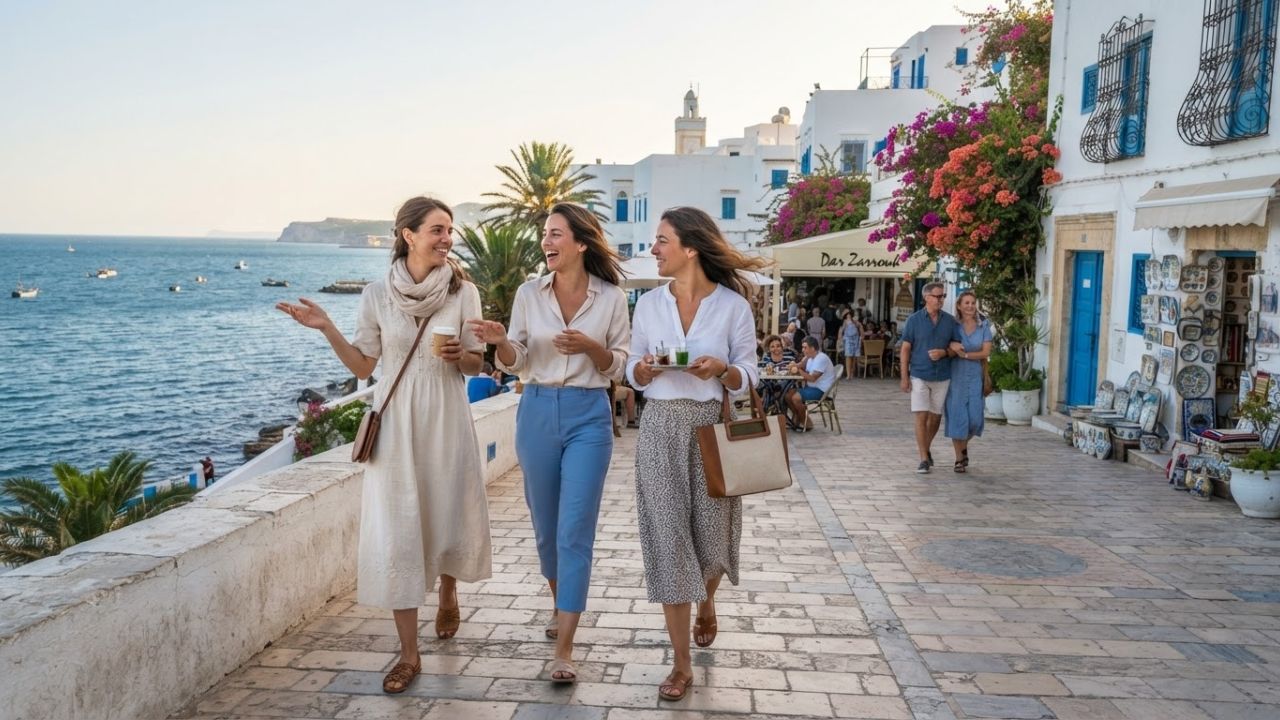
Image generated by AI
Tunisia has crossed 5.8 million international tourist arrivals in the first seven months of 2026 — a milestone that confirms the country's tourism recovery has moved beyond post-pandemic rebound into sustained structural growth — powered by Mediterranean beach demand, heritage tourism at ancient archaeological sites and historic old city districts, and the cultural magnetism of destinations such as Sidi Bou Said, the celebrated blue-and-white village perched above the Mediterranean near Tunis. The figure positions Tunisia as one of North Africa's strongest-performing destinations in 2026, with the summer season driving the majority of arrivals and foreign currency inflows continuing to strengthen the broader economy.
Tunisia's 5.8 Million International Arrivals Through July 2026: What the Number Means
TUNIS, August 21, 2026 — The crossing of the 5.8 million international visitor threshold through July 2026 is not a routine statistical update. It represents the point at which Tunisia's tourism sector has demonstrably shifted from recovery — catching up to pre-pandemic levels — to expansion, generating visitor volumes that reflect genuine, sustained demand from multiple international source markets rather than pent-up travel returning from the disrupted 2020-2022 period.
The summer season has been the primary engine of this performance. Tunisia's Mediterranean coastal resort offer — concentrated along the Gulf of Hammamet, the Sousse and Monastir coastlines, and the island of Djerba — draws the largest visitor volumes between June and September, when European package holiday demand peaks and independent travellers seek accessible, affordable Mediterranean alternatives to the more expensive and crowded resort markets of Spain, Greece, and Italy.
The 2026 summer has delivered strongly on this positioning. The combination of Tunisia's cost competitiveness, its direct flight connectivity from European hubs, and the quality of its coastal resort infrastructure has sustained a demand level that is translating into full hotels, high hospitality sector employment, and meaningful foreign currency generation for an economy in which tourism remains one of the most important hard currency earners.
Mediterranean Beaches, Sidi Bou Said, and Archaeological Sites: Why Tunisia's Visitor Mix Is Widening
Tunisia's tourism appeal has historically been anchored in its beach resort product, but the 5.8 million figure reflects a widening visitor mix that includes heritage tourists, cultural travellers, and experience-seeking visitors who are choosing Tunisia specifically for what it offers beyond the coastline.
Sidi Bou Said — the blue-and-white hilltop village overlooking the Bay of Tunis, less than 20 kilometres from the capital — has become one of Tunisia's most internationally recognised single destinations. Its distinctive architecture, panoramic Mediterranean views, traditional café culture, and walkable historic streets make it a natural social media draw and a core itinerary element for visitors combining Tunis with coastal stays. The village's visual identity has effectively become a brand asset for Tunisian tourism internationally.
Beyond Sidi Bou Said, Tunisia's ancient archaeological inventory is generating growing visitor interest. Roman-era ruins — including those at Dougga, Sbeitla, and El Jem (home to one of the best-preserved Roman amphitheatres outside Italy) — draw heritage tourists who would historically have travelled to Rome, Athens, or Cairo for equivalent ancient site access. Tunisia's comparative accessibility and lower visitor volumes at major sites offer an experience that overcrowded headline Mediterranean heritage destinations cannot easily replicate.
The medinas of Tunis, Sfax, Sousse, and Kairouan — several listed as UNESCO World Heritage Sites — add a distinct Islamic architectural and cultural heritage layer that appeals to travellers seeking authenticity in historic urban environments. Kairouan, one of Islam's holiest cities and home to the Great Mosque, attracts a dedicated religious and cultural tourism segment that contributes to arrivals outside the purely leisure-driven peak season.
Economic Impact: Foreign Currency, Employment, and the Tourism Multiplier Across Tunisian Regions
Tunisia's economy depends on tourism in a structural sense that goes beyond headline arrivals statistics. Foreign currency generated through international visitor spending is a direct input to macroeconomic stability — for a country that imports a significant share of its energy and consumer goods, the hard currency receipts from tourism provide a buffer that is particularly valuable during periods of global financial pressure.
The employment dimension is equally significant. Hotels, restaurants, tour operators, transport services, artisan markets, and the informal economy surrounding tourist sites employ hundreds of thousands of Tunisians directly and indirectly. In coastal governorates such as Nabeul-Hammamet, Sousse, Monastir, and Sfax, tourism activity is the primary economic driver during the summer months and a major employer year-round.
The 5.8 million arrival figure through July 2026 translates into spending distributed across all these sectors — hotel room nights, airport transfers, restaurant meals, local excursions, craft purchases, and the full spectrum of visitor expenditure that aggregates into Tunisia's tourism revenue total. Reports from the sector indicate that hospitality occupancy rates in the major coastal resort zones have been strong throughout the summer period, supporting hotel investment confidence and encouraging expansion of bed capacity in anticipation of continued demand growth.
Tunisia's North African Competition Position: How It Compares to Morocco and Egypt
Tunisia's 5.8 million arrivals through July 2026 places it in competitive context within North Africa's tourism market, where Morocco and Egypt are its primary competitors for European leisure traveller attention and spending.
Morocco — which runs a larger and more diversified tourism economy anchored by Marrakech, Fez, and Atlantic coastal destinations — has historically outperformed Tunisia in absolute arrival volumes and international brand recognition. Egypt's two-track tourism model (Red Sea beach resorts and Nile cultural tourism) targets different but partially overlapping market segments.
Tunisia's competitive positioning within this set rests on three factors: price competitiveness relative to equivalent Mediterranean alternatives; geographical proximity to European source markets (direct flight times from major European cities averaging two to three hours); and the availability of a beach-plus-heritage combination that Morocco and Egypt deliver less cohesively for a standard 7-14 day package holiday.
The 2026 summer season data suggests Tunisia is gaining on both competitors in the value-oriented European package market, where cost sensitivity has increased as travellers manage higher living costs in their home markets.
What the 5.8 Million Figure Means for Travellers Considering Tunisia in 2026
For the traveller evaluating Tunisia as a late-summer or autumn destination, the strong 5.8 million arrivals figure through July carries practical implications in both directions.
The positive: it confirms that international travel infrastructure to Tunisia — flight availability, hotel capacity, ground transport, tour operator offerings — is operating at scale and is reliable. A destination performing at this arrivals level has the commercial ecosystem to support independent and package travellers across a wide range of budgets and itinerary types.
The caution: peak-season availability at popular coastal resorts along the Gulf of Hammamet and in Djerba is under pressure during August, and travellers seeking specific hotels or specific room types should expect limited last-minute availability and premium pricing during the final weeks of the summer season. September and October — when beach conditions remain excellent, crowd levels drop, and pricing softens — represent the strongest value window for visitors flexible on timing.
Heritage tourism at interior sites (Dougga, El Jem, Kairouan) is less affected by peak-season crowding than the coastal resort zones and rewards visits at any time of year, with autumn temperatures making overland itinerary combinations across multiple sites more physically comfortable than in July and August.
FAQ: Tunisia International Tourism Arrivals 2026
How many international tourists has Tunisia received through July 2026? Tunisia recorded more than 5.8 million international tourist arrivals in the first seven months of 2026, marking the strongest performance in the country's recent tourism history and confirming the sector's shift from post-pandemic recovery to sustained expansion.
What is Sidi Bou Said and why is it important to Tunisia's tourism? Sidi Bou Said is a blue-and-white hilltop village overlooking the Mediterranean Sea near Tunis, approximately 20 kilometres from the capital. It is one of Tunisia's most internationally recognised cultural destinations, drawing visitors for its distinctive architecture, panoramic views, and traditional café culture.
Why is tourism important to Tunisia's economy? Tourism is one of Tunisia's most significant foreign currency earners, directly employing workers in hospitality, transport, and services sectors, and generating economic activity across coastal governorates and historic city destinations throughout the country.
How does Tunisia compare to Morocco and Egypt as a Mediterranean tourism destination? Tunisia competes primarily on price competitiveness, proximity to European source markets (2-3 hour flight times from major European cities), and a beach-plus-heritage combination product. Its coastal resorts and ancient archaeological sites deliver a Mediterranean holiday package at competitive price points relative to Morocco and Egypt.
Related Travel Guides
Disclaimer
This article is for informational and educational purposes only. It does not constitute legal, financial, or professional advice. While we strive to provide accurate and up-to-date information, travel policies, regulations, and conditions change rapidly. Always verify information with official sources before making travel decisions. Nomad Lawyer makes no representations about the accuracy, reliability, completeness, or suitability of the information provided. Readers should consult qualified professionals for advice specific to their circumstances. The views expressed in this article are those of the author and do not necessarily reflect the views of Nomad Lawyer.
Raushan Kumar
Founder & Lead Developer
Full-stack developer with 11+ years of experience and a passionate traveller. Raushan built Nomad Lawyer from the ground up with a vision to create the best travel and law experience on the web.
Learn more about our team →