
Airline Industry Faces Existential Crisis as IATA Warns of More Carrier Failures Following Spirit's Collapse
Breaking airline news and aviation industry updates for 2026.

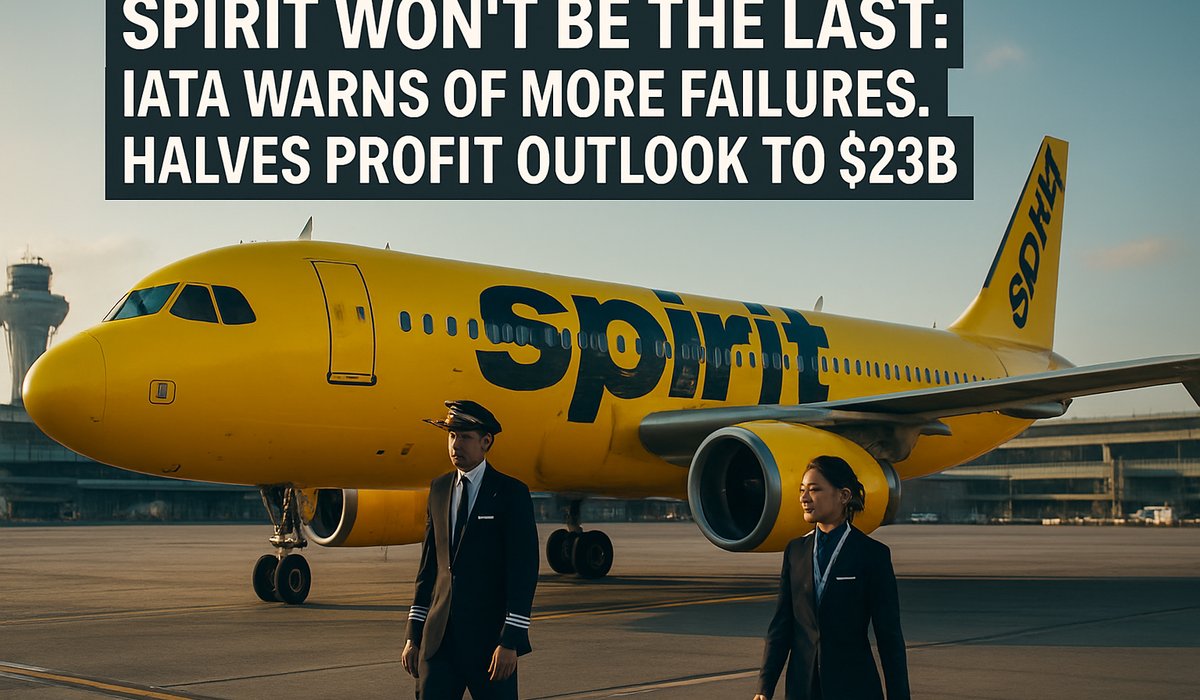
Image generated by AI
Airline Industry Faces Existential Crisis as IATA Warns of More Carrier Failures Following Spirit's Collapse
Geopolitical tensions and soaring jet fuel prices trigger industry-wide downgrades, threatening budget carriers globally
Spirit Airlines' Collapse Signals Broader Sector Vulnerability
The demise of Spirit Airlines, once a dominant force in American ultra-low-cost aviation, has sent shockwaves through the global airline industry, prompting the International Air Transport Association to issue an urgent warning: Spirit will not be the last carrier to fail under mounting financial pressures.
The Florida-based budget airline, which pioneered the aggressive ancillary revenue model of baggage fees and seat selection charges, ultimately could not withstand the convergence of escalating jet fuel costs and shifting market dynamics. Industry analysts point to geopolitical instability in the Middle East as a primary catalyst, driving crude oil prices higher and compressing already-thin profit margins that characterize the low-cost carrier sector.
IATA Slashes Profit Forecasts as Cost Pressures Mount
The International Air Transport Association has responded to deteriorating conditions by dramatically revising its financial outlook for the aviation sector. The organization cut its global industry profit forecast to $23 billion—a stark acknowledgment that the crisis extends far beyond a single carrier.
This substantial downgrade reflects widespread concerns about the sustainability of current business models for airlines operating on minimal margins. Budget carriers, which depend heavily on operational efficiency and high load factors to remain profitable, face particular vulnerability when input costs spike suddenly and dramatically.
Jet Fuel Prices and Geopolitical Risk Create Perfect Storm
The underlying driver of current industry turmoil stems from volatile energy markets. Recent Middle Eastern tensions have injected significant uncertainty into crude oil supply calculations, pushing jet fuel prices to levels that fundamentally challenge the economics of budget air travel.
For carriers like Spirit, which operated with some of the lowest cost structures in the industry but also the narrowest profit buffers, this combination proved insurmountable. Unlike legacy carriers with diversified revenue streams and stronger balance sheets, ultra-low-cost operators lack the financial resilience to absorb sustained fuel price shocks.
Broader Industry Implications
IATA's warning signals that additional carrier bankruptcies may be imminent, particularly among airlines with similar cost structures and limited financial reserves. The domino effect could reshape competitive dynamics in key markets, reduce travel options for price-sensitive passengers, and further consolidate market share among surviving carriers.
Industry observers emphasize that airline fees—from baggage charges to seat selection surcharges—may need to increase substantially across the sector to offset mounting operational costs. This could ultimately translate to higher total travel costs for consumers, offsetting the initial appeal of discounted base fares.
FAQ: Understanding the Airline Industry Crisis
Q: Why is Spirit Airlines' failure significant for the broader aviation industry? A: Spirit's collapse demonstrates that even established budget carriers cannot survive sustained spikes in jet fuel prices without substantial financial reserves, signaling systemic vulnerability across the ultra-low-cost sector.
Q: How do rising jet fuel prices affect airline fees and ticket pricing? A: As fuel costs consume larger portions of operating budgets, carriers often increase ancillary charges (baggage, seat selection) and base fares to maintain profitability.
Q: Which airlines are most vulnerable to the current crisis? A: Budget carriers with minimal profit margins and limited cash reserves face the greatest risk; legacy carriers with diversified revenue streams are better positioned to weather cost spikes.
Q: Could the aviation industry see consolidation? A: Yes. Weaker carriers may be acquired or fail entirely, potentially reducing competition and increasing fares in certain markets.
Q: When will airline travel costs stabilize? A: Cost stability depends largely on geopolitical developments affecting oil supplies and crude prices—factors beyond the aviation industry's direct control.
Related Travel Guides
-
Caribbean York Baby Born During Kennedy Airport Approach in 2026
-
South Korea Joins Singapore, Japan, Hong Kong in Asia's Airport Dining Takeover
External Resources
Disclaimer
This article is for informational and educational purposes only. It does not constitute legal, financial, or professional advice. While we strive to provide accurate and up-to-date information, travel policies, regulations, and conditions change rapidly. Always verify information with official sources before making travel decisions. Nomad Lawyer makes no representations about the accuracy, reliability, completeness, or suitability of the information provided. Readers should consult qualified professionals for advice specific to their circumstances. The views expressed in this article are those of the author and do not necessarily reflect the views of Nomad Lawyer.
Raushan Kumar
Founder & Lead Developer
Full-stack developer with 11+ years of experience and a passionate traveller. Raushan built Nomad Lawyer from the ground up with a vision to create the best travel and law experience on the web.
Learn more about our team →