
Spirit Airlines Cuts Fleet to 80 Aircraft in Chapter 11 Shake-Up
Spirit Airlines is slashing its fleet from 214 to fewer than 80 aircraft as part of its Chapter 11 bankruptcy restructuring, reducing debt from $7.4 billion to $2.1 billion, closing 11 bases, cutting 21 routes, and refocusing on high-demand markets by Q3 2026.

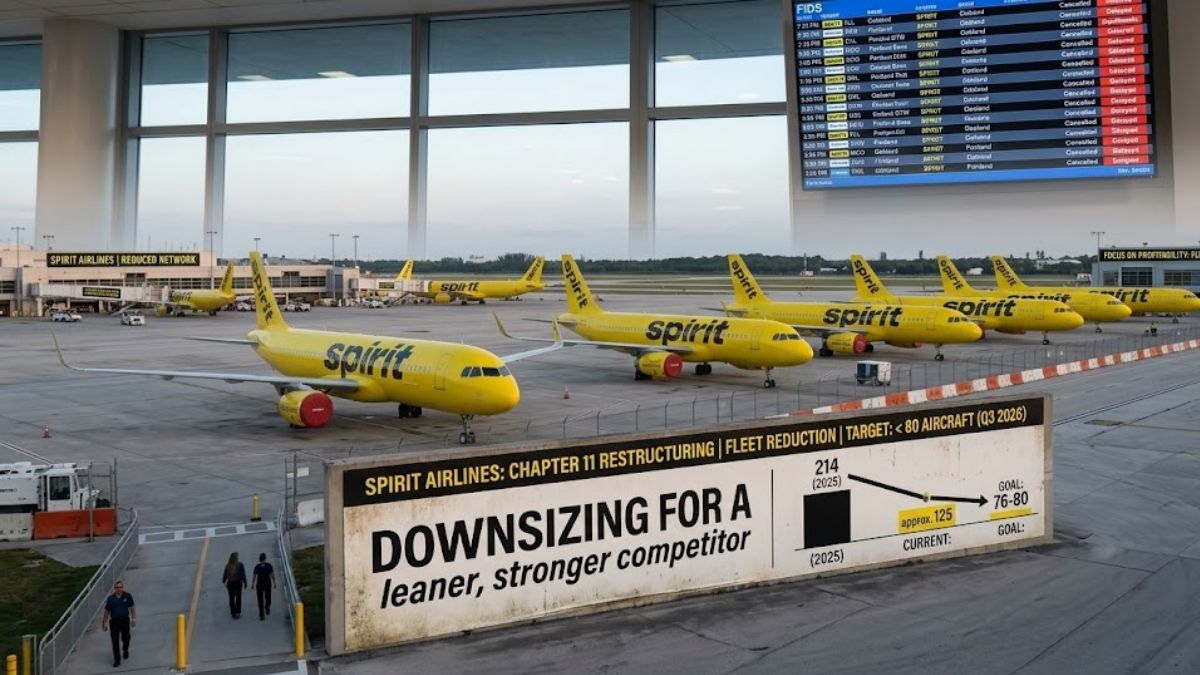
Image for illustrative purposes
**> Quick Summary
- Spirit Airlines is shrinking its fleet from 214 aircraft (at Chapter 11 filing in August 2025) to 76–80 aircraft by Q3 2026 — a reduction of more than 60% of its active fleet
- The airline is cutting its debt from $7.4 billion to $2.1 billion, closing 11 bases (including Portland and Oakland), and eliminating 21 routes as part of its restructuring plan
- Las Vegas Harry Reid International has seen a 71% year-on-year seat capacity cut — among the sharpest single-airport reductions in the restructuring
- Spirit plans to exit Chapter 11 as a leaner airline, refocusing on core markets including Fort Lauderdale, Orlando, Detroit, and New York, with fleet expansion resuming between 2027 and 2030**
Spirit Airlines, one of America's most recognised ultra-low-cost carriers, is executing one of the most dramatic fleet contractions in modern US aviation history. Under its ongoing Chapter 11 bankruptcy restructuring — filed in August 2025 — the carrier plans to reduce its active fleet from 214 aircraft at the time of filing to just 76–80 aircraft by the third quarter of 2026. As of March 2026, approximately 125 aircraft remain in operation, meaning a further 45 to 50 planes are still to be shed before the restructuring target is met.
Why Spirit Airlines Filed for Chapter 11
Spirit's path into Chapter 11 bankruptcy protection was shaped by a combination of factors that compounded over several years: a collapse of the planned Frontier Airlines merger, rising fuel costs, fierce competition from both legacy carriers and fellow ultra-low-cost rivals, and a mounting debt burden that became unsustainable when post-pandemic demand normalised.
The restructuring, overseen through the US bankruptcy court process, gives Spirit protection from creditors while it reorganises its finances and operations. The core objective: emerge as a significantly smaller but structurally solvent carrier capable of competing in a market that has changed fundamentally since Spirit built its original 214-aircraft network.
Fleet Reduction: From 214 to Fewer Than 80 Aircraft
The scale of the fleet reduction is striking by any benchmark. At peak, Spirit operated 214 Airbus narrowbody aircraft — primarily A320ceo and A321ceo variants — across a broad US domestic and Caribbean network. That number fell to around 125 as Spirit surrendered leased aircraft early in the restructuring process.
The remaining 45 to 50 aircraft to be returned will primarily exit through early lease terminations negotiated with lessors. The surviving fleet of 76–80 aircraft will be composed of Spirit's retained Airbus A320ceo and A321ceo units — older-generation aircraft with lower residual lease costs, suited to the airline's restructured operating economics.
Fleet reduction directly attacks Spirit's two largest cost lines: aircraft lease payments and the maintenance and crew obligations tied to each active airframe. A smaller fleet also simplifies scheduling, crew rostering, and ground handling logistics — operational efficiencies that compound as the airline rebuilds from a lower base.
11 Bases Closed, 21 Routes Cut — Network Rebuilt Around Profitability
Spirit has already moved decisively on its route network. The airline has closed 11 operating bases, including high-profile locations on both coasts — notably Portland and Oakland — and eliminated 21 routes identified as chronically unprofitable or directly exposed to competitive pressure from larger mainline carriers.
The impact has been particularly sharp in Las Vegas, where Spirit has slashed seat capacity at Harry Reid International Airport (KLAS) by 71% year-on-year — a contraction that has materially altered the competitive dynamics on leisure routes out of one of America's busiest vacation markets.
The surviving network is being rebuilt around a different philosophy: fewer routes, higher utilisation, stronger yield. Spirit's restructured network will concentrate on core high-demand markets where it retains a genuine cost and frequency advantage, rather than seeking blanket coverage across the US map.
Debt Slashed From $7.4 Billion to $2.1 Billion
The financial restructuring running in parallel with the operational changes is equally ambitious. Spirit is targeting a reduction in total debt from approximately $7.4 billion to around $2.1 billion — a write-down of more than $5 billion achieved through a combination of creditor negotiations, lease returns, and court-supervised debt restructuring.
Reaching a debt load of $2.1 billion would place Spirit on a structurally different operating footing — one where debt service is manageable relative to a leaner revenue base. The airline's leadership has framed this deleveraging as the essential precondition for any sustainable recovery.
Premium Push: Spirit First and Premium Economy
One of the more counter-intuitive elements of Spirit's restructuring strategy is its move upmarket. The airline is expanding its Spirit First and Premium Economy cabin offerings — a deliberate effort to capture higher-yield passengers willing to pay more for comfort, while the base ultra-low-cost product continues to attract budget-focused travelers.
This bifurcated cabin strategy mirrors moves made by fellow restructured carriers and reflects a broader industry reality: pure price competition without any differentiation has become increasingly difficult to sustain as legacy carriers like Delta, United, and American have themselves pushed into lower fare tiers and bundled product offerings.
Core Markets: Fort Lauderdale, Orlando, Detroit, New York
Spirit's restructured network is explicitly designed around four core market clusters: Fort Lauderdale, Orlando, Detroit, and the New York City area. These markets combine high passenger volumes, strong leisure and VFR (visiting friends and relatives) demand, and airport infrastructure where Spirit has historically maintained competitive slot or gate access.
The airline intends to increase aircraft utilisation during peak travel periods — concentrating capacity on summer and holiday windows — while maintaining flexibility to scale back during off-peak seasons. This dynamic capacity model is designed to protect yield without locking in fixed costs during lower-demand periods.
Fleet expansion is planned to resume between 2027 and 2030, once the restructuring is complete and the airline's financial position has stabilised.
The Fuel Cost Wildcard
A risk factor that sits outside Spirit's direct control is aviation fuel pricing. Global jet fuel costs remain volatile, shaped by geopolitical developments in the Middle East and broader crude oil market dynamics. For an ultra-low-cost carrier where fuel represents a disproportionately large share of operating costs relative to higher-yielding network carriers, sustained fuel price elevation is a structural threat to the post-restructuring financial model.
Spirit's ability to pass fuel cost increases through to passengers via fare adjustments — without triggering demand destruction among its price-sensitive core customer base — will be one of the key tests of the restructured airline's commercial resilience.
Key Facts at a Glance
| Detail | Data |
|---|---|
| Bankruptcy filing | Chapter 11 — August 2025 |
| Fleet at filing | 214 aircraft |
| Current fleet (March 2026) | ~125 aircraft |
| Target fleet (Q3 2026) | 76–80 aircraft |
| Further aircraft to be returned | 45–50 planes |
| Aircraft types retained | Airbus A320ceo, A321ceo |
| Bases closed | 11 (including Portland, Oakland) |
| Routes eliminated | 21 |
| Las Vegas capacity cut | 71% year-on-year |
| Debt reduction target | $7.4 billion → $2.1 billion |
| Core markets post-restructuring | Fort Lauderdale, Orlando, Detroit, New York |
| Fleet expansion resumption | 2027–2030 |
What This Means for Travelers
If you fly Spirit Airlines regularly — particularly on routes that have been cut or from bases that have closed — here is what to watch:
- Check your upcoming Spirit booking at spirit.com — routes and schedules are actively changing as the restructuring progresses
- Know your rights — if Spirit cancels your flight, the US Department of Transportation entitles you to a full cash refund, not just a voucher
- Las Vegas travelers — Spirit's 71% seat reduction at Harry Reid International means significantly less availability; book alternatives early via competing carriers
- Portland and Oakland passengers — Spirit has closed operations at these bases; find alternative carriers for routes you previously relied on Spirit for
- Premium product travelers — Spirit's expanded Spirit First and Premium Economy cabins may now offer a competitive option on surviving routes
Frequently Asked Questions
Is Spirit Airlines still flying during its Chapter 11 restructuring? Yes. Spirit Airlines continues to operate flights throughout its Chapter 11 restructuring process. Chapter 11 bankruptcy protection allows a company to keep operating while it reorganises its finances and operations under court supervision. Current schedules are reduced compared to pre-bankruptcy levels as the airline sheds aircraft and routes.
How many Spirit Airlines flights have been cancelled due to the restructuring? Spirit has eliminated 21 routes and closed 11 operating bases — including Portland and Oakland — as part of its restructuring plan. Las Vegas Harry Reid International has seen a 71% year-on-year seat capacity reduction. Affected passengers should check their bookings at spirit.com and contact Spirit directly for rebooking or refund options.
What happens to my Spirit Airlines ticket if the airline exits bankruptcy smaller? Tickets on operating routes remain valid. If Spirit cancels a specific flight, passengers are entitled to a full cash refund under US DOT consumer protection rules. Passengers on eliminated routes should contact Spirit for rebooking or refund processing as soon as possible.
When will Spirit Airlines fully emerge from Chapter 11 bankruptcy? Spirit Airlines has not confirmed a final exit date from Chapter 11 as of March 2026. The airline's target is to have its fleet reduced to 76–80 aircraft by Q3 2026, with fleet expansion resuming between 2027 and 2030 as the restructured airline stabilises. Follow updates via Reuters Aviation and Simple Flying for the latest restructuring developments.
Related Travel Guides
Ethiopian Airlines Moves to JFK's New Terminal One — Africa Travel Transformed
Newark Liberty Airport Meltdown: 40+ Flights Axed — Berlin to Miami Hit
Singapore, Thai & AirAsia Bet on SAF to Protect Asia's $300B Tourism Sector
Disclaimer
This article is for informational and educational purposes only. It does not constitute legal, financial, or professional advice. While we strive to provide accurate and up-to-date information, travel policies, regulations, and conditions change rapidly. Always verify information with official sources before making travel decisions. Nomad Lawyer makes no representations about the accuracy, reliability, completeness, or suitability of the information provided. Readers should consult qualified professionals for advice specific to their circumstances. The views expressed in this article are those of the author and do not necessarily reflect the views of Nomad Lawyer.
Raushan Kumar
Founder & Lead Developer
Full-stack developer with 11+ years of experience and a passionate traveller. Raushan built Nomad Lawyer from the ground up with a vision to create the best travel and law experience on the web.
Learn more about our team →