
Southwest Airlines Pet Policy Under Scrutiny After Belgian Malinois Disrupts Florida-Bound Flight
Southwest Airlines Pet Policy Under Scrutiny After Belgian Malinois Disrupts Florida-Bound Flight

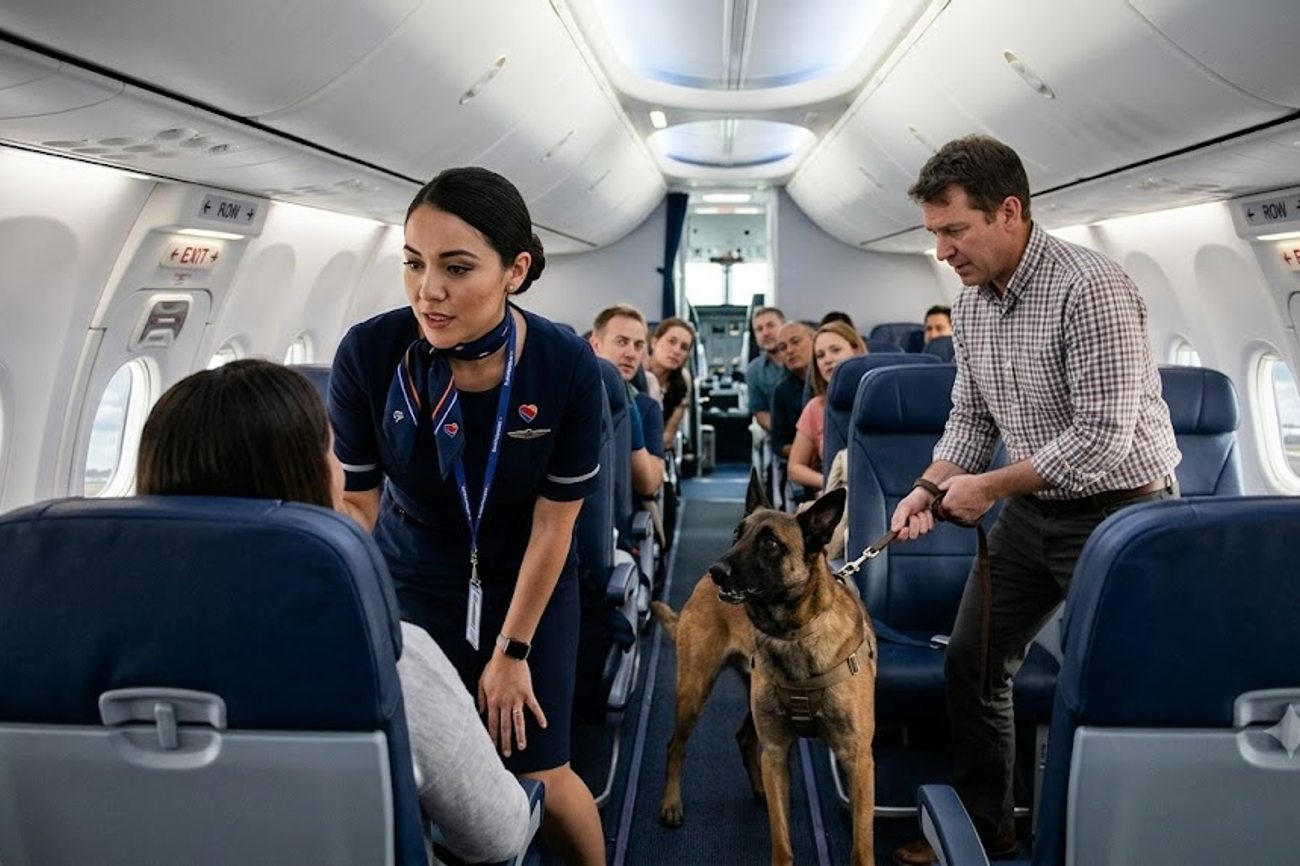
Image generated by AI
A Belgian Malinois traveling in seat 1C of a Boeing 737 MAX 8 caused a significant sanitation crisis just 30 minutes before landing in Florida on September 15, 2026. While the flight from St. Louis to Fort Lauderdale was otherwise routine, the animal's sudden distress led to a substantial liquid accident in the forward cabin, forcing crew members to scramble with paper towels to contain the mess and the accompanying odor.
The Friction of In-Cabin Animal Travel
The incident on Southwest flight WN4981 highlights a growing tension in modern aviation: the balance between accessibility for service animals and the sanitary realities of a pressurized metal tube. For the passengers on this 2-hour 16-minute journey, the flight became a lesson in the unpredictability of animal behavior. The dog, which had remained settled for the majority of the trip, reportedly became restless and began scratching at the cabin carpet as the aircraft approached South Florida. The situation peaked when another traveler approached the forward lavatory, triggering the animal's accident near the first row.
This event underscores the logistical nightmare flight crews face when a "disruption" isn't a difficult passenger, but a biological one. Because the accident occurred in one of the most heavily trafficked areas of the plane—the forward galley and lavatory zone—the impact on the passenger experience was immediate. Yet, from an operational standpoint, the aircraft (registration N8975K) proved the resilience of airline turnaround protocols. Despite the mess, the plane arrived at Fort Lauderdale-Hollywood International Airport at 5:40pm and was cleaned and inspected quickly enough to operate flight WN1478 to Baltimore later that same evening.
What Makes the U.S. Domestic Flight Experience Different
Navigating the U.S. skies requires an understanding of the strict, often misunderstood, legal divide between "pets" and "service animals." In the United States, the U.S. Department of Transportation maintains a rigid definition: a service animal is specifically a dog trained to perform tasks for a person with a disability. This is a critical distinction because it dictates where the animal sits and how it is managed.
For a standard pet on Southwest, the rules are absolute: the animal must stay inside an approved carrier tucked under the seat. However, service dogs are granted access to the cabin floor, provided they are harnessed or tethered to their handler. The WN4981 incident, involving a dog in seat 1C, falls into this latter category. While the Air Carrier Access Act protects the right of service animals to fly, that protection is not a blank check. Federal law allows airlines to refuse transport if an animal poses a direct health threat or creates a significant disruption to cabin service.
The nuance here is that "disruption" is a broad term. Southwest explicitly lists urinating or defecating in the cabin as disruptive behavior. When these two worlds—legal accessibility and sanitary necessity—collide, the crew is left to manage the fallout in real-time, often with nothing more than a roll of paper towels and a prayer for a fast turnaround.
Visitor Insider Tips
If you are traveling through major U.S. hubs like St. Louis Lambert or Fort Lauderdale-Hollywood, keep these local and operational nuances in mind to ensure a smoother trip:
- The "Forward Cabin" Trade-off: While seats in the first few rows (like 1C) offer the fastest exit, they are also the highest-traffic zones for passengers heading to the lavatory. If you are sensitive to odors or crowds, opt for a mid-cabin seat to avoid the "bottleneck" congestion of the forward galley.
- Pet Documentation: If you are flying with a pet, do not rely on the check-in counter to explain the rules. Review the Southwest Airlines pet policy in detail before arriving. Ensure your carrier is the exact dimensions required; U.S. carriers are increasingly strict about carriers that impede foot traffic.
- Timing the Florida Arrival: Flights into Fort Lauderdale often face congestion. If your arrival is scheduled for late afternoon (like the 5:55pm scheduled arrival of WN4981), expect potential taxiing delays. Use this time to ensure your luggage is organized for a quick exit.
- Service Animal Etiquette: If you encounter a service dog in the cabin, the local cultural norm is to ignore the animal entirely. Do not pet, feed, or distract the dog, as they are working. If an animal is causing a disruption, notify a flight attendant quietly rather than confronting the handler.
Cultural and Environmental Context
The presence of high-drive breeds like the Belgian Malinois in aircraft cabins reflects a broader cultural shift in the U.S. regarding the role of working dogs. These animals are often used not just for physical disabilities, but for psychiatric support and medical alert tasks. However, the environmental stress of a flight—pressure changes, confined spaces, and the scent of hundreds of strangers—can trigger "biological failures" even in well-trained animals.
Passengers traveling with pets must adhere to specific size and health requirements to ensure safety and comfort in the cabin. Detailed guidelines regarding approved carriers and prohibited breeds can be found on the Southwest Airlines pet policy page.
This creates a complex social dynamic. On one hand, there is a strong push for inclusivity and the legal protection of service animal users. On the other, there is the collective expectation of a sterile, controlled environment in the cabin. When an accident occurs, it often sparks a debate between passenger comfort and disability rights. From an environmental perspective, the rapid turnaround of aircraft like N8975K relies on industrial-strength cleaning agents that must be used quickly and effectively to ensure the cabin is sanitary for the next leg of the journey, highlighting the invisible labor of ground crews who maintain the fleet's hygiene.
FAQ: Visiting Florida via St. Louis 2026
What is the best time to visit Fort Lauderdale? The ideal window is December through April to avoid the extreme humidity and hurricane season. This period coincides with the peak "snowbird" season, so booking accommodations and flights well in advance is essential.
Do I need a visa to fly from St. Louis to Fort Lauderdale? If you are a U.S. citizen, no. International travelers must check their specific nationality requirements via the official U.S. Customs and Border Protection website to ensure they have the correct visa or ESTA.
How do I get from Fort Lauderdale-Hollywood International Airport to the city center? The most efficient methods are ride-sharing apps (Uber/Lyft) or the local shuttle services. For those on a budget, the Broward County Transit buses provide reliable access to the downtown area.
Is it safe for solo travelers to navigate these airports? Yes, both St. Louis Lambert and Fort Lauderdale-Hollywood are highly secure and well-staffed. Stick to official transport queues and keep your belongings secure in crowded boarding areas.
When the unexpected happens at 30,000 feet, the only thing more important than the destination is the cleanup crew.
Related Travel Guides
- Loganair Honours Aviation Pioneer as Women Continue Shaping the Future of UK Air Travel
- Air India Named Best Airline in India and Best Airline Staff in South Asia at Skytrax World Airline Awards 2026
- Australia Airports Restore E Gates After 14 Hour Outage Disrupts Sydney, Brisbane and Melbourne Travel, New Update
Disclaimer
This article is for informational and educational purposes only. It does not constitute legal, financial, or professional advice. While we strive to provide accurate and up-to-date information, travel policies, regulations, and conditions change rapidly. Always verify information with official sources before making travel decisions. Nomad Lawyer makes no representations about the accuracy, reliability, completeness, or suitability of the information provided. Readers should consult qualified professionals for advice specific to their circumstances. The views expressed in this article are those of the author and do not necessarily reflect the views of Nomad Lawyer.
Preeti Gunjan
Contributor & Community Manager
A passionate traveller and community builder. Preeti helps grow the Nomad Lawyer community, fostering engagement and bringing the reader experience to life.
Learn more about our team →