
Australia Airports Restore E Gates After 14 Hour Outage Disrupts Sydney, Brisbane and Melbourne Travel, New Update
A 14-hour technical failure of automated e-gates disrupted border processing across Sydney, Brisbane, and Melbourne before systems were restored on Friday.

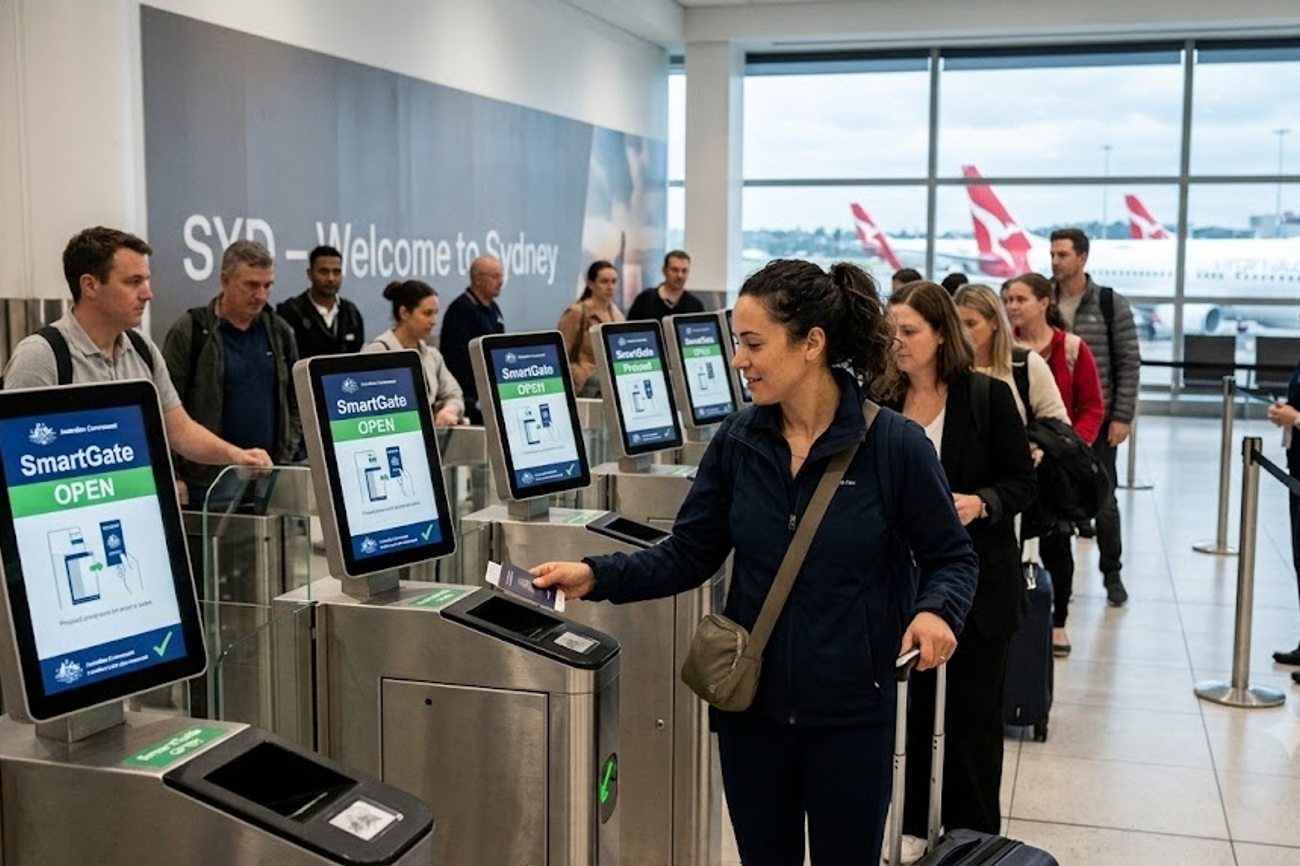
Image generated by AI
A crippling 14-hour technical blackout that shuttered automated electronic passport gates from 9:00 PM Thursday until shortly after 11:00 AM Friday forced thousands of international travelers into manual border queues across Australia’s primary gateway airports. Striking simultaneously across Sydney Airport (SYD), Brisbane Airport (BNE), and Melbourne Airport (MEL), the system collapse disabled both inbound and outbound automated SmartGates. The disruption arrived at an exceptionally vulnerable operational moment, coinciding with the start of the spring school holiday travel rush in Queensland and Victoria—a period during which Brisbane Airport alone had projected a 6.1 percent surge in international passenger volume between September 18 and October 12.
Incident Architecture: The 14-Hour Biometric Blackout Across Eastern Seaboard Hubs
The operational disruption originated within the centralized biometric processing network administered by the Department of Home Affairs and the Australian Border Force (ABF). When the electronic gates went offline at approximately 9:00 PM on Thursday, automated facial recognition verification and digital passport chips could no longer interface with national security databases. Because the failure was systemic rather than localized to a single municipal terminal, automated border clearance ground to a complete halt across the country's three busiest eastern airports.
To prevent total terminal paralysis, the Australian Border Force activated emergency contingency protocols, shifting 100 percent of passenger clearance to physical officer desks. Off-duty border personnel were summoned for emergency shifts as overnight long-haul arrivals from North America, Asia, and the Pacific landed in rapid succession. International departures faced equal friction, with outbound passengers experiencing severe security line spillbacks into airport check-in halls.
The timing proved particularly challenging for Brisbane Airport, which had just opened a newly relocated 12-lane passport control area inside its International Terminal. Designed specifically to streamline passenger movement and eliminate physical bottlenecks ahead of the school holiday peak, the physical facility found its technological foundation abruptly neutralized on opening day. While technicians restored full server connectivity shortly after 11:00 AM on Friday, the episode exposed the acute operational dependency modern aerodromes place on automated digital infrastructure.
Gateway Vulnerability and Holiday Passenger Volume Matrix
The collapse of automated processing highlighted the stark capacity difference between algorithmic border control and physical human inspection:
| Operational Metric | Automated SmartGate Standard | Emergency Manual ABF Clearance | Impact Across Major Australian Gateways |
|---|---|---|---|
| Average Clearance Velocity | 15 to 25 seconds per traveler | 90 to 180 seconds per traveler | Massive queue expansion in arrival and departure halls |
| Hourly Throughput per Lane | 200 to 300 passengers per gate | 30 to 50 passengers per officer | Processing capacity reduced by roughly 75% during peak banks |
| Brisbane Airport (BNE) Impact | Facilitates forecast +6.1% holiday surge | New 12-lane hall forced to manual desk vetting | Queues spilled into international departure retail concourses |
| Sydney Airport (SYD) Impact | Primary high-volume gateway clearance | Emergency deployment of frontline ABF officers | Delays across morning international widebody arrival banks |
| Melbourne Airport (MEL) Impact | High-density curfew-free night operations | Physical passport verification on all departing fliers | Inbound customs bottlenecks through baggage reclaim zones |
| Outage Window | Operational 24/7 under normal state | Activated 9:00 PM Thursday to 11:00 AM Friday | 14 continuous hours of manual contingency operations |
By the time systems returned to normal on Friday morning, ground handlers, airport customer care teams, and airline station managers had spent the night managing cascading flight delays. While safety and border integrity were maintained throughout the crisis, the deceleration of passenger processing rippled through aircraft turnaround schedules, threatening departure slot compliance across the trans-Tasman and long-haul international networks.
Expert Analysis: The Fragility of Centralized Border Automation
For travelers flying into or out of Australia, the direct consequence of repeated border IT failures is an erosion of travel predictability during peak holiday periods. When automated e-gates function as designed, an arriving international traveler with a biometric passport clears immigration in less than two minutes. However, when the centralized database fails, border clearance throughput drops by nearly 75 percent. For passengers with tight domestic flight connections or pre-booked ground transport, a 14-hour outage transforms a seamless transit into missed flights and significant rebooking expenses.
The pricing pressure this creates means airlines face mounting operational costs that are ultimately reflected in ancillary fees and airfares. When terminal immigration halls become gridlocked, arriving aircraft cannot disembark passengers promptly, forcing aircraft to hold on taxiways with auxiliary power units running. Ground handling equipment stands idle, departure slots are missed, and flight crews risk exceeding their legal flight duty periods under civil aviation safety regulations. Carriers operating out of Sydney, Melbourne, and Brisbane must absorb these operational inefficiencies, creating friction across airline cost structures.
Additionally, this incident reveals the inherent vulnerability of Australia’s centralized border architecture. Modern airports have invested billions of dollars in terminal expansions, automated baggage routing, and architectural upgrades—such as Brisbane's 12-lane border zone. Yet, these physical assets remain entirely dependent on a single digital pipeline. If the national biometric matching server suffers a communication outage or software failure, state-of-the-art terminal facilities are immediately rendered useless.
While the Australian Border Force responded effectively by deploying reserve officers, manual processing cannot scale to meet modern passenger volumes. With international travel demand surpassing pre-pandemic records and major airports gearing up for holiday passenger records, federal authorities must establish decentralized fail-safe architectures. Until border control agencies implement local edge-computing backups that can process biometric credentials during centralized network blackouts, travelers remain vulnerable to sudden systemwide delays.
Key Takeaways
- 14-Hour Technical Blackout: Automated passport e-gates collapsed across Sydney, Melbourne, and Brisbane airports from 9:00 PM Thursday until after 11:00 AM Friday.
- School Holiday Collision: The failure coincided with the start of peak school holidays in Queensland and Victoria, hitting Brisbane Airport as international passenger traffic was forecast to climb 6.1 percent.
- Full Manual Intervention: Australian Border Force officers transitioned to 100 percent manual passport inspections for both arriving and departing international fliers.
- Brisbane Infrastructure Irony: The outage occurred immediately following the debut of Brisbane Airport’s new 12-lane passport control area, neutralizing its intended efficiency.
- Underlying IT Vulnerability: The incident marks the latest in a recurring series of digital border outages, highlighting the fragility of centralized immigration databases.
FAQ: Australia Airport E-Gate Outage and Travel Disruptions 2026
What caused the 14-hour e-gate outage at Australian airports?
The outage stemmed from a nationwide technical failure within the centralized automated border processing systems managed by the Department of Home Affairs, affecting biometric e-gates across major hubs.
Which airports were affected by the passport gate failure?
The failure impacted international arrivals and departures at Australia’s three busiest eastern gateways: Sydney Airport (SYD), Melbourne Airport (MEL), and Brisbane Airport (BNE).
Are the electronic passport gates currently working in Australia?
Yes. Automated SmartGate systems were fully restored shortly after 11:00 AM on Friday, and passenger processing queues have returned to normal operating speeds.
What happens if border e-gates fail while I am traveling?
Border security personnel shift to manual passport verification at physical desks. Travelers should expect longer queues and allow at least three hours for international departures during holiday periods.
[As airports invest billions in physical passenger terminals, the true resilience of international travel remains tethered to the lines of code running border servers.]
Related Travel Guides
Cathay Pacific Celebrates Skytrax Success With World’s Best Cabin Crew and Lounge Recognition
Japan Airlines Sets New Green Aviation Milestone With CORSIA Carbon Removal Partnership
10 Best Airline Lounges at JFK Airport: Complete Terminal Guide 2026
Disclaimer
This article is for informational and educational purposes only. It does not constitute legal, financial, or professional advice. While we strive to provide accurate and up-to-date information, travel policies, regulations, and conditions change rapidly. Always verify information with official sources before making travel decisions. Nomad Lawyer makes no representations about the accuracy, reliability, completeness, or suitability of the information provided. Readers should consult qualified professionals for advice specific to their circumstances. The views expressed in this article are those of the author and do not necessarily reflect the views of Nomad Lawyer.
Raushan Kumar
Founder & Lead Developer
Full-stack developer with 11+ years of experience and a passionate traveller. Raushan built Nomad Lawyer from the ground up with a vision to create the best travel and law experience on the web.
Learn more about our team →