
Southwest Airlines Brings First Airport Lounges to Texas and Maryland in Major Premium Travel Shift
Southwest Airlines breaks ground on its first-ever airport lounges across Austin, Baltimore, Honolulu, and Nashville, signaling a high-stakes premium strategy with Chase.

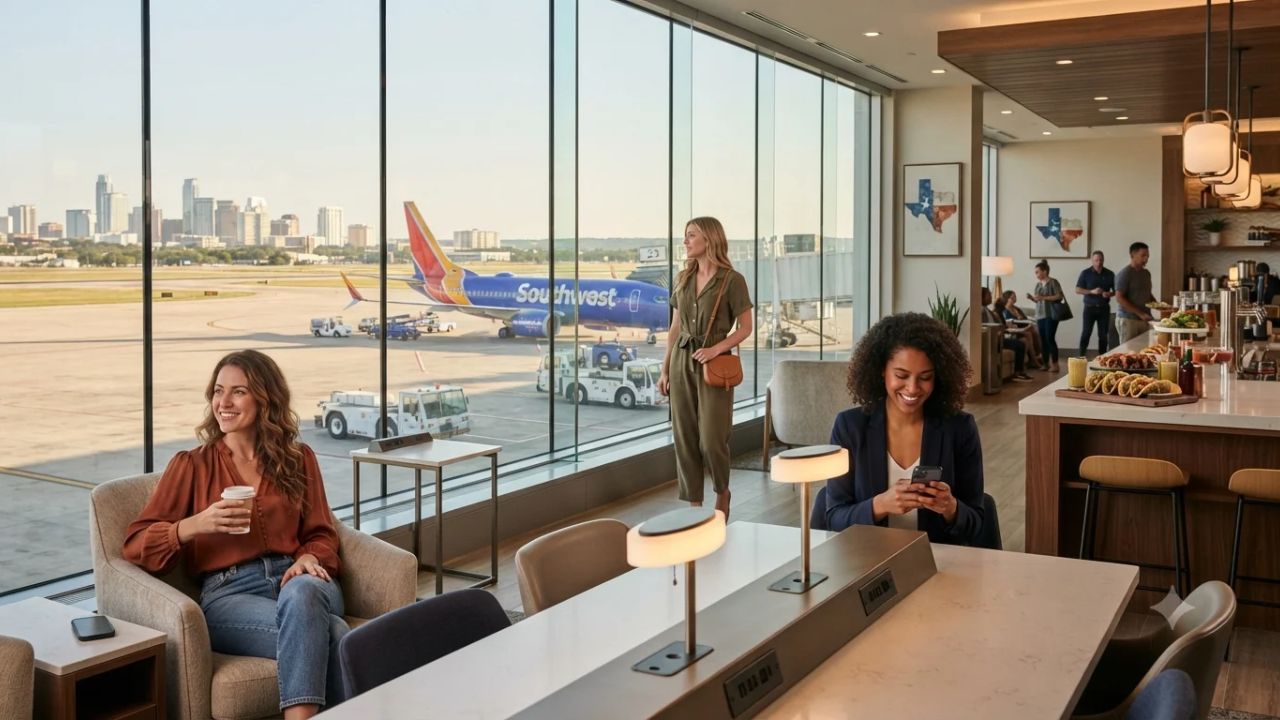
Image generated by AI
A planned network of at least 11 airport lounges alongside an extra 3 to 5 inches of premium seat pitch signals the definitive end of single-class egalitarian air travel at America's largest domestic carrier. By breaking ground on dedicated airport clubs across Texas, Maryland, Hawaii, and Tennessee, the carrier is dismantling more than five decades of operational orthodoxy to protect high-margin corporate and cardholder revenue from legacy rivals. The initial four facilities mark the start of an expansive network rather than an isolated brand trial, with passenger doors scheduled to open from late 2027 onwards. The shift reflects intense commercial pressure across the domestic aviation sector, where premium cabin monetization and co-branded credit card swipe fees dictate airline profitability far more than baseline economy ticket sales. For millions of travelers accustomed to boarding by lettered plastic stanchions and selecting any open seat, the terminal journey is transforming into a strictly partitioned ecosystem that begins long before passing through the aircraft boarding door.
The Strategic Pivot to Late 2027: Breaking Ground in Four Core Markets
Southwest Airlines selected four highly distinct commercial markets to inaugurate its lounge network: Austin-Bergstrom International Airport in Texas, Baltimore/Washington International Thurgood Marshall Airport in Maryland, Daniel K. Inouye International Airport in Honolulu, Hawaii, and Nashville International Airport in Tennessee. Active construction has started at all four facilities, establishing an initial operational footprint designed to address varied passenger demographics. Following this four-station rollout, the carrier confirmed that at least 7 additional lounges are planned across high-demand business and leisure markets, taking the announced program to a minimum of 11 locations over the following years.
The geographic distribution of these initial locations reveals a calculated commercial strategy. In Austin, the airline commands significant market share within its home state of Texas, where technology sector expansions and high-yield corporate travel demand dedicated ground hospitality to compete with legacy carrier clubs. Baltimore/Washington serves as an essential Mid-Atlantic fortress for Southwest Airlines, capturing federal government travel, defense contractors, and connecting passengers across the broader Washington metropolitan area. In Nashville, convention delegates and discretionary entertainment travelers generate consistent demand for premium pre-flight spaces. Honolulu introduces an entirely different operating environment: transpacific flights involve extended block hours, high baggage volume, and prolonged airport dwell times, creating an atmosphere where leisure vacationers readily invest in quiet seating, power connectivity, and private dining.
This terminal investment builds on the structural transformation launched on 27 January 2026, when the carrier officially ended its open-seating model and began operating assigned seating. That operational shift eliminated boarding scrums and enabled the airline to monetize forward cabin rows. Combined with upcoming lounge facilities, the strategy positions the airline directly against legacy competitors that have long leveraged airport clubs to shield corporate accounts from low-cost competition.
Cabin Segmentation and Terminal Infrastructure: The Data Behind the Shift
The overhaul of the passenger journey divides into two synchronized tiers: aircraft interior re-engineering and terminal-level access control. Onboard, aircraft maintain a single physical cabin configuration without bulkheads or separate galley curtains, preserving quick thirty-minute aircraft turnarounds at the gate. However, seat pitch is now tiered across three distinct seating categories. Extra Legroom rows provide between 3 and 5 additional inches of pitch compared with Standard seats, located in the forward cabin and along emergency exit rows. Preferred seats offer standard legroom with prime forward cabin placement for faster deplaning, while Standard seats occupy the remainder of the fuselage.
To monetize these cabin divisions, the airline established four structured fare bundles: Basic, Choice, Choice Preferred, and Choice Extra. Travelers purchasing Choice Extra receive access to available Extra Legroom seating at the time of reservation. The Choice Preferred tier provides access to Preferred or Standard seating, while Basic purchasers face unbundled fees to secure advance seat assignments.
On the ground, the airline is co-developing its lounge network in partnership with JPMorgan Chase. The airport facilities will incorporate design philosophies and service elements associated with the Chase Sapphire Reserve Lounge Network, combining dedicated quiet work spaces, charging stations, pre-flight relaxation areas, and localized food and beverage menus crafted from regional culinary traditions. Access to the network will center on a new premium Southwest Rapid Rewards credit card issued by Chase, scheduled to launch in 2027.
| Airport Facility | Metropolitan Jurisdiction | Rollout Timeline | Infrastructure Focus |
|---|---|---|---|
| Austin-Bergstrom International Airport | Austin, Texas | Late 2027 onwards | Technology sector corporate travel and regional Texas business |
| Baltimore/Washington International Thurgood Marshall Airport | Baltimore, Maryland | Late 2027 onwards | Government, defense, and Mid-Atlantic connecting passenger flows |
| Daniel K. Inouye International Airport | Honolulu, Hawaii | Late 2027 onwards | Transpacific leisure dwell times and long-haul vacationers |
| Nashville International Airport | Nashville, Tennessee | Late 2027 onwards | Entertainment industry executives, convention visitors, and regional tourism |
| Future Expansion Phase | Networkwide | Subsequent years | At least 7 additional high-demand commercial stations |
| Seat and Fare Category | Pitch and Space Variance | Cabin Placement | Included Fare Bundles | Booking Access Rules |
|---|---|---|---|---|
| Extra Legroom | +3 to +5 inches of pitch | Front rows and exit rows | Choice Extra | Selected at booking; paid add-on for lower fares |
| Preferred | Standard seat pitch | Forward cabin rows | Choice Preferred, Choice Extra | Included at booking for select bundles |
| Standard | Standard seat pitch | Mid-cabin to rear rows | Basic, Choice | Assigned at check-in or fee-based advance pick |
Expert Analysis: The High-Stakes Economics Behind Co-Branded Card Monetization
For travelers booking these routes, the direct consequence is that ticket purchases alone no longer grant entry to the carrier's highest tier of service. Modern airline balance sheets depend heavily on loyalty programs and financial services partnerships, with co-branded credit card agreements generating billions of dollars in high-margin pre-tax income. According to financial trends monitored by the Bureau of Transportation Statistics, non-ticket ancillary revenue and mileage sales to banking institutions represent the primary buffer against escalating fuel and labor expenses across US aviation.
The pricing pressure this creates means the carrier must transition from selling commodity air transit to operating an integrated travel ecosystem. Under the historical model, a road warrior flying fifty segments annually received identical airport amenities to an occasional flyer on an ultra-discounted fare. That egalitarian structure became an operational liability when legacy network carriers began capturing high-yield travelers through lie-flat domestic seats, priority security access, and private airport retreats. By partnering with Chase to launch a dedicated premium credit card in 2027, the airline creates a recurring annual fee revenue stream that finances terminal real estate while cementing customer retention.
The cause-and-effect dynamic inside airport concourses is equally clear. Because the airline refuses to install physical cabin dividers or reduce total seat counts, it preserves the single-type fleet architecture essential for rapid gate turns. Yet by selling 3 to 5 inches of added legroom and segmenting boarding zones by status, fare bundle, and seat location, the airline extracts premium yield without the operating drag of traditional multi-cabin aircraft. In leisure markets like Honolulu and high-growth commercial centers like Austin, this segmentation captures vacationers willing to pay for pre-flight dining and corporate executives requiring quiet workspaces with high-speed connectivity. The direct result will be a bifurcated traveler experience: price-conscious flyers who receive a functional, unbundled budget flight, and premium cardholders whose journeys begin hours earlier inside private, regionally inspired airport retreats.
Key Takeaways
- Initial Four-Station Deployment: Construction has started on dedicated facilities at Austin-Bergstrom International Airport, Baltimore/Washington International Thurgood Marshall Airport, Daniel K. Inouye International Airport, and Nashville International Airport, with passenger entry scheduled for late 2027 onwards.
- Multi-Year Network Expansion: Southwest plans to construct at least 7 additional airport lounges across high-demand business and leisure corridors, establishing a total network of at least 11 locations.
- Premium Financial Partnership: Access will center on an all-new premium Southwest Rapid Rewards credit card issued by Chase, launching in 2027 and incorporating design cues and amenities from the Chase Sapphire Reserve Lounge Network.
- Two-Tiered Experience Architecture: The ground initiative expands the cabin overhaul introduced on 27 January 2026, which implemented assigned seating, 3 to 5 inches of added pitch in Extra Legroom seats, and four fare bundles (Basic, Choice, Choice Preferred, and Choice Extra).
- Preservation of Fleet Commonality: The airline retains a single physical cabin configuration across its Boeing fleet, avoiding structural bulkheads to preserve turnaround times while creating distinct service tiers through fare unbundling and credit card membership.
FAQ: Southwest Airport Lounges 2026
When will the first Southwest Airlines airport lounges open to passengers?
Southwest expects its initial four lounges in Austin, Baltimore, Honolulu, and Nashville to welcome passengers starting in late 2027. Construction on all four airport facilities is already underway, marking the opening phase of a broader multi-station rollout.
How do travelers gain access to the new Southwest lounge network?
Lounge entry will center on an all-new premium Southwest Rapid Rewards credit card issued by Chase, scheduled to debut in 2027. The ground spaces will share hospitality elements and design standards associated with the established Chase Sapphire Reserve Lounge Network.
Will Southwest aircraft feature physical first-class cabins?
No. The airline retains its unified, single-cabin aircraft configuration across its Boeing fleet without physical bulkheads. Instead, premium travelers can purchase Extra Legroom seating with 3 to 5 additional inches of pitch in forward cabin rows and exit rows.
How many total lounges does Southwest plan to operate?
Southwest plans to build at least 11 lounge locations. Following the initial four airports opening from late 2027 onwards, the carrier has committed to developing at least 7 additional lounges across high-demand business and leisure markets.
[The airline that built American low-cost aviation on open seating and bags that fly free has officially determined that in modern air travel, quiet spaces and extra inches command the highest margin.]
Related Travel Guides
The 10 Best Airline Lounges at New York JFK Airport, According to Reddit (2026 Guide)
Aspire Opens New American Express Premium Lounge at Calgary Airport with Luxury Travel Experience
Disclaimer
This article is for informational and educational purposes only. It does not constitute legal, financial, or professional advice. While we strive to provide accurate and up-to-date information, travel policies, regulations, and conditions change rapidly. Always verify information with official sources before making travel decisions. Nomad Lawyer makes no representations about the accuracy, reliability, completeness, or suitability of the information provided. Readers should consult qualified professionals for advice specific to their circumstances. The views expressed in this article are those of the author and do not necessarily reflect the views of Nomad Lawyer.
Raushan Kumar
Founder & Lead Developer
Full-stack developer with 11+ years of experience and a passionate traveller. Raushan built Nomad Lawyer from the ground up with a vision to create the best travel and law experience on the web.
Learn more about our team →