
Mexico City and State of Mexico Airports Halt Flights for Four Hours as Independence Day Parade Takes Over Airspace
AICM and AIFA suspend all flight movements for four hours on 16 September 2026 as nearly 100 military aircraft conduct Independence Day ceremonial flyovers.

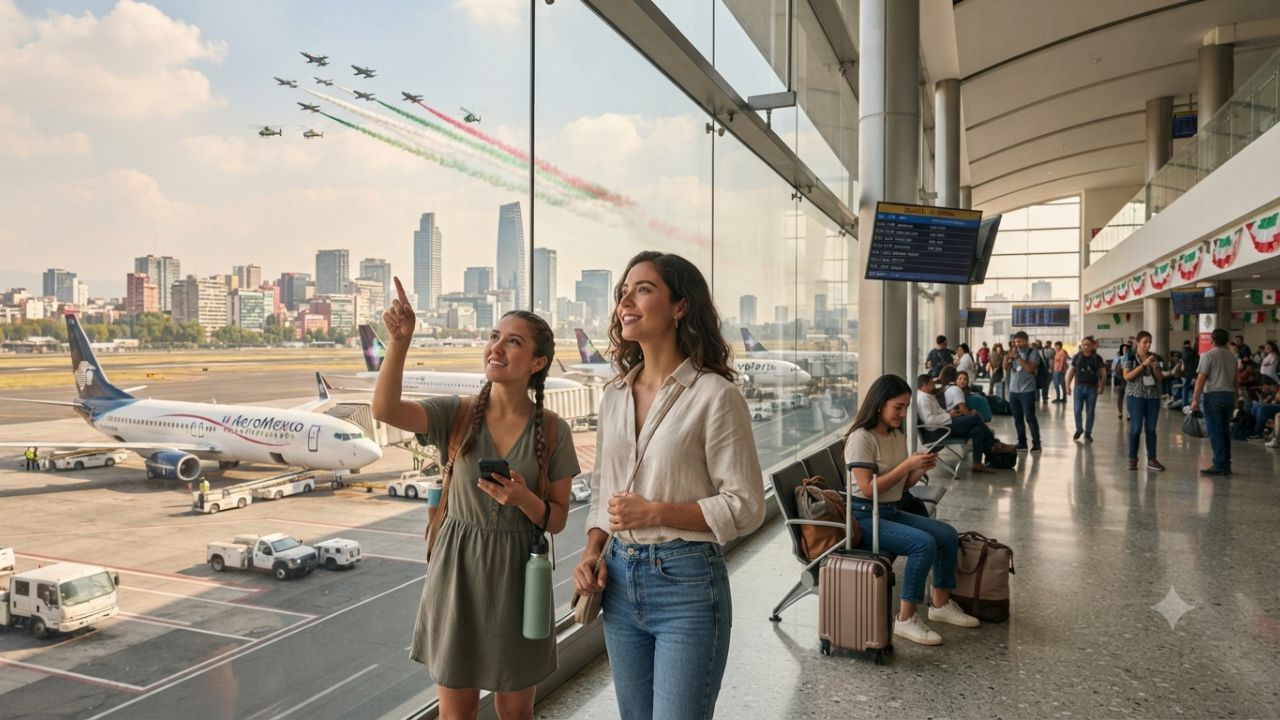
Image generated by AI
A complete four-hour shutdown of commercial flight operations across two metropolitan airports alongside the aerial deployment of nearly 100 military aircraft will halt civil aviation in the Valley of Mexico on 16 September 2026. Coordinated by the Federal Civil Aviation Agency and distributed through Mexican Airspace Navigation Services, the mandatory flight pause freezes all departures and arrivals between 10:00 and 14:00 local time at both Mexico City International Airport (AICM) and Felipe Ángeles International Airport (AIFA). Enacted to safeguard terminal airspace while Mexican Air Force and National Guard aircraft execute ceremonial flyovers for the 216th anniversary of Mexican independence, the temporary ground stop will cascade across domestic and international route networks. While terminal buildings remain open to ticketed passengers, the midday operational vacuum forces domestic and international carriers to completely restructure daily aircraft rotations, crew duty schedules, and connecting banks spanning North America, Europe, and Latin America.
Airspace Deconfliction: The 216th Independence Day Flyover Mandate
The annual Independence Day military parade through the heart of Mexico City represents one of the most demanding airspace deconfliction exercises in Latin American aviation. On 16 September, ground columns march from the Zócalo past the historic center, moving along Juárez Avenue and Paseo de la Reforma before concluding near Campo Marte. Directly overhead, an extensive air armada comprising almost 100 fixed-wing aircraft and tactical helicopters from the Mexican Air Force and the National Guard will conduct precise low-altitude flybys across dense urban corridors.
Because the Valley of Mexico sits in an elevated basin surrounded by high terrain, civilian flight paths into Mexico City International Airport (AICM) and AIFA operate within narrow arrival and departure corridors. Operating high-speed military jets and multi-aircraft rotor formations within this congested terminal area creates insurmountable separation challenges if mixed with commercial traffic. To eliminate the risk of mid-air proximity incidents, civil aviation regulators mandate an absolute halt to all commercial departures and arrivals during the four-hour display.
The formal mechanism for this operational freeze relies on official aeronautical notices issued by the Federal Civil Aviation Agency (AFAC) and executed through Mexican Airspace Navigation Services (SENEAM). Air traffic control units will clear the airspace prior to 10:00, creating an exclusive operational corridor for military squadrons until the final ceremonial pass concludes at 14:00.
Dual Hub Ground Stop: Operational Metrics Across AICM and AIFA
The simultaneous grounding of both commercial airports temporarily disables the primary economic gateway of the country. AICM functions as Mexico's core international hub, handling long-haul flights from Europe, transatlantic commercial corridors, South American trunk routes, and transborder business traffic from the United States and Canada. When runways fall silent for four continuous daytime hours, arriving long-haul flights must either be retimed at their origin stations or routed into expensive holding patterns and remote diversion airfields.
At Felipe Ángeles International Airport, located in the State of Mexico, the operational link to the military display is structural. AIFA was constructed directly adjacent to the Santa Lucía Military Air Base, the primary operational hub where many of the participating Air Force and National Guard aircraft are stationed and staged. Consequently, AIFA shares ground taxiways, perimeter control, and immediate approach lanes with the military display flights.
The disruption occurs as AIFA continues its rapid commercial expansion. Official airport records indicate that between its commercial inauguration in March 2022 and the conclusion of July 2026, AIFA processed more than 21.3 million passengers and managed over 217,000 aircraft movements. Halting operations across both facilities simultaneously removes hundreds of scheduled aircraft movements from the daily aviation grid.
| Airport Facility | Metropolitan Jurisdiction | IATA Code | Scheduled Operational Pause | Tactical Function During Parade |
|---|---|---|---|---|
| Mexico City International Airport (AICM) | Venustiano Carranza, Mexico City | MEX | 10:00 to 14:00 Local Time | Terminal area airspace cleared for central city flyover routes |
| Felipe Ángeles International Airport (AIFA) | Zumpango, State of Mexico | NLU | 10:00 to 14:00 Local Time | Co-located runway clearing for Santa Lucía military departures |
| Commemorative Military Flyover | Valley of Mexico Airspace | N/A | 10:00 to 14:00 Local Time | 216th Independence Anniversary aerial display over Zócalo |
| Operating Metric | AICM Operational Footprint | AIFA Operational Footprint | Industry Impact Dimension |
|---|---|---|---|
| Historical Volume (March 2022 – July 2026) | National legacy hub; slot-constrained | >21.3 million passengers; >217,000 movements | Rapidly growing secondary capacity frozen |
| Airfield Relationship | Hemmed in by central urban neighborhoods | Direct adjacency to Santa Lucía Air Base | Military squadrons launch directly from shared airfield |
| Surface Transit Sensitivity | High congestion on Circuito Interior | Extended transit via Northern highway links | Street closures along Reforma sever hotel transfers |
| Post-Closure Slot Recovery | High density; tight slot buffers | Expanding apron capacity; faster resequencing | Slot backlogs push departures into late evening |
Expert Analysis: Rotational Slack, Crew Duty Timeouts, and Slot Recovery
For travelers booking flights through the Mexican capital on 16 September, the direct consequence is that the disruption will extend well past the official 14:00 reopening bell. Airline schedules are highly integrated networks of aircraft rotations. A narrowbody jet scheduled to touch down at AICM at 11:00 cannot simply wait in the sky; its outbound morning flight must be delayed at the outstation, rescheduled to depart hours early, or cancelled entirely. When operations restart, air traffic controllers face the complex challenge of sequencing dozens of delayed arrivals alongside scheduled afternoon departures, resulting in extended gate holds and runway queues that stretch into the evening.
The pricing pressure this creates means airlines absorb elevated operating expenses that cannot easily be recovered. Ground stops trigger severe disruptions to flight crew legal duty periods governed by international standards monitored by the International Air Transport Association (IATA). If a flight crew scheduled to operate an afternoon round-trip from Mexico City to Monterrey or Miami reaches maximum duty limits while waiting on the tarmac, the airline must source reserve crews or cancel the service, leaving passengers stranded even though the airspace is completely clear.
Complicating the aviation picture is severe surface gridlock across Mexico City. The ground parade traverses Paseo de la Reforma, Juárez Avenue, and the historical center, severing major east-west arteries connecting western business districts and central hotel corridors to AICM. Travelers attempting to reach the airport during the morning hours face extensive police barricades, public transit detours, and heavy vehicular congestion. International travelers connecting between flights at AICM or transferring across town to AIFA face elevated risks of missed connections, requiring proactive itinerary verification before departing their accommodations.
Key Takeaways
- Mandatory Four-Hour Airspace Closure: Commercial flights are suspended between 10:00 and 14:00 local time on 16 September 2026 across both Mexico City International Airport (AICM) and Felipe Ángeles International Airport (AIFA).
- Military Display Scale: The ground stop accommodates ceremonial low-altitude maneuvers by nearly 100 Mexican Air Force and National Guard aircraft and helicopters marking the 216th anniversary of Mexican independence.
- Statutory Airspace Control: The operational freeze is mandated through official notices issued by the Federal Civil Aviation Agency (AFAC) and executed by Mexican Airspace Navigation Services (SENEAM).
- High-Volume Systemic Shock: AIFA, which recorded over 21.3 million passengers and 217,000 operations from March 2022 through July 2026, halts traffic in tandem with the primary AICM hub.
- Surface Transit and Network Repercussions: Major parade road closures along Paseo de la Reforma, Juárez Avenue, and the Zócalo complicate airport transfers, while flight delays are projected to ripple into evening schedules.
FAQ: Mexico City Airspace Closure 2026
Are Mexico City airports closed completely on 16 September 2026?
No. Passenger terminals remain open, but all aircraft take-offs and landings are suspended between 10:00 and 14:00 local time at both AICM and AIFA to allow military parade flyovers.
Why is commercial air traffic halted across both AICM and AIFA?
Civil aviation is paused for safety separation while nearly 100 military aircraft and helicopters conduct ceremonial low-altitude flyovers across the Valley of Mexico for the 216th Independence Day anniversary.
Will flights scheduled after 14:00 depart on time?
Not necessarily. While runways reopen at 14:00, morning flight backlogs, aircraft repositioning delays, and crew duty limits will create secondary delays and schedule adjustments extending into the evening.
How does the Independence Day parade impact ground travel to AICM?
Major street closures along Paseo de la Reforma, Juárez Avenue, and the Zócalo create severe traffic congestion, requiring passengers traveling from central hotels to allow significant extra transit time.
[While fighter jets and transport helicopters claim the skies above Mexico City for four hours of national celebration, the real operational test begins at 14:01 when air traffic controllers attempt to untangle a nationwide scheduling knot.]
Related Travel Guides
The 10 Best Airline Lounges at New York JFK Airport, According to Reddit (2026 Guide)
The 10 Best International Gateway Airports in Canada, According to Reddit
The 10 Best Transit Hotels in Mexico City, According to Reddit
Disclaimer
This article is for informational and educational purposes only. It does not constitute legal, financial, or professional advice. While we strive to provide accurate and up-to-date information, travel policies, regulations, and conditions change rapidly. Always verify information with official sources before making travel decisions. Nomad Lawyer makes no representations about the accuracy, reliability, completeness, or suitability of the information provided. Readers should consult qualified professionals for advice specific to their circumstances. The views expressed in this article are those of the author and do not necessarily reflect the views of Nomad Lawyer.
Raushan Kumar
Founder & Lead Developer
Full-stack developer with 11+ years of experience and a passionate traveller. Raushan built Nomad Lawyer from the ground up with a vision to create the best travel and law experience on the web.
Learn more about our team →