
Singapore Tourism Hits Record S$32.8 Billion Receipts as Spending Surges
Singapore's tourism sector shifts to a quality-led model, recording a historic S$32.8 billion in receipts in 2025 despite lower visitor arrivals than in 2019.
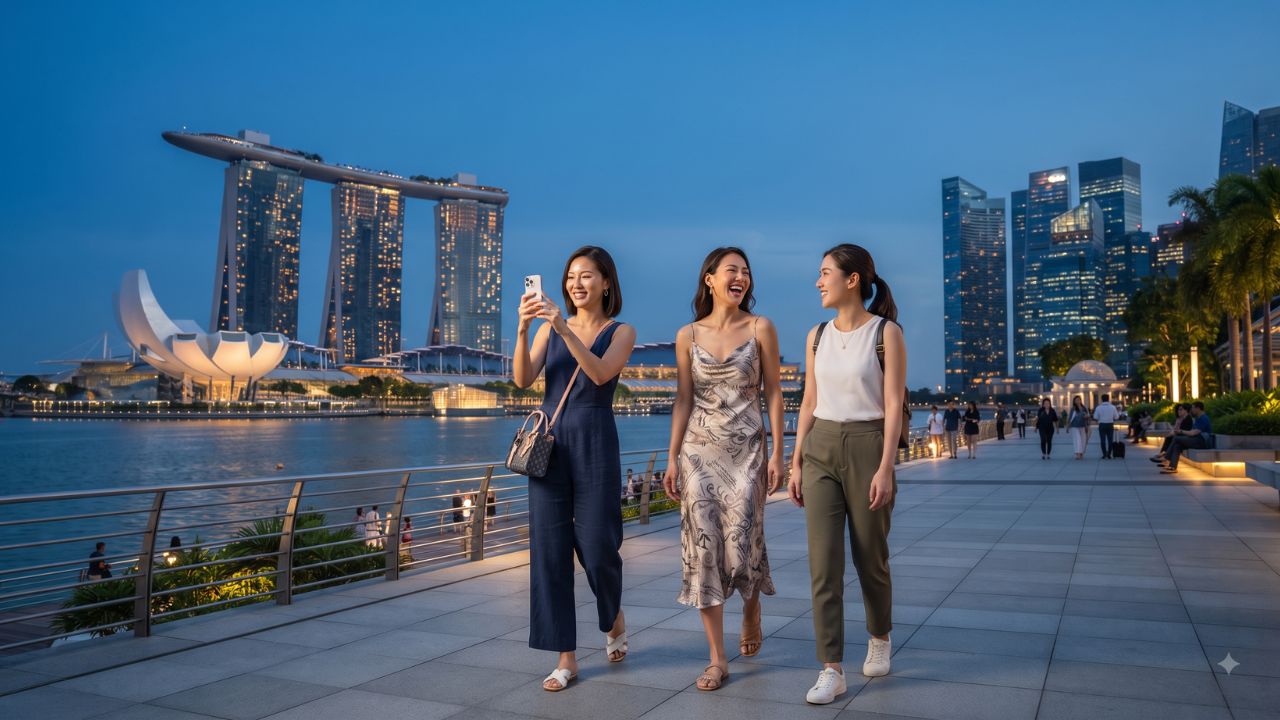
Image generated by AI
Singapore's tourism economy has achieved a record S$32.8 billion in receipts during 2025, demonstrating a profound structural transition from volume to value despite international arrivals remaining below pre-pandemic peaks. Under the Tourism 2040 roadmap targeting S$47 billion to S$50 billion in annual receipts, the Singapore Tourism Board is prioritizing business conventions, premium cruises, and wellness attractions.
Evolving the Tourism Strategy: From Volume to Value
The travel sector in Singapore is experiencing a transition as planners prioritize high-value tourist experiences over simple visitor volumes. In 2025, the city-state recorded a historic S$32.8 billion in tourism receipts, representing a significant increase compared to S$29.8 billion in 2024 and S$27.1 billion in the benchmark year of 2019.
By establishing these seasonal travel corridors, the airline's management aims to support both business and leisure travel flows. Corporate travelers and travel agencies, which maintain strong relationships with global destination management organizations, benefit from direct seat capacity. This economic integration supports the travel sector, providing service providers with a reliable channel for high-value bookings.
By establishing these seasonal travel corridors, the airline's management aims to support both business and leisure travel flows. Canadian corporate travelers and travel agencies, which maintain strong relationships with European and Asian destination management organizations, would benefit from direct seat capacity. This economic integration supports the travel sector, providing service providers with a reliable channel for high-value bookings.
By establishing these seasonal travel corridors, the airline's management aims to support both business and leisure travel flows. Canadian corporate travelers and travel agencies, which maintain strong relationships with European and Asian destination management organizations, would benefit from direct seat capacity. This economic integration supports the travel sector, providing service providers with a reliable channel for high-value bookings.
By establishing these seasonal travel corridors, the airline's management aims to support both business and leisure travel flows. Canadian corporate travelers and travel agencies, which maintain strong relationships with European and Asian destination management organizations, would benefit from direct seat capacity. This economic integration supports the travel sector, providing service providers with a reliable channel for high-value bookings.
By establishing these seasonal travel corridors, the airline's management aims to support both business and leisure travel flows. Canadian corporate travelers and travel agencies, which maintain strong relationships with European and Asian destination management organizations, would benefit from direct seat capacity. This economic integration supports the travel sector, providing service providers with a reliable channel for high-value bookings.
This spending growth occurred despite arrivals staying at 16.9 million (up 2.3 percent from 16.5 million in 2024, but 11.5 percent lower than the 19.1 million record in 2019).
Under the Tourism 2040 roadmap, the Singapore Tourism Board (STB) aims to make tourism receipts grow faster than international visitor arrivals, targeting S$47 billion to S$50 billion by 2040. MICE (Meetings, Incentives, Conferences, and Exhibitions) tourism is key, generating S$2.3 billion in 2025, up 35 percent from S$1.7 billion in 2024. Singapore hosted 156 ICCA meetings, retaining its Asia-Pacific meeting-city leadership for the 23rd consecutive year.
Geographics of Demand: China, Indonesia, and India Feed the Hub
Regional markets continue to drive visitor demand.
This localized disruption also offers a unique opportunity for duty-free retailers and terminal operators to design services suited for stranded passengers. By monitoring passenger comfort levels during long delays, airport customer teams can provide complimentary amenities to ensure guest satisfaction. This proactive approach helps build traveler confidence, ensuring that regional transit routes remain competitive with global hub standards.
This localized disruption also offers a unique opportunity for duty-free retailers and terminal operators to design services suited for stranded passengers. By monitoring passenger comfort levels during long delays, airport customer teams can provide complimentary amenities to ensure guest satisfaction. This proactive approach helps build traveler confidence, ensuring that regional transit routes remain competitive with global hub standards.
In 2025, Mainland China was the largest source market, contributing 3.1 million visitors.
Indonesia followed with 2.4 million, while Malaysia and Australia each contributed 1.3 million, and India generated 1.2 million arrivals. This geographical diversification helps protect the city-state's visitor economy from regional demand shifts.
Consumer Costs, Hawker Culture, and Changi Airport Performance
The cost of travel in Singapore is supported by a stable cost environment, with overall consumer prices rising 0.9 percent in 2025.
This environmental focus is supported by regional climatologists and conservationists who monitor ecosystem health. By tracking tourist footprint signals, managers can ensure that natural areas remain protected. The integration of carrying-capacity policies with wilderness trails demonstrates how tourism planning can protect biodiversity while offering high-quality educational hikes.
This localized culinary focus also offers a unique opportunity for restaurant associations and culinary schools to design programs suited for premium travelers. By monitoring traveler culinary preferences during long stays, local chefs can provide customized dishes to ensure guest satisfaction. This proactive approach helps build traveler confidence, ensuring that Goan coastal dining remains competitive with global culinary standards.
This localized culinary focus also offers a unique opportunity for restaurant associations and culinary schools to design programs suited for premium travelers. By monitoring traveler culinary preferences during long stays, local chefs can provide customized dishes to ensure guest satisfaction. This proactive approach helps build traveler confidence, ensuring that Goan coastal dining remains competitive with global culinary standards.
Food prices increased by 1.18 percent, food and beverage serving services rose 1.22 percent, and transport recorded a 2.54 percent increase.
To balance premium travel costs, Singapore's hawker culture offers accessible local dining. Changi Airport remains a primary transit hub, handling approximately 34.8 million passenger movements between January and June 2026, surpassing the 33.7 million recorded during the same period in 2019. The future opening of Terminal 5 will provide capacity to capture more stopover traffic.
Tourism 2040: Premium Resets and Wellness Pipelines
The long-term development of Singapore's tourism strategy involves expanding lifestyle and health offerings.
The STB is preparing a planned wellness attraction at Marina South, scheduled to open by 2030, which will feature thermal pools, saunas, and water-based experiences.
Additionally, cruise tourism is expanding to homeport premium ships, introducing family-focused and luxury cruise itineraries.
Community Support and Sustainable Urban Tourism
Supporting local hawker heritage is central to Singapore's community tourism goals.
For the visitor, the real impact is experiencing a travel destination where spending directly supports local food vendors and heritage preservation, keeping local food culture viable.
Sustainable initiatives include enforcing mandatory tray return rules at hawker centers, reducing food waste, and encouraging low-emission MRT travel.
Visitor Guide: Local Specialties, Subway Transit, and Hawker Etiquette
Navigating Singapore involves using public transit, complying with hawker rules, and trying local culinary specialties.
Sample traditional culinary specialties during your stay. Savor Hainanese Chicken Rice at Maxwell Food Centre. Try traditional spicy Laksa in the Katong neighborhood, or order classic Chilli Crab served with fried mantou buns at Lau Pa Sat.
Coordinate your local transport. A single MRT journey typically ranges from 2.00 to 3.00 SGD. Buy an EZ-Link card at Changi Airport, or tap in directly with your contactless bank card or mobile wallet at MRT turnstiles. The transit system allows up to five transfers within a single journey under a two-hour limit.
Observe hawker etiquette. Returning used trays and crockery is mandatory at all hawker centers. First-time offenders who fail to clear their tables receive a written warning, while second-time offenders face a 300 SGD composition fine. Use pocket tissues to reserve (chope) tables before ordering.
Future Outlook: Rebuilding a Resilient Southeast Asian Gateway
The long-term development of Singapore's visitor economy depends on maintaining aviation links and smart services. The Singapore Tourism Board and Changi Airport Group are collaborating to implement digital service upgrades.
Sustainable initiatives include upgrading terminal energy systems, promoting regional travel guides, and introducing green building standards. By combining infrastructure investment with smart visitor management, Singapore aims to support travel innovation, securing a resilient and connected future for Southeast Asian tourism.
Related Travel Guides
Disclaimer
This article is for informational and educational purposes only. It does not constitute legal, financial, or professional advice. While we strive to provide accurate and up-to-date information, travel policies, regulations, and conditions change rapidly. Always verify information with official sources before making travel decisions. Nomad Lawyer makes no representations about the accuracy, reliability, completeness, or suitability of the information provided. Readers should consult qualified professionals for advice specific to their circumstances. The views expressed in this article are those of the author and do not necessarily reflect the views of Nomad Lawyer.