
Singapore Airlines 737 MAX Tyre Failure Triggers Severe Travel Chaos and Flight Cancellations After Paralyzing Kuala Lumpur Airport Runway for Six Hours: Latest Airline News
As a Boeing 737 MAX 8 suffers a multiple tyre blowout upon landing at KUL, the resulting six-hour runway closure sparks severe travel chaos and rolling flight cancellations across Southeast Asia.

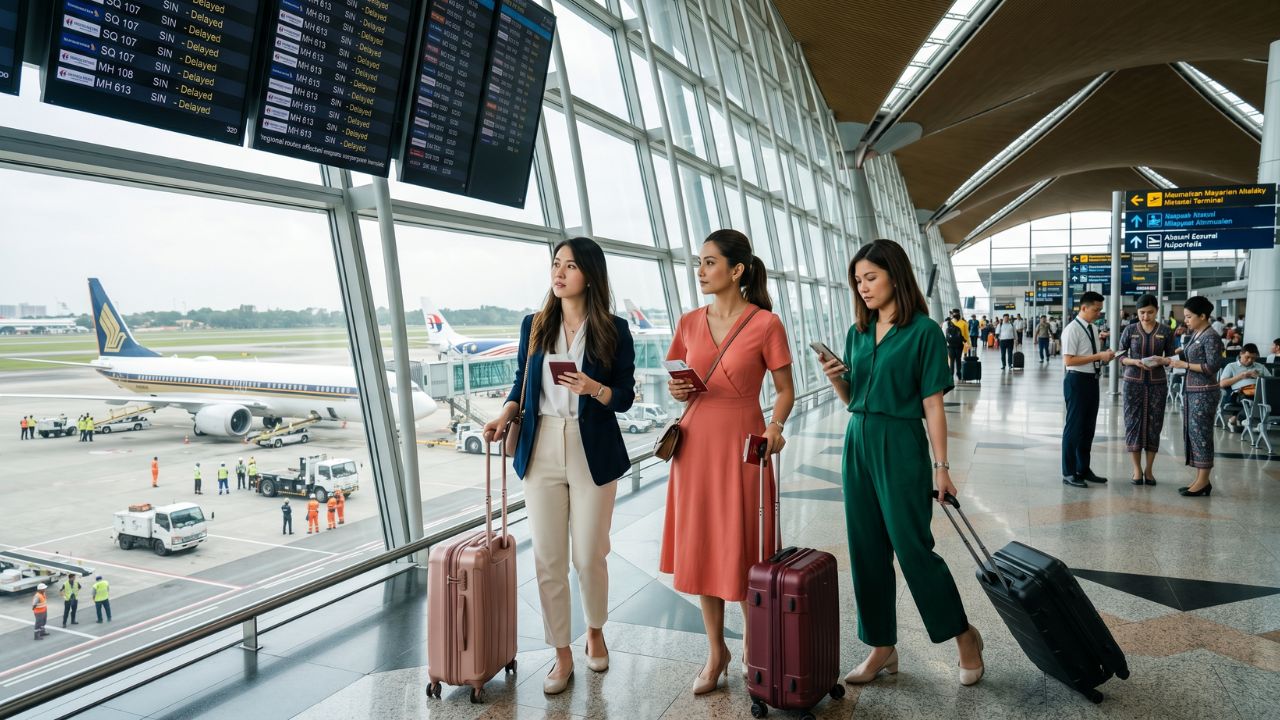
Image generated by AI
In a massive operational breakdown that instantly paralyzed one of Southeast Asia's most critical transit corridors, a Singapore Airlines flight suffered a catastrophic multiple tyre failure upon landing, immediately triggering severe travel chaos across the region. As flight SQ114 touched down at Kuala Lumpur International Airport (KUL), the Boeing 737 MAX 8 sustained a double tyre burst, leaving the aircraft completely stranded on the tarmac. Because the crippled jet could not independently vacate Runway 14R/32L, airport authorities were forced to execute a rigid, six-hour runway closure to facilitate a complex extraction. This sudden infrastructure chokehold generated massive rolling flight cancellations, devastating holding patterns, and brutal airport disruptions that rippled violently through both Malaysia and Singapore. As engineers launch detailed technical reviews, navigating the intense fallout from this single-runway closure represents the premier headline in today's breaking airline news and essential global aviation updates.
By introducing direct passenger coordination and dynamic scheduling backups, the regional aviation hubs target growing passenger demand across vital commerce sectors. The choice to coordinate flight departures in phases helps to manage gate capacity, supporting the country's broader regional transportation network.
Context: The Fragility of Mega-Hub Operations
For the tens of millions of tourists and corporate delegates moving through the hyper-dense Singapore–Malaysia aviation corridor, a single mechanical failure on the tarmac is the absolute blueprint for travel chaos.
Historically, the route connecting Changi Airport to Kuala Lumpur International Airport handles extraordinary volume, functioning as a vital connecting artery for global long-haul networks. However, because both hubs operate at near-maximum capacity, they possess virtually zero margin for error. When the Singapore Airlines Boeing 737 MAX 8 suffered its tyre failure, it did not just block a strip of concrete; it severed a primary arrival artery at KUL for approximately six hours. The immediate reduction in runway capacity forced incoming aircraft into agonizing holding patterns, burning excess fuel and drastically extending flight times. On the ground, the inability to sequence departures effectively led to massive taxi congestion, directly causing severe missed onward flights. This cascading scheduling pressure instantly shattered aircraft rotations for the day, plunging the regional network into immediate airport disruptions and forcing widespread flight cancellations across multiple competing carriers.
To view live flight schedules, specific airline rebooking protocols, or alternative connection statuses, travelers must consult official Southeast Asian aviation directories. For direct booking access on routes successfully bypassing this specific KUL backlog, travelers should check the official airline portals for Singapore Airlines or Malaysia Airlines. To explore live flight tracking and monitor the exact severity of the holding patterns and airspace bottlenecks caused by this runway closure, passengers can consult the official FlightAware tracking service.
Section-Wise Breakdown of the Runway Paralysis
The Touchdown: SQ114 Tyre Failure
Flight SQ114, operating a highly popular regional service from Singapore, successfully executed its final approach into Kuala Lumpur. However, upon touching down at speeds exceeding 240 km/h, the Boeing 737 MAX 8 suffered a multiple tyre failure. While the pilots effectively utilized the multi-wheel landing gear to safely maintain control and bring the aircraft to a halt with zero injuries reported, the damaged components rendered the plane immobile, trapping it directly on the active runway and instantly generating localized travel chaos.
The Ground Response: Six Hours of Gridlock
Because the aircraft could not be towed without specialized assessment and replacement of the damaged tyre components, airport technical teams were forced to physically close Runway 14R/32L. This six-hour recovery process was highly complex, requiring heavy engineering support and a subsequent, meticulous inspection of the runway surface for foreign object debris. During this massive delay window, the airport's capacity was artificially slashed, causing extreme flight cancellations as airlines could not safely cycle their fleets through the remaining operational runways.
The Aircraft: Boeing 737 MAX 8 Scrutiny
The Boeing 737 MAX 8 is a critical workhorse for short and medium-haul routes across Asia due to its improved fuel efficiency. Operated heavily by carriers like Singapore Airlines, Lion Air Group, and Akasa Air, the aircraft has flown millions of safe passenger journeys since returning to service. However, this high-profile stranding proves that regardless of modern fuel economics or enhanced regulatory oversight, a simple mechanical failure on the undercarriage can entirely neutralize a $100 million jet and trigger regional airport disruptions.
Technical Roster: Incident Data and Disruption Matrices
To ensure absolute factual accuracy regarding the specific flight details, the cascading effects of a runway closure, and the mechanics of aircraft tyre failures driving this massive operational disruption, the following tables detail the exact integration data:
Key Incident Details
| Category | Information |
|---|---|
| Airline | Singapore Airlines |
| Flight Number | SQ114 |
| Route | Singapore (SIN) – Kuala Lumpur (KUL) |
| Aircraft Type | Boeing 737 MAX 8 |
| Incident | Multiple tyre failure upon landing |
| Injuries Reported | None |
| Runway Affected | Runway 14R/32L |
| Estimated Closure Duration | Approximately 6 hours |
| Operational Impact | Flight delays and air traffic adjustments |
Why a Single Runway Closure Can Disrupt an Entire Travel Hub
| Operational Challenge | Impact on Travellers |
|---|---|
| Reduced runway capacity | Delayed departures and arrivals |
| Aircraft holding patterns | Longer flight times |
| Increased taxi congestion | Extended ground delays |
| Connection disruptions | Missed onward flights |
| Airline scheduling pressure | Aircraft rotation delays |
Understanding Aircraft Tyre Failures
| Potential Cause | Explanation |
|---|---|
| Wear and tear | Tyres have finite operational cycles |
| Foreign object debris | Sharp objects on runways can damage tyres |
| Excessive heat | High temperatures can affect tyre integrity |
| Hard landings | Increased stress during touchdown |
| Manufacturing defects | Rare but possible component issues |
| Maintenance-related factors | Inspection or replacement timing |
Boeing 737 MAX 8 Snapshot
| Specification | Details |
|---|---|
| Aircraft Family | Boeing 737 MAX |
| Typical Seating Capacity | 162–210 passengers |
| Range | Up to approximately 6,570 km |
| Primary Use | Short and medium-haul routes |
| Key Advantage | Improved fuel efficiency |
| Common Operators in Asia | Singapore Airlines, Lion Air Group, Akasa Air, Flydubai and others |
Singapore–Kuala Lumpur Travel Significance
| Travel Metric | Importance |
|---|---|
| Tourism Traffic | Strong two-way visitor flows |
| Business Travel | Major corporate and financial links |
| Transit Connectivity | Access to global long-haul networks |
| Airline Competition | Multiple daily services |
| Economic Importance | Supports regional commerce and trade |
Passenger Impact: Stranded in the Mega-Hubs
For the everyday passenger and corporate delegate relying on seamless connectivity between Singapore and Malaysia, this six-hour runway closure represents the ultimate logistical nightmare.
The immediate passenger impact was a total collapse of scheduling certainty. Because the Singapore-Kuala Lumpur route frequently feeds into massive global long-haul networks serving Europe and the Middle East, the inbound flight delays caused by the runway closure mathematically guaranteed missed connections for thousands of travelers. Passengers waiting to depart KUL were trapped in overcrowded terminals or subjected to extended ground delays inside sweltering aircraft cabins as taxiways became gridlocked. This specific travel chaos highlights the brutal vulnerability of complex multi-segment itineraries; a minor mechanical delay on a 60-minute regional hop will entirely destroy a premium long-haul journey, forcing travelers to leverage comprehensive travel insurance policies to cover emergency rebooking and hotel costs.
Industry Analysis: The Mechanics of Hub Resilience
Aviation industry analysts view the SQ114 incident at KUL as a stark demonstration of the fragility inherent in ultra-high-density airport operations.
Analysts note that while a tyre failure is relatively uncommon—given the extraordinary stress of 240 km/h touchdowns—it is a known operational hazard. The broader industry concern is not the tyre failure itself, but the airport's recovery velocity. A six-hour closure of Runway 14R/32L is an agonizingly long duration for a mega-hub handling tens of millions of passengers annually. Aviation investigators will exhaustively review the aircraft maintenance records and runway environments, but operations experts are analyzing the recovery protocols. Analysts agree that as regional passenger volume explodes across Asia, airports must develop vastly accelerated procedures for removing stranded narrow-body aircraft. If clearing a disabled Boeing 737 MAX 8 from a runway routinely takes six hours, the resulting airport disruptions and flight cancellations will continue to cost the Southeast Asian travel industry millions in lost productivity and passenger compensation.
Actionable Advice for Surviving Asian Transit Chaos
If you are a passenger flying through major international hubs like Kuala Lumpur, Singapore, Bangkok, or Jakarta and wish to avoid the severe travel chaos associated with sudden runway closures, execute this strategic planning checklist immediately:
- Pad Your Connection Windows: Never book a tight, 60-minute connection when transiting through Southeast Asian mega-hubs. Always build a minimum of three hours into your itinerary to survive the inevitable holding patterns caused by sudden runway disruptions or weather events.
- Monitor Ground Flow Digitally: Do not wait for the gate agent to announce flight cancellations. Utilize mobile airline applications and airport notification systems to receive real-time updates the moment a runway is closed, allowing you to rebook before the terminal descends into panic.
- Purchase Bulletproof Transit Insurance: Ensure your travel insurance explicitly covers "missed connections" due to operational delays. If a stranded jet at KUL causes you to miss a $4,000 onward flight to London, you must be financially protected.
- Prioritize Morning Flights: Runway closures create a cascading backlog. Flights scheduled early in the morning are statistically much less likely to be impacted by the rolling airport disruptions that accumulate throughout the day.
FAQ: Singapore Airlines KUL Emergency & Travel Chaos 2026
What happened to Singapore Airlines flight SQ114 in Kuala Lumpur?
The Boeing 737 MAX 8 suffered a multiple tyre failure upon landing at KUL from Singapore. While there were no injuries, the crippled aircraft became stranded on the tarmac, forcing authorities to completely close Runway 14R/32L.
How did a single tyre failure cause massive flight cancellations?
Because the runway was closed for approximately six hours to remove the aircraft and inspect for debris, incoming flights were forced into holding patterns, sparking severe travel chaos and cascading flight delays across the airport network.
Why is the Singapore to Kuala Lumpur route so vulnerable to airport disruptions?
The SIN-KUL corridor is one of the busiest in the world, handling massive volumes of business travelers and long-haul transit passengers; any minor delay instantly ripples through the network, destroying tight connecting itineraries.
The Brutal Reality of Airport Bottlenecks
The terrifying runway paralysis triggered by the Singapore Airlines SQ114 tyre failure proves definitively that modern aviation remains highly vulnerable to single-point mechanical breakdowns. By landing safely, the crew of the Boeing 737 MAX 8 successfully prevented a disaster, but the ensuing six-hour closure of a critical runway plunged Kuala Lumpur into absolute travel chaos. As legacy airports desperately attempt to manage explosive post-pandemic passenger volumes on limited infrastructure, travelers must accept a critical new reality: avoiding brutal airport disruptions requires assuming that the mega-hub you are flying into is always one blown tyre away from a total operational collapse.
Key Takeaways
- Runway Paralysis: A Singapore Airlines Boeing 737 MAX 8 suffered a double tyre burst upon landing, entirely blocking Runway 14R/32L at Kuala Lumpur International Airport for roughly six hours.
- Rolling Flight Cancellations: The massive reduction in runway capacity triggered extreme travel chaos, forcing inbound aircraft into holding patterns and causing severe missed connections for transit passengers.
- No Casualties: The aircraft successfully maintained control during the 240 km/h touchdown, and no injuries were reported among the passengers or crew aboard flight SQ114.
- Mega-Hub Vulnerability: The SIN-KUL corridor handles tens of millions of passengers annually; this incident exposes how quickly a minor technical failure can disrupt the entire Southeast Asian aviation grid.
- Complex Recovery Operations: The six-hour delay highlights the severe logistical challenges of safely removing a crippled aircraft and inspecting the runway for foreign object debris before resuming operations.
Related Travel Guides
British Airways Cabin Fire Triggers Airport Disruptions
Washington DCA Shutdown Triggers Massive Travel Chaos
Kuala Lumpur Airport Runway Chaos and Rebooking Hacks on Reddit
Disclaimer
This article is for informational and educational purposes only. It does not constitute legal, financial, or professional advice. While we strive to provide accurate and up-to-date information, travel policies, regulations, and conditions change rapidly. Always verify information with official sources before making travel decisions. Nomad Lawyer makes no representations about the accuracy, reliability, completeness, or suitability of the information provided. Readers should consult qualified professionals for advice specific to their circumstances. The views expressed in this article are those of the author and do not necessarily reflect the views of Nomad Lawyer.
Kunal K Choudhary
Co-Founder & Contributor
A passionate traveller and tech enthusiast. Kunal contributes to the vision and growth of Nomad Lawyer, bringing fresh perspectives and driving the community forward.
Learn more about our team →