
Singapore Airlines, Emirates, and Delta Drive Historic Business Class Profit Surge Across Global Hubs, Shielding Elite Passengers From Economy Travel Chaos and Airport Disruptions: Latest Airline News and Aviation Updates
The world's leading global carriers are aggressively pivoting toward ultra-premium long-haul travel, driving record-shattering profits while completely transforming the passenger experience across massive international hubs.

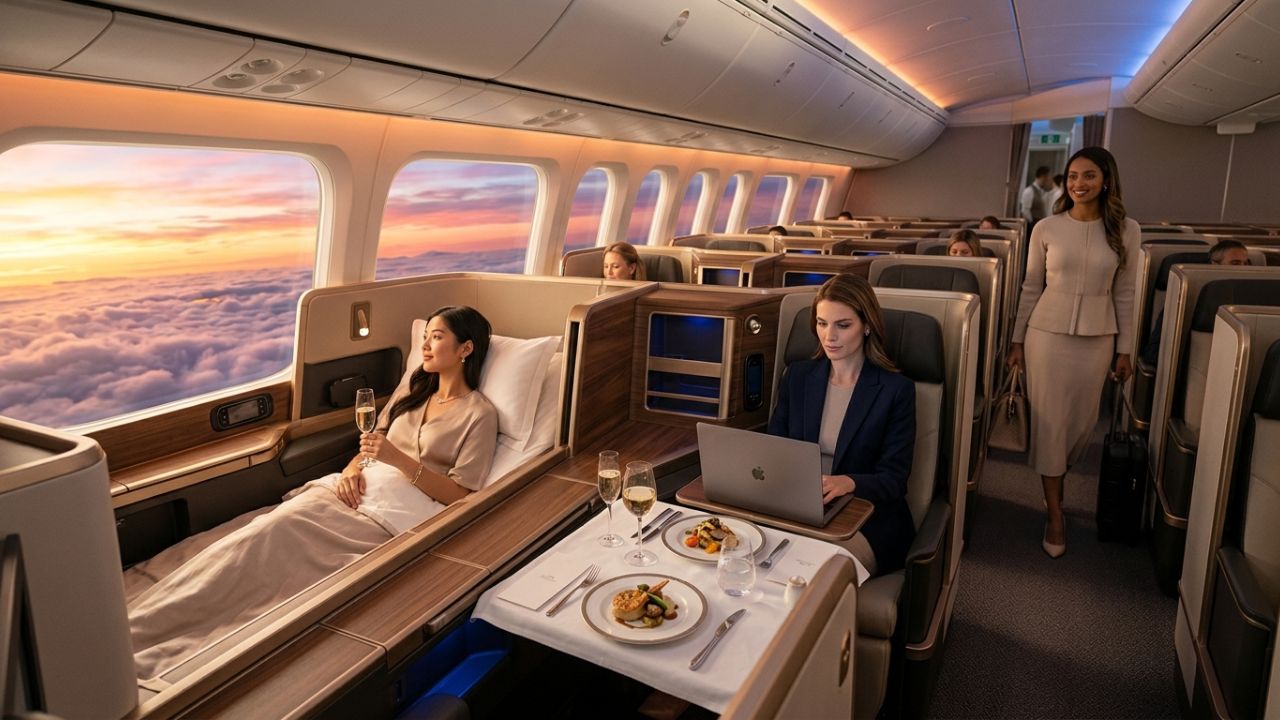
Image generated by AI
In a structural development that is violently reshaping the underlying economics of commercial aviation, the world's most formidable global carriers—including Singapore Airlines, Emirates, Delta Air Lines, Air France-KLM, and Lufthansa—are driving an unprecedented, record-shattering surge in premium business class revenue. By aggressively expanding high-end, lie-flat cabins across massive intercontinental routes routed through global mega-hubs like Singapore Changi (SIN), Dubai (DXB), New York (JFK), Paris (CDG), and Frankfurt (FRA), these airlines are converting intense corporate and luxury demand into billion-dollar profits. As airlines deliberately shrink main cabin capacity to favor high-margin seating, elite passengers are increasingly paying a massive premium to entirely bypass the brutal realities of economy class, shielding themselves from grueling flight cancellations, immense terminal airport disruptions, and the sprawling travel chaos that defines modern transit. This aggressive pivot toward ultra-premium long-haul travel represents the premier headline in today's airline news and global aviation updates.
By introducing direct passenger coordination and dynamic scheduling backups, the regional aviation hubs target growing passenger demand across vital commerce sectors. The choice to coordinate flight departures in phases helps to manage gate capacity, supporting the country's broader regional transportation network.
Context: The Eradication of the Economy Class Dependency
For decades, the standard airline business model relied heavily on packing hundreds of economy passengers into the rear of widebody jets to cover the operational costs of long-haul flights.
The post-pandemic recovery has entirely inverted that dynamic. Internal data from carriers like Delta Air Lines vividly illustrates this aggressive structural shift: premium ticket revenue is currently surging so violently that it is on track to completely surpass main cabin revenue. The global tourism rebound is staggering; international arrivals surged by roughly 4% in 2025, reaching a near-record 1.52 billion travelers globally. Yet, the vast majority of airline profit is now being generated by the front of the aircraft. Consequently, legacy carriers are ruthlessly ripping out low-yield economy seats to retrofit their fleets with highly lucrative, space-intensive business class suites.
To view live flight schedules, real-time terminal maps, or check-in rules at major global hubs, travelers can consult the official Dubai International Airport (DXB) directory. For direct booking access, specific business class upgrades, and premium loyalty rules, passengers can check the official Delta Air Lines portal. To explore live flight tracking, check delay maps, or monitor exact widebody fleet routing, passengers can consult the official FlightAware tracking service.
Section-Wise Breakdown of the Premium Aviation Boom
European Powerhouses: Record Profits and Retrofits
The pivot to premium is heavily enriching European legacy carriers. Air France-KLM recently posted an absolutely staggering record operating profit of €2 billion for 2025, heavily driven by intense demand for premium cabins on its lucrative transatlantic network out of Paris and Amsterdam. Simultaneously, the Lufthansa Group managed to fly an immense 135 million passengers, actively aggressively expanding premium seating across its network after finally resolving complex certification delays on its Boeing 787 fleet.
The Delta Revenue Inversion in the Americas
In North America, Delta Air Lines is leading the charge in reshaping the aircraft cabin. Utilizing its massive presence at New York (JFK), Delta has successfully weaponized its "Delta One" premium product. The carrier's strategic fleet investments are paying massive dividends, with premium seating revenue growing at a significantly faster rate than standard coach revenue, proving that American corporate travelers are willing to pay massive premiums for elevated comfort.
Asian and Middle Eastern Dominance
In the Eastern hemisphere, ultra-premium transit remains the standard. Emirates continues to funnel massive volumes of luxury traffic through its Dubai (DXB) megahub, leveraging its renowned business class lounges and A380 onboard bars to dominate the market. Meanwhile, Singapore Airlines—operating out of Changi (SIN)—continues to ride massive passenger demand, expanding its long-haul services to include highly lucrative new routes, such as a major Riyadh launch planned for 2026.
Technical Roster: Global Premium Route Expansion in 2025/2026
To ensure absolute factual accuracy regarding this massive structural shift, the following table summarizes the key hub strategies and premium route expansions for the world's leading airlines:
| Global Airline | Primary Megahub | Key Premium Growth Metric / Expansion |
|---|---|---|
| Singapore Airlines | Singapore Changi (SIN) | Massive premium revenue growth; executing Riyadh launch in 2026 |
| Delta Air Lines | New York (JFK) | Premium revenue explicitly rising faster than main cabin sales |
| Air France-KLM | Paris (CDG) / Amsterdam (AMS) | Achieved €2 billion record profit heavily driven by premium demand |
| Emirates | Dubai International (DXB) | Sustained high-volume business class sales across global network |
| Lufthansa Group | Frankfurt (FRA) / Munich (MUC) | Aggressive premium seat retrofits deployed across Boeing 787 fleet |
Passenger Impact: The Growing Gap Between Cabins
For the international traveler, the aggressive shift toward premium seating guarantees a deeply polarized travel experience.
For the corporate executive or luxury tourist occupying the business class cabin, the experience has never been better. Passengers are entirely insulated from the crushing reality of massive airport crowds, utilizing dedicated security lanes, opulent lounges, and lie-flat beds that effectively eradicate jet lag. However, for the standard economy traveler, the impact is severe. As airlines physically remove economy seats to make room for massive business class suites, the sheer supply of cheap, long-haul coach tickets is violently contracting, leading to significantly higher baseline airfares for the average vacationer.
Industry Analysis: The Future of the Widebody Cabin
Aviation industry analysts view this premium surge not as a temporary post-pandemic anomaly, but as a permanent, foundational shift in commercial aviation economics.
Airlines have realized that high-net-worth individuals and corporate travel departments will unconditionally pay a massive premium to avoid the physical toll of international transit. As global tourism prepares for continued aggressive growth into 2026, carriers will continue to optimize their cabin configurations. The era of the "high-density" cattle-car widebody on flagship intercontinental routes is ending; the future of the aircraft cabin is heavily biased toward highly profitable, space-intensive luxury.
Actionable Advice for Global Travelers in 2026
Whether you are flying in business or economy, the shifting economics of aviation require immediate adjustments to your booking strategy:
- Book Economy Extremely Early: Because airlines are actively shrinking the size of their main cabins to add business class seats, the supply of cheap economy tickets is lower than ever. Book at least four months in advance.
- Leverage Premium Economy: If true business class is out of budget, aggressively target "Premium Economy." Airlines are heavily investing in this middle tier, offering wider seats and better food at a fraction of the lie-flat cost.
- Exploit Loyalty Programs: With basic economy becoming increasingly brutal, loyalty status is your only shield against travel chaos. Consolidate all your flying onto a single airline alliance (SkyTeam, Star Alliance, or Oneworld) to secure lounge access.
- Protect Premium Tickets: If you are spending $5,000+ on a business class ticket, never book without comprehensive travel insurance. If a sudden disruption forces a downgrade to economy, you must be financially protected.
- Monitor Visa Facilitation: As global tourism surges past 1.5 billion travelers, many nations are digitizing their visa processes; always verify entry requirements weeks before your departure to avoid being denied boarding.
FAQ: The Airline Business Class Profit Surge
Why are airlines focusing so heavily on business class seats?
Airlines are aggressively prioritizing premium seating because it generates exponentially higher revenue per passenger than economy class, insulating the carrier's profit margins against fluctuating fuel costs.
Which airlines are driving this shift toward premium travel?
The structural shift is being led by the world's premier global legacy carriers, including Delta Air Lines, Emirates, Singapore Airlines, Air France-KLM, and the Lufthansa Group.
How is this affecting the global tourism market?
The surge in premium travel aligns perfectly with a massive global tourism rebound, which saw international arrivals reach roughly 1.52 billion travelers in 2025, heavily favoring high-spending luxury demographics.
The Polarization of the Skies
The explosive growth of premium business class revenue across the fleets of Singapore Airlines, Emirates, Delta, and Lufthansa marks a permanent, irreversible shift in the economics of global transit. By aggressively converting aircraft real estate into highly lucrative luxury suites, these carriers have successfully weaponized comfort, allowing elite passengers to effectively buy their way out of the grueling misery of the modern airport experience. As the industry sails past the 1.5 billion traveler mark, the divide within the aircraft cabin has never been starker—guaranteeing that the future of long-haul aviation belongs entirely to those willing to pay a massive premium for peace of mind.
Key Takeaways
- Record Profits: Legacy carriers like Air France-KLM posted a staggering €2 billion operating profit in 2025, heavily driven by intense transatlantic premium demand.
- Revenue Inversion: Delta Air Lines data confirms that premium seating revenue is growing so rapidly that it is on track to surpass standard main cabin revenue.
- Shrinking Economy: To maximize high-margin profits, airlines are actively shrinking the physical footprint of economy cabins to install more space-intensive lie-flat suites.
- Global Tourism Boom: The aggressive premium demand is fueled by a massive global travel rebound, which saw 1.52 billion international arrivals in 2025.
- Hub Dominance: Mega-hubs like Singapore Changi (SIN), Dubai (DXB), and New York (JFK) are heavily capitalizing on this surge in high-yield corporate and luxury transit.
Related Travel Guides
Saudia Deploys Airbus A321XLR on Vital European Routes
Air India Unveils Ultra-Luxury Maharaja Lounge at San Francisco Airport
Airline Business Class Revenue Surge Review on Reddit in 2026
Disclaimer
This article is for informational and educational purposes only. It does not constitute legal, financial, or professional advice. While we strive to provide accurate and up-to-date information, travel policies, regulations, and conditions change rapidly. Always verify information with official sources before making travel decisions. Nomad Lawyer makes no representations about the accuracy, reliability, completeness, or suitability of the information provided. Readers should consult qualified professionals for advice specific to their circumstances. The views expressed in this article are those of the author and do not necessarily reflect the views of Nomad Lawyer.
Kunal K Choudhary
Co-Founder & Contributor
A passionate traveller and tech enthusiast. Kunal contributes to the vision and growth of Nomad Lawyer, bringing fresh perspectives and driving the community forward.
Learn more about our team →