
Breaking Airline News: Severe Travel Chaos Hits Global Grids as China Eastern, Air China, and Garuda Cancel 96 Flights Amid 607 Delays
Breaking airline news: A catastrophic wave of severe travel chaos has paralyzed major aviation corridors across China, Indonesia, and Argentina, as six major carriers cancel 96 flights and delay 607, stranding thousands.

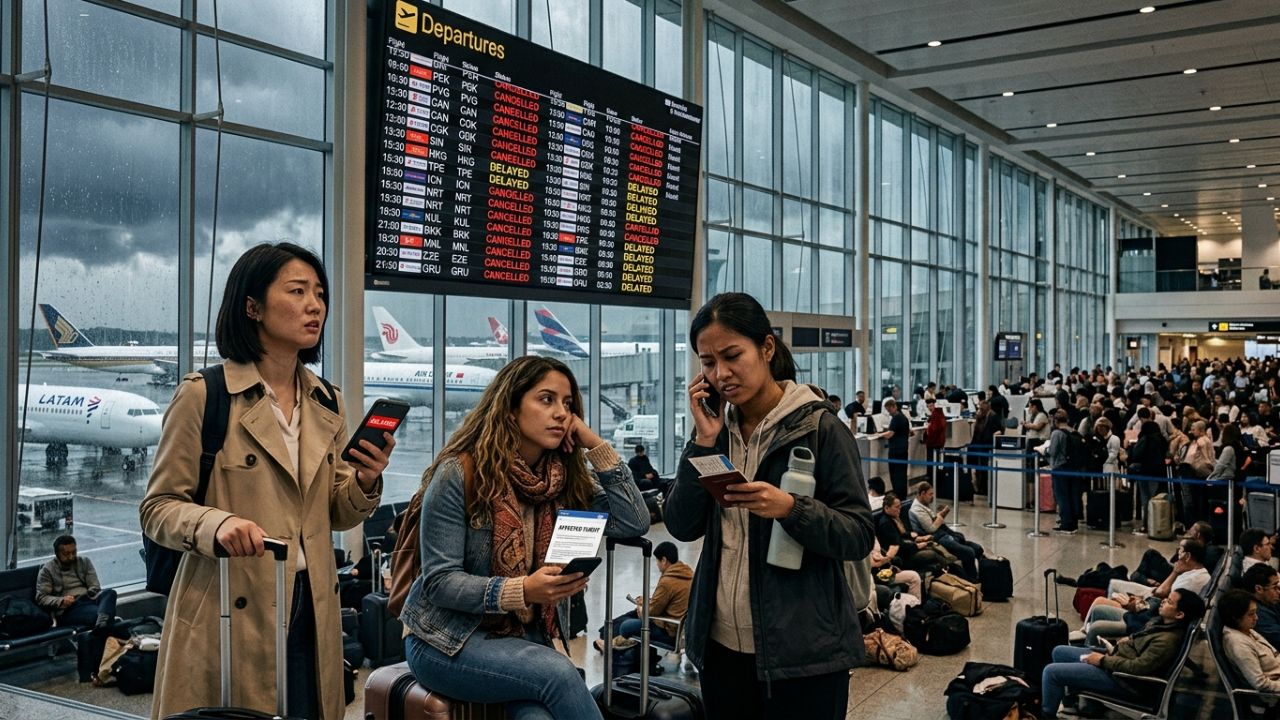
Image representing the intense strategic operational meltdown as severe travel chaos paralyzes major aviation hubs across China, Indonesia, and Argentina, with airlines like China Eastern and Air China suffering massive flight cancellations and delays.
Breaking Airline News: Severe Travel Chaos Hits Global Grids as China Eastern, Air China, and Garuda Cancel 96 Flights Amid 607 Delays
A catastrophic wave of severe travel chaos has violently struck three distinct international aviation grids, entirely paralyzing massive transit corridors across China, Indonesia, and Argentina. In a brutal demonstration of global network fragility, a massive cluster of severe airport disruptions has forced China Eastern, Air China, Shanghai Airlines, Batik Air, Garuda Indonesia, and Flybondi to execute 96 sudden flight cancellations and post a staggering 607 massive delays. This explosive operational meltdown, totaling 703 disrupted flight operations, has violently severed domestic and regional connections, stranding thousands of desperate passengers inside primary gateways like Beijing, Shanghai, Jakarta, and Buenos Aires. As this massive disruption wave spreads outward, travelers are being plunged into a grueling logistical nightmare, facing destroyed itineraries, devastating missed connections, and the terrifying reality of widespread capacity collapse.
When a multi-carrier operational failure of this magnitude detonates across highly critical international and domestic networks, the cascading damage is immediate and extreme. The sheer volume of delayed aircraft virtually guarantees that subsequent rotations will fail, creating an inescapable gridlock that traps both business professionals and leisure tourists. The massive delay counts—particularly in the Chinese aviation sector—reveal an infrastructure buckling under immense operational pressure, proving that surviving the modern era of commercial aviation requires intense tactical planning and immediate rebooking strategies to escape localized meltdowns.
Expanded Overview: The Anatomy of a Multi-Continental Meltdown
The terrifying reality of overwhelming passenger stress currently testing these massive international gateways brutally exposes the extreme consequences of dense, highly constrained airline schedules. Because primary networks are deeply interconnected, the sudden loss of stability across six different carriers forces broader regional infrastructures into crisis management protocols. To fully comprehend the massive logistical failures dominating the skies today, aviation analysts and stranded flyers must rigorously review exactly how this explosive disruption is destroying the travel grid.
Section-Wise Breakdown: Decoding the Disruption by Carrier
China Eastern and Air China: The Heavyweight Collapse To understand the absolute severity of this catastrophe, one must look at the exact operational telemetry coming out of China. China Eastern emerged as the most heavily battered carrier, buckling under the weight of 20 sudden flight cancellations and a massive, crippling 320 delays—accounting for more than half of all reported delays in this crisis. This massive disruption aggressively tore through highly critical hubs including Chongqing, Beijing Daxing, Shanghai Hongqiao, Guangzhou Baiyun, and Shenzhen. Critical routes, such as Chongqing to Taiyuan and Nanjing to Chongqing, were entirely severed.
Air China matched this catastrophic cancellation volume, officially axing 20 flights while posting an equally terrifying 196 massive delays. The flag carrier’s operational failure violently struck primary gateways including Beijing Capital, Chengdu Shuangliu, and Wuhan. When a legacy carrier suffers nearly 200 delays, the operational fallout is apocalyptic; passengers face catastrophic missed connections and schedule uncertainty that bleeds across the entire operating day.
Shanghai Airlines: Dual-Airport Gridlock The chaos aggressively expanded as Shanghai Airlines officially recorded 17 cancellations and 40 delays. The epicenter of this disruption was the vital Shanghai dual-airport system, with Pudong and Hongqiao suffering severe bottlenecks. The carrier was forced to cancel critical routes, including Shanghai Hongqiao to Shenzhen and Shanghai Pudong to Jieyang Chaoshan. Any severe disruption hitting Shanghai instantly creates a terrifying choke point for millions of domestic and international travelers attempting to transit through China’s financial heart.
Indonesia’s Domestic Crisis: Batik Air and Garuda Simultaneously, a massive operational failure struck the highly fragile Indonesian archipelago. Batik Air was forced to execute 19 sudden flight cancellations and 27 delays. The disruption severed highly critical domestic island routes, crippling operations at Jakarta Soekarno-Hatta, Surabaya, Medan, and Makassar. Garuda Indonesia added to the regional travel chaos, reporting 10 cancellations and 22 delays, severely impacting the critical Jakarta to Bali tourism corridor. Because Indonesia relies heavily on aviation for inter-island mobility without viable ground alternatives, these 29 combined cancellations act as a devastating blow to regional commerce and tourism, triggering massive rebooking queues.
Flybondi: South American Low-Cost Chaos The disruption wave also detonated in South America. Argentine low-cost carrier Flybondi officially recorded 10 flight cancellations and 2 delays. While smaller in scale than the Asian meltdowns, this localized chaos aggressively severed vital domestic routes, notably impacting operations at Buenos Aires Jorge Newbery and the critical Bariloche tourism gateway. When low-cost flights are suddenly scrubbed, passengers are frequently left stranded without immediate, same-day recovery options, escalating the logistical trauma.
Global Aviation Disruption Matrix
To guarantee that travelers can aggressively track the specific intelligence regarding this massive operational failure, the following matrix details the exact, verified data confirming the scale of this travel chaos.
| Operating Carrier | Verified Cancellations | Verified Delays | Disruption Impact Overview |
|---|---|---|---|
| China Eastern | 20 | 320 | Recorded the highest number of delays among all six airlines and shared the top cancellation count. |
| Air China | 20 | 196 | Matched China Eastern with 20 cancellations and ranked second in total delays. |
| Batik Air | 19 | 27 | Stood out in Indonesia with nearly as many cancellations as the two largest Chinese carriers. |
| Shanghai Airlines | 17 | 40 | Faced moderate cancellations and delays, mainly adding pressure to China’s domestic network. |
| Garuda Indonesia | 10 | 22 | Reported lower cancellations, but disruptions still affected Indonesia’s key domestic routes. |
| Flybondi | 10 | 2 | Had the fewest delays, but 10 cancellations still created pressure on Argentina’s domestic network. |
| Grand Total | 96 | 607 | Massive network failure affecting 703 total operations. |
Data reflects the massive multi-carrier operational breakdown driving severe airport disruptions globally.
Passenger Impact and Industry Analysis
For the thousands of passengers caught in this multi-continental gridlock, the effect of this massive capacity loss is devastating. A massive delay wave violently destroys certainty; travel plans are instantly shredded by cascading failures and sudden flight cancellations. Passengers expecting reliable transfers in Jakarta or Shanghai are facing terrifying realities: sleeping on terminal floors, fighting for scarce hotel accommodations, and suffering massive out-of-pocket expenses to secure alternative transport.
Aviation industry analysts confirm that multi-airline cancellation clusters of this magnitude are typically triggered by a catastrophic mix of external pressures. Severe weather fronts, localized air traffic control flow restrictions, and massive aircraft rotation failures create a highly destructive chain reaction. When hubs like Beijing, Shanghai, and Jakarta enforce reduced arrival rates, the entire domestic and regional system backs up, causing flight crews to time out and aircraft to be trapped on the tarmac out of position.
Conclusion: Surviving the Chaos
As the extremely critical global transit network braces for further instability, this massive 703-flight disruption represents a terrifying reality for modern travelers. Passengers desperate to avoid sudden flight cancellations and the severe logistical nightmare of being stranded mid-journey must immediately execute aggressive survival strategies. Travelers must fiercely prioritize early check-ins, aggressively monitor real-time flight telemetry on airline apps, and absolutely refuse to book itineraries with tight connections. This intelligence proves that surviving the modern era of commercial aviation relies entirely on anticipating sudden operational failures and reacting instantly to secure alternative routing before the masses.
Key Takeaways
- Massive Network Failure: A massive disruption wave has resulted in 96 total flight cancellations and 607 extreme delays across six major carriers.
- China’s Heavy Impact: China Eastern (20 cancellations, 320 delays) and Air China (20 cancellations, 196 delays) suffered catastrophic operational meltdowns affecting vital hubs like Beijing and Shanghai.
- Indonesian Archipelago Severed: Batik Air (19 cancellations) and Garuda Indonesia (10 cancellations) triggered massive domestic travel chaos, cutting off critical island connections.
- Argentine Disruption: Flybondi canceled 10 flights, severely impacting the Buenos Aires and Bariloche domestic corridors.
- Passenger Survival: Stranded travelers must utilize airline apps for immediate digital rebooking to escape the catastrophic travel chaos and massive physical queues forming at affected airports.
Related Travel Guides
- How Airline Consolidations Are Sparking Major Travel Chaos Across the Globe
- Navigating Severe Flight Cancellations: A Passenger's Guide to Surviving Airport Disruptions
- The Ultimate Guide to Beating Airport Congestion During the 2026 Summer Surge
Disclaimer: The strategic operational metrics, specific cancellation and delay data (China Eastern: 20/320, Air China: 20/196, Shanghai Airlines: 17/40, Batik Air: 19/27, Garuda: 10/22, Flybondi: 10/2), and affected routes presented in this matrix are based on manually collected data from FlightAware as of June 13, 2026. Authors Observation: All intelligence regarding shifting airline schedules, capacity expansions, and operational network stability is subject to change based on real-time global events. In order to maintain safety and operational efficiency, airlines actively modify frequency targets without prior public warning to manage extreme market conditions. In order to get to their destinations safely, passengers are asked to heavily research airline operational stability to avoid the massive risks associated with sudden flight cancellations. Relying on real-time updates and maintaining absolute flexibility with travel plans are all highly recommended to survive airport disruptions.
Kunal K Choudhary
Co-Founder & Contributor
A passionate traveller and tech enthusiast. Kunal contributes to the vision and growth of Nomad Lawyer, bringing fresh perspectives and driving the community forward.
Learn more about our team →