
Semmering Base Tunnel: Austrian Officials Complete Historic First Transit
Austrian Federal Railways achieves major 2026 milestone as officials traverse the 27.3km Semmering Base Tunnel for the first time, signaling progress toward 2029 opening and 46-minute reduction in Vienna-Graz travel time.

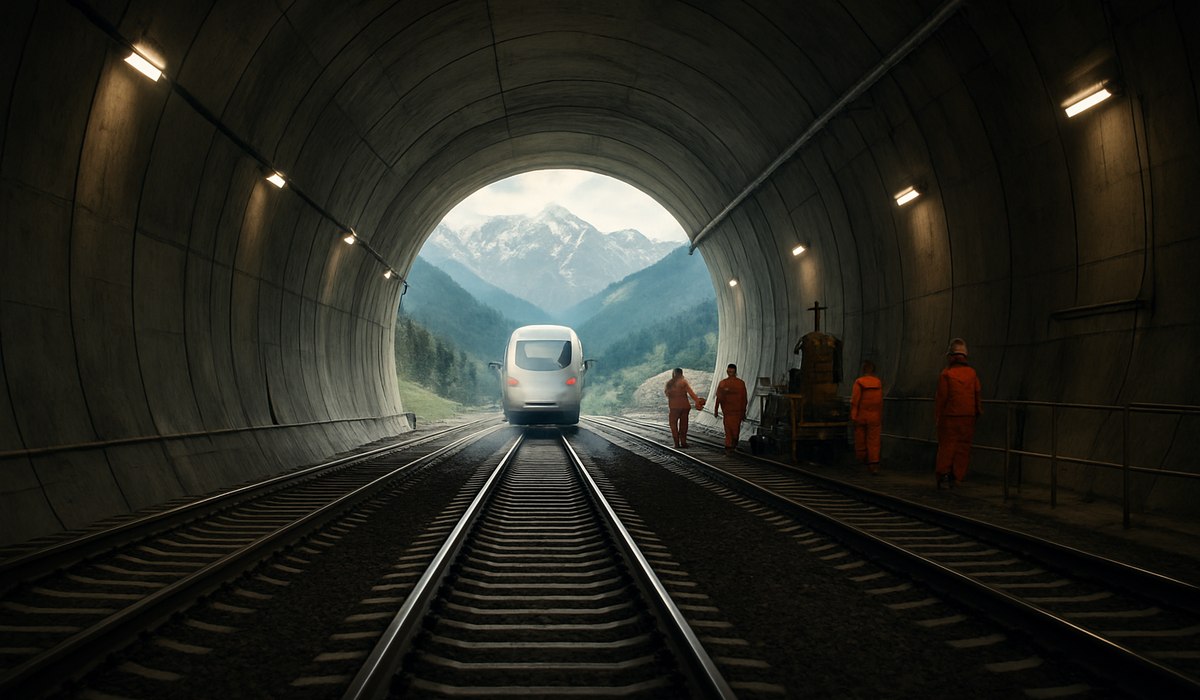
Image generated by AI
Austrian Officials Mark Historic First Passage Through Semmering Base Tunnel
Austrian Federal Railways (ÖBB) has achieved a watershed moment in European rail infrastructure, with senior government officials completing the inaugural full-length transit through the 27.3-kilometer Semmering Base Tunnel. Austria's Mobility Minister Peter Hanke, ÖBB CEO Andreas Matthä, and National Council President Doris Bures traveled the entire span connecting Gloggnitz to Mürzzuschlag on May 21, 2026, marking the first human passage through the twin-bore structure since tunnel boring commenced nearly 15 years ago.
While the officials made their journey by road vehicle rather than rail, the symbolic crossing underscores dramatic progress on one of Austria's most ambitious transportation projects. The Semmering Base Tunnel represents a transformative upgrade for rail connectivity between Vienna and Graz, two of Austria's major economic centers. Completion of this bore marks the culmination of an extraordinary engineering effort spanning more than a decade of continuous underground excavation across challenging Alpine terrain.
Historic First Passage Marks Construction Milestone
The inaugural delegation's traverse through the Semmering Base Tunnel represents validation of years of intensive construction work. Tunnel boring was successfully completed in November 2024, ahead of initial projections. Following this achievement, ÖBB awarded a fitting contract in June 2024 and subsequently assigned slab track installation contracts in March 2025.
Current work focuses on deploying sophisticated technical tunnel equipment and finalizing concrete inner lining systems, particularly in the Gloggnitz section and around emergency shafts at Fröschnitzgraben. According to ÖBB officials, the scale of the Semmering Base Tunnel demands meticulous attention to installation details. The sheer physical dimensions of this twin-bore structure necessitate extended timelines for systems integration and safety certification.
ÖBB anticipates that specialized equipment installation and completion protocols will continue through 2029. The organization emphasizes that rushing these final stages could compromise operational safety or system reliability once revenue service begins. Officials stress that this three-year preparation phase, while extensive, remains essential for systems testing and regulatory compliance across Austria's rail network standards.
Engineering Challenge: Three More Years to Completion
Despite reaching the tunneling milestone, the Semmering Base Tunnel faces substantial remaining technical work before passenger operations commence. The twin-bore design incorporates advanced safety systems, high-speed capability, and emergency infrastructure across 27.3 kilometers of underground passages.
Interior lining concrete work continues in multiple sections, with particular focus on areas containing emergency shafts and crossover connections. Technical installations include ventilation systems, drainage infrastructure, electrical supply networks, and modern signaling equipment compatible with European Train Control System (ETCS) standards. Fire safety systems, emergency lighting, and communication networks must be tested exhaustively before opening.
Track installation represents another major phase. The slab track system selected for the Semmering Base Tunnel provides advantages including reduced maintenance requirements and superior noise isolation compared to traditional ballasted track. However, precision installation across 27.3 kilometers demands careful quality assurance at every stage.
ÖBB has allocated resources through 2029 to ensure comprehensive final inspections, safety audits, and operator training. This extended timeline reflects the complexity of Austria's most significant rail infrastructure investment in recent decades.
Travel Time Revolution: Vienna to Graz in Under Two Hours
The completed Semmering Base Tunnel will fundamentally transform travel between Austria's first and second-largest cities. Currently, the Vienna-Graz route requires two hours and 36 minutes due to restrictive speeds on the winding Semmering Pass line, where maximum velocities range from 60 to 80 kilometers per hour.
Once operational by late 2029, the Semmering Base Tunnel will enable 230 kilometers-per-hour running speeds throughout the underground section. This capability reduces total journey time to approximately one hour and 50 minutes, eliminating 46 minutes from current schedules. The acceleration represents a 29 percent improvement in travel efficiency.
This transformation extends beyond time savings. Higher speeds increase capacity on the Vienna-Graz corridor, enabling more frequent daily service. Regional connectivity from Styria to Vienna improves substantially, potentially supporting greater business travel and tourism flows between these cities.
The 230-kilometer-per-hour design speed places the Semmering Base Tunnel among Europe's highest-performance domestic rail infrastructure. Austria positions this investment as part of broader European rail modernization efforts, supporting shifting transportation demand toward rail networks and away from highway congestion.
Economic Impact and Regional Connectivity
The Semmering Base Tunnel investment represents one of Austria's largest single rail infrastructure projects, with substantial economic implications extending beyond travel time reductions. Enhanced Vienna-Graz connectivity supports labor market integration across these regions, enabling workers to commute feasibly between economic centers separated by 200 kilometers.
Regional towns along the Vienna-Graz corridor benefit from improved accessibility. Bruck an der Mur, Leoben, and other intermediate stations gain enhanced transportation options. These communities attract additional investment and tourism traffic through improved rail connectivity to Vienna's international hub status.
For ÖBB, operating the Semmering Base Tunnel establishes Austria as a leader in Alpine rail engineering. The project demonstrates sophisticated tunnel boring capabilities, systems integration expertise, and project management sophistication that position Austria favorably within European rail modernization discussions.
Broader Central European corridors connecting Germany, Czech Republic, and Hungary benefit from improved Vienna-Graz capacity. The tunnel supports the emerging Vienna-Budapest transportation axis, potentially stimulating regional economic development across Central Europe's largest metropolitan corridor.
Environmental advantages accompany these economic benefits. Every Vienna-Graz passenger transferred from highway transportation to rail reduces carbon emissions and highway congestion. The Semmering Base Tunnel investment supports Austria's climate commitments while addressing road infrastructure limitations through modal shift toward rail.
How to Book the Best Fare
Once the Semmering Base Tunnel opens in 2029, several booking options will serve Vienna-Graz passengers. Austrian Federal Railways will operate the service through ÖBB's comprehensive booking ecosystem.
Advance reservations typically offer the lowest fares on Austrian domestic routes. Early bookings, made 30 to 60 days ahead, generally provide discounts of 25 to 40 percent compared to walk-up prices. The Trainline platform offers convenient access to ÖBB fares alongside European rail options through a unified booking interface.
ÖBB's website provides native booking capabilities with loyalty program integration. Registered users earn points on eligible journeys, creating incremental value on frequent Vienna-Graz travel. Monthly subscriptions may appeal to commuters, while rail cards targeting younger travelers or seniors provide additional discounts.
Flexible ticketing options balance cost with convenience. Open-return tickets allow passengers to modify return dates without penalty, valuable for business travelers with uncertain schedules. These typically cost 10 to 15 percent more than fixed-date reservations but provide scheduling flexibility.
Group bookings receive preferential pricing when six or more passengers travel together. Organizations arranging team travel or school groups should contact ÖBB group sales directly for tailored quotations. Corporate accounts with substantial annual travel often negotiate dedicated rates.
The Trainline's app streamlines mobile booking, displaying real-time availability and price comparisons across multiple fare categories. Push notifications alert users to flash sales and promotional fares on Vienna-Graz routes, enabling opportunistic bookings during price drops.
Key Data: Semmering Base Tunnel Project Specifications
| Metric | Details |
|---|---|
| Tunnel Length | 27.3 kilometers twin-bore structure |
| Design Speed | 230 kilometers per hour |
| **Current Vienna- |
Disclaimer
This article is for informational and educational purposes only. It does not constitute legal, financial, or professional advice. While we strive to provide accurate and up-to-date information, travel policies, regulations, and conditions change rapidly. Always verify information with official sources before making travel decisions. Nomad Lawyer makes no representations about the accuracy, reliability, completeness, or suitability of the information provided. Readers should consult qualified professionals for advice specific to their circumstances. The views expressed in this article are those of the author and do not necessarily reflect the views of Nomad Lawyer.
Preeti Gunjan
Contributor & Community Manager
A passionate traveller and community builder. Preeti helps grow the Nomad Lawyer community, fostering engagement and bringing the reader experience to life.
Learn more about our team →