
Queen Mary 2 Leads 100+ Vessel Fleet in Historic New York Harbor US 250th Celebration Parade July 2026
Over 100 vessels converge in New York Harbor for Sail4th celebration as Queen Mary 2 anchors rare international maritime formation marking America's 250th anniversary through historic waterway.

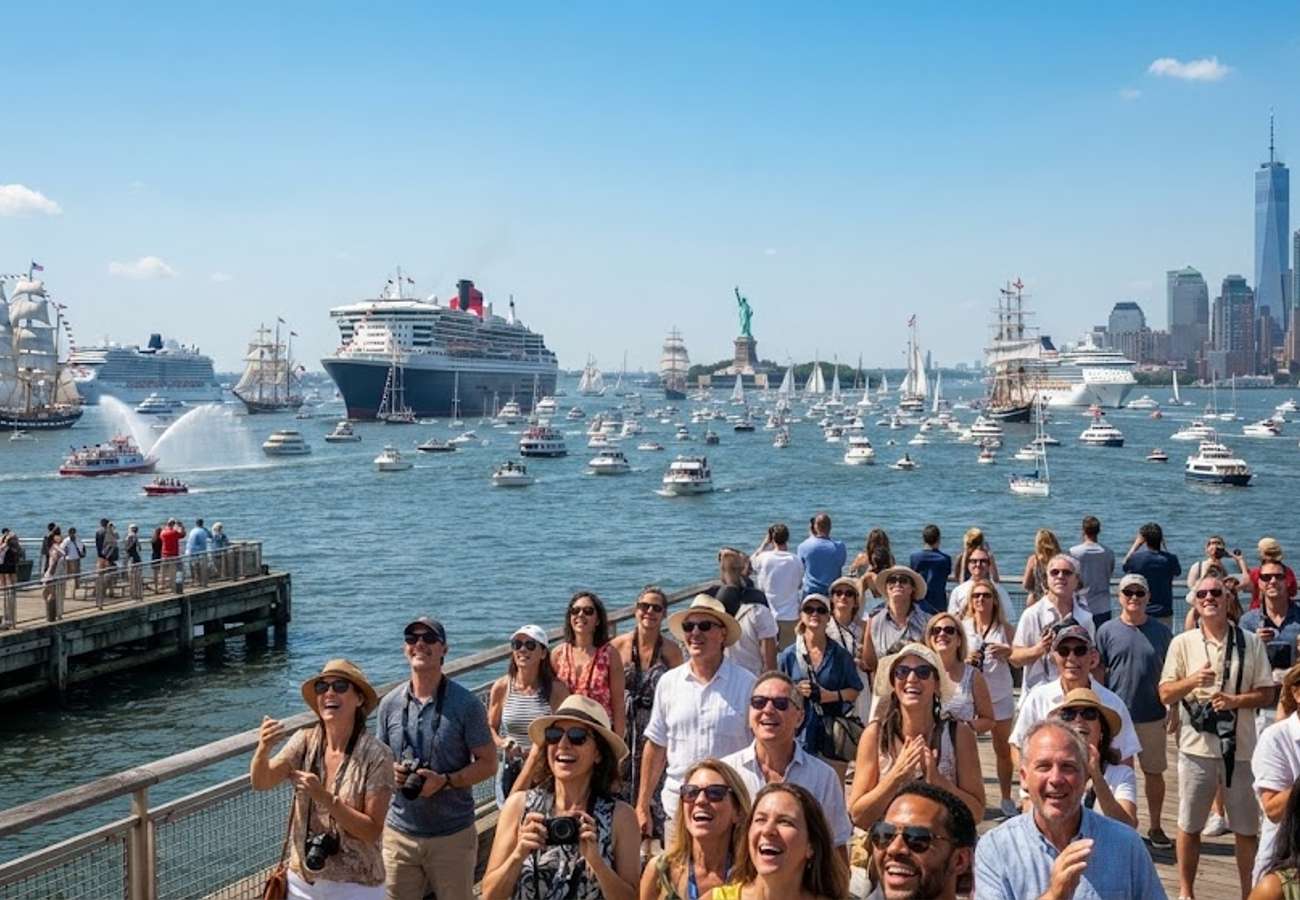
Image generated by AI
On July 4, 2026, New York Harbor transformed into a living maritime museum as more than 100 vessels converged in one of the most coordinated nautical spectacles ever staged on American waters. At the heart of this unprecedented formation sailed Queen Mary 2, the world's most iconic modern ocean liner, anchoring a fleet of historic tall ships, traditional sailing vessels, and contemporary cruise ships in a rare international gathering.
The Sail4th celebration wasn't just another harbor event—it was a deliberate maritime statement marking the United States' 250th anniversary through centuries-old ocean tradition, with the entire route carefully choreographed to transform the waterway into a ceremonial corridor of history, symbolism, and global participation.
A Flotilla Spanning Two Centuries of Ocean Heritage
The formation began near the Verrazzano-Narrows Bridge, flowed through Upper New York Bay passing the Statue of Liberty, and continued northward along the Hudson River toward the George Washington Bridge. This 10-mile maritime procession created a continuous narrative arc through New York's most recognizable waterfront landmarks.
What struck observers most was the sheer scale of coordination. Organizing 100+ vessels of varying sizes, draft requirements, and operational demands into a single moving formation requires weeks of harbor authority coordination, tide planning, and precise navigational choreography. Yet here it was—executed flawlessly on America's birthday.
Reddit: "Seeing Queen Mary 2 surrounded by 100+ other ships in NYC harbor is the kind of moment that reminds you why maritime history still matters. Absolute spectacle." — r/cruise
Queen Mary 2: Where Modern Luxury Meets Ocean Legacy
The inclusion of Queen Mary 2—a 151,400-ton flagship that continues the unbroken tradition of scheduled transatlantic passenger service—created a striking visual metaphor. On one side, historic sailing vessels relying on wind and canvas. On the other, a 1,000-foot engineered marvel representing 180+ years of continuous steam and diesel-powered Atlantic crossings.
The ship's presence wasn't ceremonial tokenism. Cunard Line, which operates Queen Mary 2, literally traces its founding to 1840, when the company launched the first regularly scheduled transatlantic steam service between Liverpool and Boston. That's 186 years of uninterrupted Atlantic operations—a maritime continuity matched by almost no other institution on Earth.
After the harbor parade concluded, Queen Mary 2 departed on a dedicated seven-night transatlantic voyage focused explicitly on US-UK maritime heritage, extending the celebration from harbor waters into open ocean.
The Symbolic Route: New York's Waterfront as Living History
The parade route was far more than logistical necessity—it was deliberate storytelling. Beginning in the outer harbor represented global maritime connectivity. The central bay passage past Liberty Island highlighted national identity and immigration. The Hudson River stretch embodied urban development and modern trade.
As the flotilla moved northward, Manhattan's skyline framed the procession on the west, while New Jersey's waterfront anchored the east. This geography literally enclosed the celebration within the city's maritime heart—the same waters that received millions of immigrants, that powered American trade supremacy, and that continue to define New York's identity as a global port city.
According to maritime historians at the Mariners' Museum in Newport News, formations of this scale and coordination occur perhaps once per decade in American waters. The last comparable event was the bicentennial celebrations of 1976.
A Rare Celebration of Ocean Travel in the Aviation Era
What made Sail4th particularly newsworthy was its implicit statement: ocean travel still matters, even in 2026.
In an era where transatlantic flight takes eight hours versus seven days at sea, the cruise industry's decision to celebrate scheduled ocean crossings with this level of ceremony signaled something deeper than nostalgia. It acknowledged that ocean travel serves cultural and experiential functions that aviation cannot replicate—the rhythm of the sea, the gradual transition between continents, the meditative quality of multi-day voyages.
Queen Mary 2 maintains a year-round schedule of transatlantic crossings, each crossing attracting passengers specifically seeking the ocean voyage experience rather than treating it as transportation merely. The ship's occupancy rates and advance bookings consistently demonstrate strong demand for this service.
The 450th Crossing: A Milestone Reinforcing Continuity
Later in 2026, Queen Mary 2 will complete its 450th transatlantic crossing—a number that staggers the imagination when you consider the operational, logistical, and commercial continuity required to maintain scheduled ocean service across nearly two centuries.
Cunard has opened public participation for this milestone sailing, offering civilians the opportunity to be aboard during this historic moment. The initiative reflects sustained global interest in maritime heritage and the enduring romance of the Atlantic crossing.
"This milestone further strengthens the position of long-distance ocean travel as a continuing element of international connectivity," according to Cruise Industry News, "even as air travel dominates commercial transatlantic movement."
The Harbor Transforms Into Global Theater
Over 100 vessels—each with distinct national origin, operational purpose, and historical significance—moving in synchronized formation across one of Earth's most famous harbors created a visual narrative that transcended typical maritime news.
For attendees watching from Brooklyn waterfront parks, Battery Park, or the Hoboken waterfront, Sail4th delivered something increasingly rare in modern travel: genuine awe. The slow, deliberate progression of the fleet allowed observers to absorb the scale of participation and the symbolic weight of the moment.
The spectacle reinforced New York Harbor's continuing identity as a global maritime gateway—a role it has maintained for over 400 years, from colonial trading posts through Ellis Island immigration to present-day cruise operations.
What Comes After the Parade
Queen Mary 2's post-parade transatlantic voyage extended the celebration into operational reality. Rather than simply returning to regular service, the ship carried the US 250th commemoration into the Atlantic, with onboard programming, historical presentations, and themed itineraries reinforcing the maritime heritage narrative.
This continuation reflected a broader cruise industry strategy: connecting shoreside celebration with actual ocean-based experiences, making the commemoration tangible rather than purely symbolic.
New York Harbor proved once again that in an age of rapid transit and digital connection, the slow ceremony of ships moving through historic waters still commands our deepest attention.
Related Travel Guides
Disclaimer
This article is for informational and educational purposes only. It does not constitute legal, financial, or professional advice. While we strive to provide accurate and up-to-date information, travel policies, regulations, and conditions change rapidly. Always verify information with official sources before making travel decisions. Nomad Lawyer makes no representations about the accuracy, reliability, completeness, or suitability of the information provided. Readers should consult qualified professionals for advice specific to their circumstances. The views expressed in this article are those of the author and do not necessarily reflect the views of Nomad Lawyer.
Preeti Gunjan
Contributor & Community Manager
A passionate traveller and community builder. Preeti helps grow the Nomad Lawyer community, fostering engagement and bringing the reader experience to life.
Learn more about our team →