
Qantas Strips Down Boeing 787 to Bare Essentials for Record-Breaking 22-Hour Nonstop Routes
Breaking airline news and aviation industry updates for 2026.

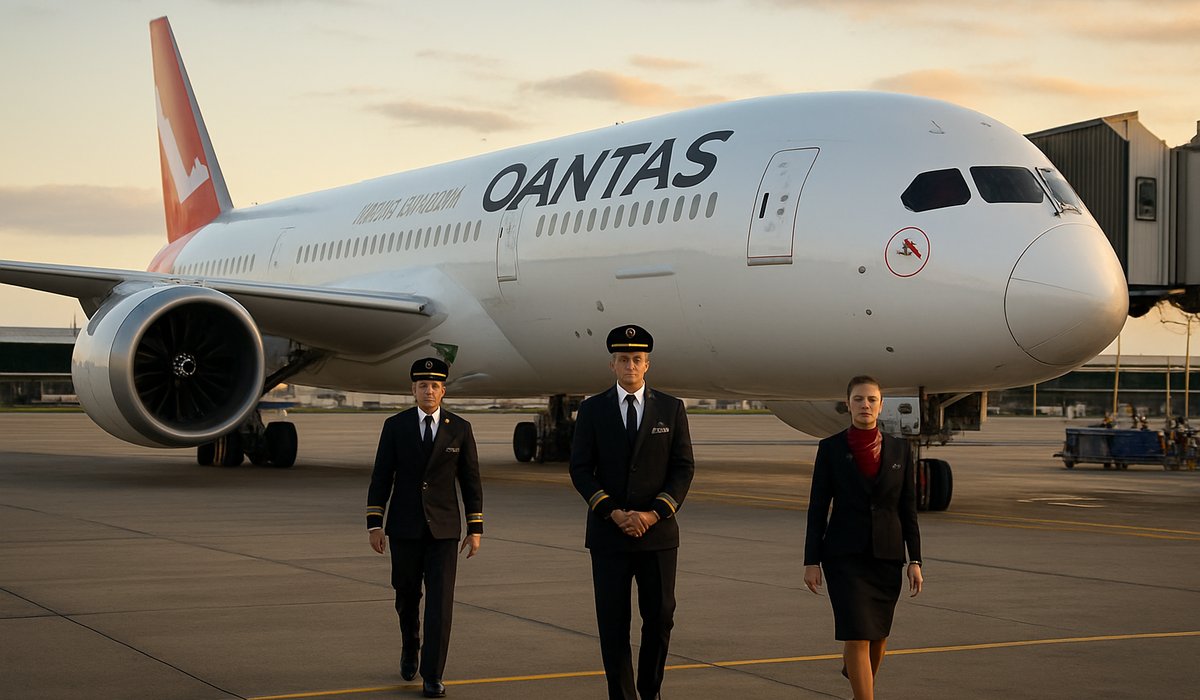
Image generated by AI
Qantas Strips Down Boeing 787 to Bare Essentials for Record-Breaking 22-Hour Nonstop Routes
Australian carrier sacrifices passenger capacity and comfort to pioneer extreme ultra-long-haul aviation
The Trade-Off: Capacity Sacrificed for Distance
Qantas has fundamentally reimagined commercial aviation's possibilities by configuring a Boeing 787 Dreamliner with just 238 seats—a stark reduction that underscores the brutal calculus underlying ultra-long-haul operations. The decision represents a watershed moment in aviation strategy: the airline is voluntarily abandoning conventional revenue models to achieve what was once considered operationally impossible.
The radical cabin configuration reflects an uncomfortable truth facing the aviation industry. To sustain non-stop flights exceeding 22 hours—connecting cities like London and Sydney or New York and Melbourne without intermediate stops—airlines must fundamentally restructure their business model. Additional fuel capacity, reinforced structural components, and extended crew rest facilities consume space that traditionally houses paying passengers.
Pushing the Boundaries of Human Endurance
Ultra-long-haul aviation transcends conventional aircraft engineering. These routes demand revolutionary approaches to crew scheduling, passenger welfare, and aircraft maintenance cycles. The 787 Dreamliner's advanced materials and fuel efficiency made it the only viable platform for Qantas's ambition, yet even this state-of-the-art aircraft requires substantial modifications to function as intended.
Qantas's decision to operate with approximately 238 seats—compared to standard 787 configurations carrying 242-330 passengers—reveals how marginal the economics become at aviation's extreme boundaries. Every available cubic meter must serve either operational necessity or essential passenger comfort, with discretionary amenities becoming luxury rather than standard offerings.
Industry-Wide Implications for Aviation's Future
This development signals a broader shift in how premium carriers approach market positioning. Rather than competing on seat count and density, airlines increasingly recognize that ultra-long-haul routes offer opportunities to command premium pricing while maintaining operational sustainability.
The move reflects persistent pressures facing global aviation: elevated jet fuel costs stemming from geopolitical instability, recovery demands following pandemic-induced losses, and growing environmental scrutiny. Airlines must balance profitability with operational reality. Qantas's ultra-long-haul strategy sidesteps traditional high-capacity, low-margin models entirely.
The Competitive Calculus
Competitors including Singapore Airlines, British Airways, and others have explored comparable routes, yet few have committed to such radical capacity constraints. The decision positions Qantas as a market leader willing to sacrifice short-term revenue volume for long-term route establishment and premium pricing power.
The airline's approach addresses a fundamental aviation industry challenge: connecting the world's most distant population centers profitably requires accepting lower seat counts and higher per-passenger costs. This formula works only when demand supports premium fares substantially exceeding conventional long-haul pricing.
FAQ: Ultra-Long-Haul Aviation and Changing Travel Economics
Why do airlines reduce passenger capacity on ultra-long-haul flights? Extended flight durations demand significantly greater fuel reserves, requiring structural reinforcement and larger tanks. This necessitates trading passenger seats for operational fuel capacity and crew facilities.
How does ultra-long-haul flying affect airline fees and baggage charges? Premium pricing on these routes typically covers additional operational costs, potentially reducing reliance on ancillary baggage fees and seat charges compared to conventional flights.
What impact do jet fuel prices have on ultra-long-haul route viability? Volatile fuel costs directly determine profitability on these ultra-efficient routes. Lower fuel prices improve margins; elevated costs may render certain routes commercially unviable.
Which airlines currently operate 22-hour nonstop flights? Qantas leads this segment, though other major carriers including Singapore Airlines continue developing comparable capabilities.
Will ultra-long-haul routes become standard in aviation's future? Industry analysts anticipate gradual expansion, though only on high-demand routes where premium pricing justifies reduced capacity and higher operational complexity.
Related Travel Guides
Flight Delay Compensation Guide 2026
Understanding Airline Route Changes
Airport Security Process Updated (2026)
External Resources
Disclaimer
This article is for informational and educational purposes only. It does not constitute legal, financial, or professional advice. While we strive to provide accurate and up-to-date information, travel policies, regulations, and conditions change rapidly. Always verify information with official sources before making travel decisions. Nomad Lawyer makes no representations about the accuracy, reliability, completeness, or suitability of the information provided. Readers should consult qualified professionals for advice specific to their circumstances. The views expressed in this article are those of the author and do not necessarily reflect the views of Nomad Lawyer.
Kunal K Choudhary
Co-Founder & Contributor
A passionate traveller and tech enthusiast. Kunal contributes to the vision and growth of Nomad Lawyer, bringing fresh perspectives and driving the community forward.
Learn more about our team →