
Newark Unites with JFK, LaGuardia and Philadelphia Airports Hit by FAA Equipment Outage, Triggering Major Flight Delays: New Update
Newark Unites with JFK, LaGuardia and Philadelphia Airports Hit by FAA Equipment Outage, Triggering Major Flight Delays: New Update

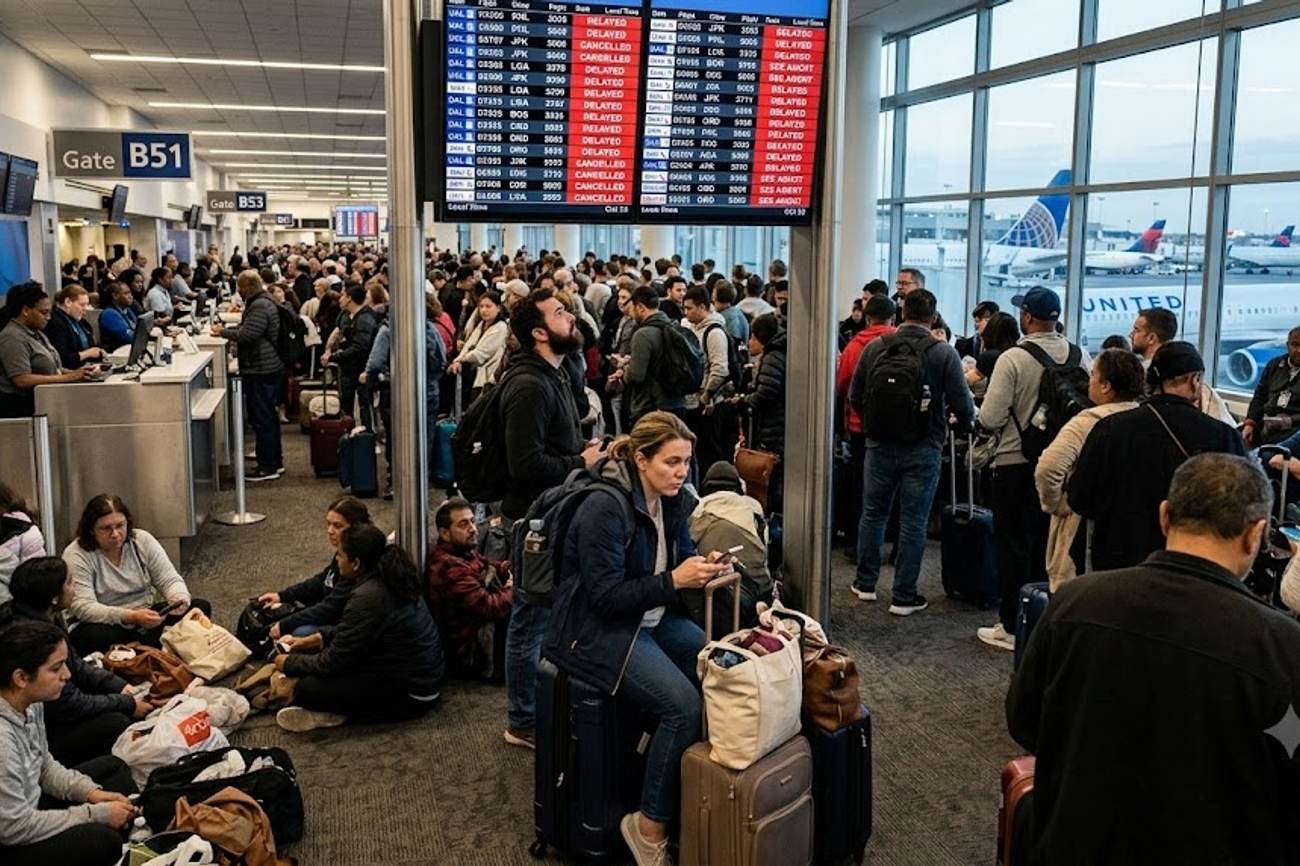
Image generated by AI
112 minutes was the average delay experienced at Newark Liberty International Airport during a systemic air-traffic-control collapse on September 21, 2026. This disruption, triggered by a dual-layer communications failure at the Philadelphia Terminal Radar Approach Control (TRACON), effectively paralyzed aviation operations across the Northeast Corridor, proving that the fragility of the U.S. airspace infrastructure remains a critical vulnerability for global travel.
The Philadelphia TRACON Systemic Failure
The crisis originated not at a passenger terminal, but within the technical architecture of the Philadelphia TRACON. According to FAA Administrator Bryan Bedford, the facility suffered a primary circuit failure that was immediately compounded by a fiber break, which neutralized the backup connection. In the high-stakes environment of air traffic management, the loss of both primary and redundant communications frequencies creates an immediate safety risk, as controllers lose the ability to sequence aircraft safely within terminal airspace.
This technical blackout forced the Federal Aviation Administration (FAA) to implement aggressive traffic-management measures. The initial impact was felt most acutely at Philadelphia International Airport and Teterboro Airport. However, because the Northeast airspace is one of the most densely congested corridors in the world, the failure acted as a bottleneck. As Philadelphia TRACON lost the ability to manage its sector, the FAA was forced to redistribute traffic, leading to reduced airspace capacity that rippled outward to John F. Kennedy International Airport, LaGuardia Airport, and Newark Liberty International Airport.
Operational Breakdown and Network Contagion
The contagion of this outage moved from a localized equipment failure to a regional ground stop. By approximately 10 a.m. on September 21, the FAA ordered a total ground stop at Newark, which was extended multiple times as the agency attempted to stabilize the network. The resulting diversions and holding patterns created a "knock-on" effect, where aircraft unable to land in the Northeast began clogging airspace in adjacent regions.
The following table delineates the specific operational exposure of carriers based on their hub architecture and presence in the affected zone:
| Airline | Primary Affected Airport(s) | Operational Role | Impact Type | Primary Consequence |
|---|---|---|---|---|
| United Airlines | Newark (EWR) | Major Global Hub | Direct | Massive delays; crew displacement |
| American Airlines | Philadelphia (PHL) | Major Domestic/Intl Hub | Direct | Ground restrictions; connection failure |
| Delta Air Lines | JFK, LaGuardia (LGA) | Major NY Presence | Indirect | Capacity-driven delays |
| JetBlue Airways | JFK, LGA, EWR | Major NY Presence | Indirect | Schedule volatility; missed connections |
| Alaska Airlines | EWR, JFK | Regional Service | Indirect | Airspace transit delays |
| Air Canada | EWR, NY Area | Transborder | Indirect | Arrival/Departure volatility |
| British Airways | JFK, EWR | Long-haul | Indirect | Rotation and connection delays |
| Air India | NY Area | Long-haul | Indirect | Aircraft rotation disruptions |
| Lufthansa | EWR, JFK | Long-haul | Indirect | Restricted airspace delays |
| Air France | JFK | Long-haul | Indirect | Arrival/Departure volatility |
| Emirates | JFK | Long-haul | Indirect | New York airspace congestion |
Expert Analysis: The Hub-and-Spoke Vulnerability
For the modern traveler, this incident reveals the inherent danger of the "hub-and-spoke" model employed by giants like United Airlines and American Airlines. When a hub like Newark or Philadelphia is paralyzed, the disruption is not linear—it is exponential.
The 112-minute average delay at Newark is a deceptive statistic. While it represents the mean, the actual impact for a traveler is determined by "aircraft rotation." A single Boeing 737 arriving two hours late into Newark does not just delay one flight; it delays every subsequent leg that aircraft is scheduled to fly for the remainder of the day. Furthermore, crew legality—the strict FAA-mandated limits on how many hours a pilot or flight attendant can work—means that a morning ground stop can lead to afternoon cancellations even after the technical glitch is fixed, simply because the crew has "timed out."
The failure of the backup fiber connection at Philadelphia TRACON is the most alarming detail for industry analysts. Redundancy is the bedrock of aviation safety. When a primary circuit fails and the backup is simultaneously compromised by a physical fiber break, it suggests a lack of true geographic or systemic diversity in the infrastructure. For travelers booking routes through the Northeast, the direct consequence is a heightened risk of "cascading delays," where a technical failure in one city causes a cancellation in another state.
Key Takeaways
- Infrastructure Fragility: A single-point failure at Philadelphia TRACON disabled operations across five major airports, highlighting the interdependence of the Northeast airspace.
- Hub Exposure: United and American Airlines suffered the most severe impacts due to their reliance on Newark and Philadelphia as primary operational nodes.
- Recovery Lag: Even after the FAA restores communications, delays persist for hours or days due to displaced crews and disrupted aircraft rotations.
- Redundancy Failure: The simultaneous loss of primary and backup circuits indicates a critical vulnerability in the FAA's communication hardware.
- Network Ripple: International carriers like Emirates and Lufthansa experienced indirect delays, proving that local US ATC failures impact global flight schedules.
FAQ: Northeast Airspace Outage 2026
Why did a problem in Philadelphia cause delays at JFK and LaGuardia? The Northeast airspace is a tightly integrated system. When Philadelphia TRACON cannot manage its sector, the FAA reduces the overall capacity of the surrounding airspace to ensure safety, forcing aircraft at nearby New York airports to hold or delay departures.
If the FAA equipment is fixed, why is my flight still delayed? Airlines operate on strict rotations. If your plane was stuck in another city during the ground stop, or if the crew exceeded their legal working hours due to the delay, the flight cannot depart until a new aircraft or crew is sourced.
What should I do if my flight is affected by an ATC outage? Check your flight status directly through the airline's app rather than the airport screens. If you have a tight connection at a hub like Newark or Philadelphia during a TRACON failure, contact the airline immediately to rebook.
Who is responsible for the equipment failure at TRACON? The Federal Aviation Administration (FAA) manages the air-traffic-control infrastructure. In this instance, a primary circuit failure and a subsequent fiber break in the FAA's communication network caused the disruption.
When the invisible architecture of the sky fails, the most expensive aircraft in the world become nothing more than very expensive parking lots.
Tags: Philadelphia TRACON, FAA Equipment Outage 2026, Newark Liberty International Airport, United Airlines Hub Disruption, American Airlines PHL, Northeast Corridor Aviation
Related Travel Guides
- Montenegro Travel Growth Snapshot as 994459 Visitors Drive Over Five Percent Arrival Rise in H1 2026
- Ireland’s The CCD Earns International Recognition With Silver Honour For Best Overseas Conference Centre At M&IT Awards
- Antigua and Barbuda Charts Next Tourism Era With Comprehensive Study on Growth Limits and Opportunities
Disclaimer
This article is for informational and educational purposes only. It does not constitute legal, financial, or professional advice. While we strive to provide accurate and up-to-date information, travel policies, regulations, and conditions change rapidly. Always verify information with official sources before making travel decisions. Nomad Lawyer makes no representations about the accuracy, reliability, completeness, or suitability of the information provided. Readers should consult qualified professionals for advice specific to their circumstances. The views expressed in this article are those of the author and do not necessarily reflect the views of Nomad Lawyer.
Raushan Kumar
Founder & Lead Developer
Full-stack developer with 11+ years of experience and a passionate traveller. Raushan built Nomad Lawyer from the ground up with a vision to create the best travel and law experience on the web.
Learn more about our team →