
New York Unveils $1 Billion Sustainable Future Programme to Cut Energy Costs and Expand Clean Power
New York Unveils $1 Billion Sustainable Future Programme to Cut Energy Costs and Expand Clean Power

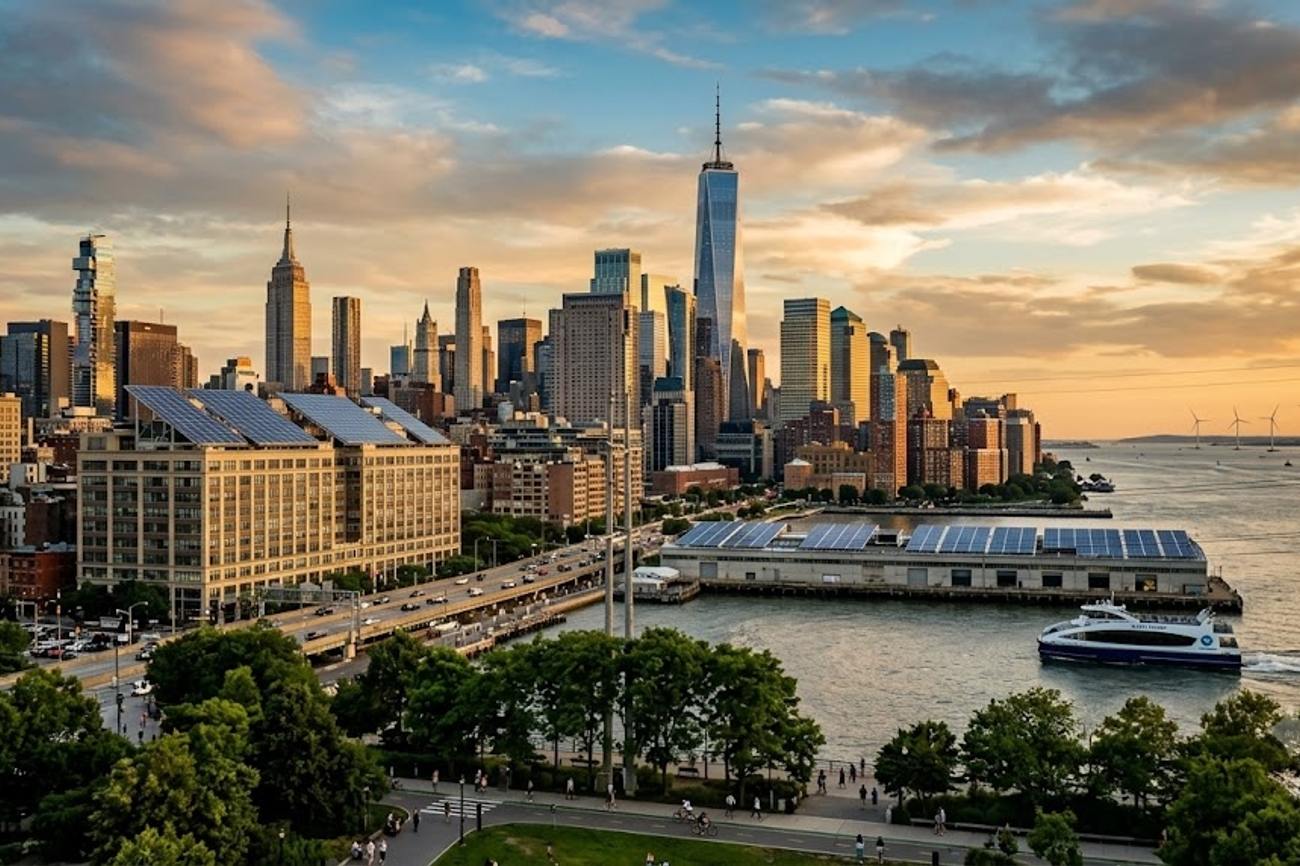
Image generated by AI
$1 billion in fresh capital is being deployed by New York State to insulate its energy grid and lower consumer costs as the region faces an unprecedented surge in electricity demand. This funding package, an expansion of the Sustainable Future Programme, represents the largest climate-action investment in the state's history, designed to pivot the region away from fossil-fuel dependence while simultaneously addressing the massive power requirements of the artificial intelligence boom and industrial electrification.
The Convergence of AI and Infrastructure
The timing of this investment is not coincidental. New York is currently navigating a volatile intersection of economic growth and resource scarcity. The state is witnessing a sharp increase in electricity consumption driven by three primary engines: the expansion of high-tech manufacturing, the systemic electrification of heating and transport, and the energy-intensive nature of artificial intelligence data centers.
To manage this, Governor Kathy Hochul has introduced two complementary frameworks alongside the funding: the CHARGE agenda and the Energy Infrastructure Development Plan (EIDP). The EIDP is specifically designed to replace reactive planning with a coordinated framework, ensuring that the New York State Energy Research and Development Authority (NYSERDA) and the State Energy Planning Board can align grid upgrades with actual economic growth patterns. For the first time, the state is treating energy capacity not just as a utility issue, but as a prerequisite for economic competitiveness in the AI era.
Fiscal Breakdown of the Sustainable Future Programme
The $1 billion allocation is not a monolithic fund but a surgical distribution across residential, public, and environmental sectors. The primary objective is to decouple economic growth from carbon emissions while protecting low-income residents from the resulting price volatility.
| Investment Category | Allocation | Primary Objective |
|---|---|---|
| Building Decarbonization | $500 Million | Energy-cost reduction and efficiency |
| Affordable Renewables | $300 Million | Expansion of solar and public energy |
| Thermal Energy Networks | $150 Million | Utility-scale clean heating/cooling |
| EmPower+ Programme | $150 Million | Free assessments and heat pumps for low-income |
| Clean Green Schools | $50 Million | Indoor air quality and facility modernization |
| NY-Sun Programme | $200 Million | Solar incentives for homes and businesses |
| NYPA Renewables | $100 Million | Public-sector renewable project financing |
| Municipal Recycling/Waste | $25 Million | Composting and food donation initiatives |
| Climate-Resilient Ag | $25 Million | Methane reduction and soil health |
| Public Lands/Parks | $25 Million | Land acquisition and facility repairs |
| Urban Forestry | $12.5 Million | Tree cover expansion and forest restoration |
Expert Analysis: The Hidden Logistics of the Energy Transition
For the average resident or business owner in New York, this funding signals a shift from "incentivized" green energy to "infrastructure-led" green energy. The most critical data point here is the $150 million earmarked for thermal energy networks. Unlike individual heat pumps, these are utility-scale systems. This indicates that the state is moving toward a centralized "district energy" model, which is far more efficient for high-density urban environments than fragmented residential upgrades.
The pricing pressure created by the AI surge is the invisible hand driving this policy. Data centers require immense, constant loads of electricity, which typically drives up the "spot price" of power for everyone else. By investing $300 million into affordable renewables—specifically the $200 million for the NY-Sun Programme—the state is attempting to decentralize power generation. If more single-family homes and businesses generate their own solar power, the overall strain on the centralized grid is reduced, theoretically capping the price hikes that usually accompany industrial expansion.
Furthermore, the $150 million EmPower+ Programme and the $150 million for the Affordable Green Transition to Housing (which includes $40 million for Weatherization Assistance and $100 million for the Clean Energy Initiative) act as a social hedge. The state recognizes that as it mandates a transition away from fossil fuels, the "cost of entry" for clean energy is too high for low-to-moderate income households. By subsidizing the hardware (heat pumps) and the envelope (weatherization), the state is preventing a scenario where the energy transition creates a new class of "energy poverty."
New York's $1 billion Sustainable Future Programme aims to reduce energy costs and increase clean power usage, with a focus on renewable energy sources and energy-efficient technologies. The programme is expected to create jobs and stimulate local economies, while also reducing the city's carbon footprint. For more information on the programme and its initiatives, visit the New York State Government website to learn about the state's sustainability goals and efforts.
From a regulatory perspective, the Energy Infrastructure Development Plan is the most significant long-term move. By integrating the International Energy Agency (IEA) standards of coordinated planning, New York is attempting to avoid the "bottleneck effect" seen in other global hubs where data centers are built but the grid cannot provide the power to run them.
Key Takeaways
- AI-Driven Demand: A significant portion of the strategic planning is now dedicated to offsetting the massive electricity requirements of artificial intelligence and new manufacturing plants.
- Direct Consumer Relief: Eligible low- and moderate-income New Yorkers can access free home energy assessments and heat-pump installations via the $150 million EmPower+ Programme.
- Decentralized Power: The $200 million NY-Sun investment aims to lower electricity bills by expanding solar incentives for multifamily buildings and local authorities.
- Public Health Linkage: The $50 million Clean Green Schools initiative explicitly links carbon reduction to improved indoor air quality for students and staff.
- Agricultural Integration: $25 million is dedicated to methane-reduction technologies, acknowledging that the energy transition must include the farming sector to meet climate goals.
FAQ: New York Energy Transition 2024
Who is eligible for the free heat pump installations? The $150 million EmPower+ Programme is specifically targeted at low- and moderate-income New Yorkers. Eligibility is typically based on household income levels relative to the area median income.
How does the NY-Sun Programme lower my electricity bill? By providing financial incentives for the installation of solar panels on single-family homes, multifamily buildings, and businesses, the programme reduces the amount of power you must purchase from the grid.
What are thermal energy networks? These are large-scale, community-wide systems that move heat or chilled water through underground pipes to provide heating and cooling to multiple buildings, replacing individual fossil-fuel boilers.
Why is the state spending money on urban forestry and recycling? The Sustainable Future Programme views energy as part of a broader ecosystem. Reducing food waste ($25 million) and increasing tree cover ($12.5 million) reduces the "urban heat island" effect, which in turn lowers the energy needed for air conditioning.
New York is betting a billion dollars that it can feed the hunger of AI while keeping the lights affordable for the working class.
Tags: Governor Kathy Hochul, Sustainable Future Programme, NY-Sun Programme, New York Power Authority, Energy Infrastructure Development Plan, New York State Energy Planning Board
Related Travel Guides
- New Religious Tourism Plans at Borobudur and Prambanan Temples Set to Attract More Global Travellers to Indonesia
- Richmond Second Street Festival 2026 Turns Jackson Ward Into a Living Rhythm of Black Heritage
- Sweden Aligns With Denmark and Other Nordic Countries Fueling Colombia Tourism Growth as Arrivals Rise Fourfold
Disclaimer
This article is for informational and educational purposes only. It does not constitute legal, financial, or professional advice. While we strive to provide accurate and up-to-date information, travel policies, regulations, and conditions change rapidly. Always verify information with official sources before making travel decisions. Nomad Lawyer makes no representations about the accuracy, reliability, completeness, or suitability of the information provided. Readers should consult qualified professionals for advice specific to their circumstances. The views expressed in this article are those of the author and do not necessarily reflect the views of Nomad Lawyer.
Preeti Gunjan
Contributor & Community Manager
A passionate traveller and community builder. Preeti helps grow the Nomad Lawyer community, fostering engagement and bringing the reader experience to life.
Learn more about our team →