
Narita Airport Expands Smart Travel With Multi-Cube Lockers Across All Terminals for Easier Luggage Handling
Narita International Airport introduces JR East Multi-Cube smart lockers across Terminals 1, 2, and 3, featuring online reservations, cashless payments, and direct-to-hotel luggage delivery.

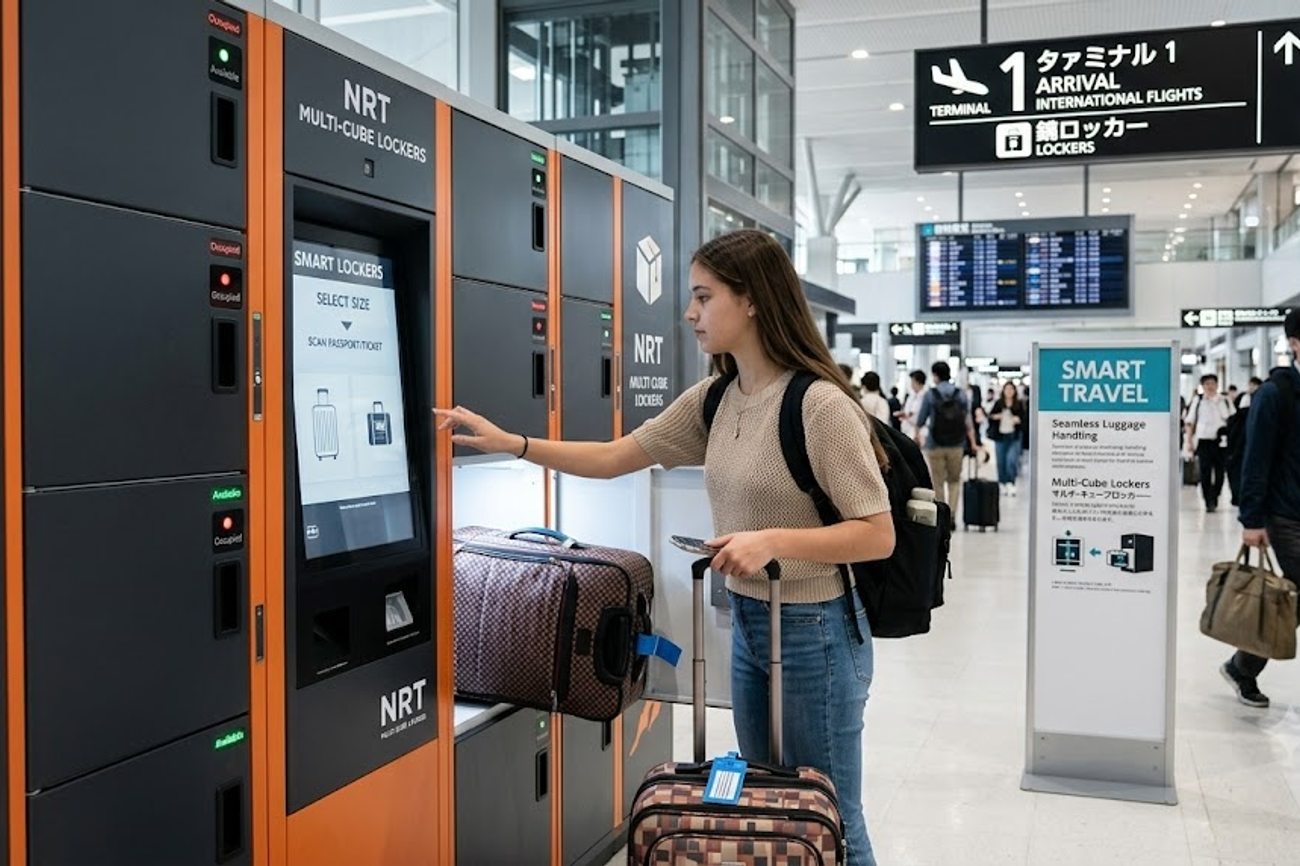
Image generated by AI
A network of more than 1,100 automated Multi-Cube locker units deployed across Japan has expanded directly into Narita International Airport, establishing a terminal-wide automated baggage ecosystem ahead of a projected 2,000-unit national footprint by fiscal year 2030. Spearheaded by JR East Smart Logistics—the smart infrastructure arm of JR East (East Japan Railway Company)—the deployment integrates advance online reservations, contactless storage, automated collection, and direct-to-hotel luggage delivery into a single unified terminal platform. By situating these digital lockers in accessible public landside zones across Terminal 1, Terminal 2, and Terminal 3, Narita International Airport is overhauling Japan's traditional coin-locker architecture. For overseas visitors arriving in Tokyo ahead of standard hotel check-in windows or departing hours after morning checkout, the initiative eliminates the chronic physical friction of navigating metropolitan rail transit with heavy luggage, aligning airport operations with the national hands-free travel policy championed by the Japan National Tourism Organization (JNTO).
The Terminal Deployment Strategy: Integrating Air Arrivals with Tokyo Rail Corridors
The implementation of the Multi-Cube system across Narita International Airport resolves one of the most enduring logistical pain points facing international passengers in Japan: the gap between flight schedules and urban accommodation availability. Inbound long-haul flights from North America, Europe, and Australasia frequently touch down at Narita during the early morning hours, leaving passengers stranded with oversized suitcases hours before Japanese hotels open their doors for check-in. Conversely, outbound flights scheduled for late evening often force departing guests to abandon hotel premises before noon.
Historically, travelers attempted to solve this dilemma by relying on traditional physical coin lockers located in railway station concourses or manned baggage counters operated by airport handling agencies. However, analog coin lockers present acute functional limitations for modern air travelers: they require physical Japanese currency, lack dimensional capacity for standard 28-inch international suitcases, and provide zero real-time inventory visibility. Travelers routinely arrive at underground rail basements only to find all large-capacity units occupied. Meanwhile, manned cloakrooms often suffer from peak-hour queuing, restrictive operating hours, and manual paper-claim protocols.
JR East Smart Logistics designed the Multi-Cube system to bypass these bottlenecks by bridging air terminals directly to Japan’s extensive rail and parcel network. The Narita rollout began in Terminal 2 on September 5, 2026, positioning initial hardware in the Main Building on the Basement 1 Floor—the critical transit threshold where arriving air passengers funnel downward to board the Narita Express and local commuter rail links. The deployment expanded to Terminal 1 on September 17, 2026, positioning units in the public landside arrivals concourse on the North Wing 1st Floor. The final phase concludes on October 8, 2026, with the operational activation of units on the 2nd Floor Main Building of Terminal 3, the airport’s primary dedicated low-cost carrier hub.
Because all Multi-Cube units reside in non-restricted public concourses rather than secure airside departure lounges, they serve arriving passengers, departing travelers, layover transits, and airport day visitors alike. By standardizing digital luggage infrastructure before passengers pass through security or board regional trains, the airport converts what was once an ad-hoc baggage struggle into a structured, predictable transit step.
Terminal Infrastructure and Multi-Cube Operational Capabilities
The Multi-Cube platform deviates fundamentally from mechanical storage by merging four distinct logistical operations into an automated touchscreen terminal. Rather than functioning purely as stationary lockboxes, these units operate as localized logistics nodes connected to JR East’s national logistics grid.
| Terminal | Specific Facility Location | Service Start Date | Primary Passenger Flow Served | Core Logistics Capabilities |
|---|---|---|---|---|
| Terminal 1 | North Wing, 1st Floor | September 17, 2026 | Full-service international arrivals and sky-train connections | Advance online reservation, short-term deposit, cashless payment, outbound courier pickup |
| Terminal 2 | Main Building, Basement 1 Floor | September 5, 2026 | Rail passengers transferring to JR East Narita Express & Keisei Lines | Rapid train-to-air bag drops, hotel forward delivery, integrated IC card reader |
| Terminal 3 | Main Building, 2nd Floor | October 8, 2026 | Budget carrier passengers and regional domestic flight connections | Budget traveler luggage staging, pre-booked storage, automated locker dispatch |
The system’s architecture is anchored by four central functional pillars designed for high-throughput passenger terminals:
- Advance Digital Reservation: Through the centralized Multi-Cube digital portal, international visitors can monitor real-time locker availability and secure specific compartment dimensions before landing in Japan, eliminating the arrival-time anxiety of finding storage bays fully occupied.
- Contactless Secure Storage: Lockers accommodate everything from carry-on daypacks to maximum-allowable international checked baggage, secured through encrypted QR code credentials and digital verification codes rather than physical keys.
- Automated On-Demand Collection: Passengers retrieving stored belongings authenticate their identity digitally, allowing instantaneous locker release without interacting with service desk staff or sorting through physical receipts.
- Integrated Hotel and Regional Shipping: Selected Multi-Cube units function as unassisted courier dispatch depots. Arriving passengers can deposit luggage directly into a locker and initiate automated forwarding to participating hotels across the Greater Tokyo area and wider regional prefectures, freeing them to board public transport entirely unencumbered.
To accommodate international travelers who frequently lack domestic currency upon arrival, the entire Narita Multi-Cube installation operates strictly on cashless payment architecture. The terminals support Japanese contactless transportation IC cards (including Suica, Pasmo, and ICOCA), major global credit card networks (Visa, Mastercard, JCB, and American Express), and standardized mobile QR code payment protocols.
Expert Analysis: The Economics of Airport Self-Service and Luggage Disintermediation
The deployment of Multi-Cube lockers across Narita International Airport represents a critical structural transition in how aviation hubs manage passenger flow and labor allocation. For travelers booking itineraries into Narita, the direct consequence is the elimination of the baggage penalty that has historically restricted post-arrival mobility in Japan. Under conventional arrival models, an international traveler landing at 08:00 must either pay an exorbitant fee for early hotel check-in, journey two hours into central Tokyo solely to drop bags at a hotel concierge, or navigate densely packed commuter rail cars while managing multiple pieces of heavy luggage. By enabling pre-reserved locker drops and direct hotel forwarding immediately upon exiting customs, the Multi-Cube network decouples the traveler from their physical luggage at the airport boundary.
The pricing pressure this creates on traditional manned luggage counters and dedicated private courier desks is substantial. Conventional airport delivery counters typically require passengers to wait in manual queues, complete physical dispatch paperwork, and pay premium handling surcharges. An automated, self-service locker network lowers the overhead associated with manual intake, driving competitive efficiency across airport baggage handling operations.
From an airport management perspective, Narita's pivot to smart lockers addresses severe structural labor constraints within Japan's aviation ecosystem. Japanese ground handling and airport customer service agencies continue to face severe labor shortages driven by national demographic shifts. Automating routine storage and parcel transfer tasks allows airport authorities and handling concessionaires to reallocate scarce human personnel toward critical safety, security, and complex passenger service operations.
Simultaneously, this initiative serves as a core operational driver for Japan's national "Hands-Free Travel" (Tebura Kanko) campaign. Japanese transport planners have long identified large luggage on public transport as a primary source of commuter congestion and safety incidents along high-density transit corridors such as the Yamanote Line and airport express trains. When overseas visitors route their luggage through automated storage and forward-shipping networks, rail car crowding diminishes, boarding dwell times at station platforms decrease, and traveler stress drops.
Additionally, disencumbering international visitors generates measurable economic spillover for the tourism economy. Travelers relieved of heavy baggage are significantly more likely to make impromptu intermediate stops, explore shopping and dining districts surrounding Narita City and Chiba, or immediately embark on regional sightseeing tours prior to hotel check-in. By leveraging JR East Smart Logistics' existing footprint of more than 1,100 operational units and expanding toward its stated goal of 2,000 units by fiscal year 2030, this initiative constructs a seamless logistics bridge between air arrival gates, metropolitan commuter arteries, and final hotel destinations.
Key Takeaways
- Terminal-Wide Deployment: JR East Smart Logistics has deployed Multi-Cube automated smart lockers across all three passenger terminals at Narita International Airport, positioning hardware in public landside concourses.
- Staged Activation Timeline: Facilities launched in Terminal 2 on September 5, 2026, followed by Terminal 1 on September 17, 2026, and will reach full coverage when Terminal 3 goes live on October 8, 2026.
- Four Integrated Functions: The Multi-Cube ecosystem combines advance online reservations, contactless physical storage, rapid digital collection, and direct luggage forwarding to hotels in a single terminal.
- Comprehensive Cashless Operation: Lockers accept transportation IC cards (Suica, Pasmo), major international credit cards, and QR code digital payments, completely eliminating the need for Japanese yen coins.
- Aggressive National Scaling: Narita's rollout expands an existing base of over 1,100 Multi-Cube units across Japan, advancing JR East Smart Logistics toward its target of 2,000 operational units by fiscal year 2030.
FAQ: Narita Airport Multi-Cube Smart Lockers 2026
Where are the Multi-Cube smart lockers located in Narita Airport?
Multi-Cube units are located in public landside concourses across all three terminals: Terminal 1 on the 1st Floor North Wing, Terminal 2 on the Basement 1 Floor Main Building, and Terminal 3 on the 2nd Floor Main Building.
Can international travelers reserve a Multi-Cube locker before landing?
Yes. Passengers can access the official Multi-Cube web portal prior to departure or during transit to check real-time compartment availability and reserve locker space ahead of landing at Narita International Airport.
How does direct luggage shipping from the lockers to hotels operate?
Selected Multi-Cube units allow users to deposit baggage, input destination details, and dispatch items directly to designated hotels and addresses via integrated courier services, enabling hands-free travel directly from the terminal.
What payment methods are supported by Narita's Multi-Cube lockers?
The lockers operate exclusively on cashless payment systems, accepting Japanese transportation IC cards (such as Suica and Pasmo), major global credit cards, and smartphone-based QR code payment applications.
[Automating the first and final miles of baggage transit transforms Narita Airport from a congested processing bottleneck into an agile gateway for frictionless Japanese exploration.]
Related Travel Guides
Japan Airlines Sets New Green Aviation Milestone With CORSIA Carbon Removal Partnership
Cathay Pacific Celebrates Skytrax Success With World’s Best Cabin Crew and Lounge Recognition
10 Best Airline Lounges at JFK Airport: Complete Terminal Guide 2026
Disclaimer
This article is for informational and educational purposes only. It does not constitute legal, financial, or professional advice. While we strive to provide accurate and up-to-date information, travel policies, regulations, and conditions change rapidly. Always verify information with official sources before making travel decisions. Nomad Lawyer makes no representations about the accuracy, reliability, completeness, or suitability of the information provided. Readers should consult qualified professionals for advice specific to their circumstances. The views expressed in this article are those of the author and do not necessarily reflect the views of Nomad Lawyer.
Raushan Kumar
Founder & Lead Developer
Full-stack developer with 11+ years of experience and a passionate traveller. Raushan built Nomad Lawyer from the ground up with a vision to create the best travel and law experience on the web.
Learn more about our team →