
Brisbane Airport Opens New and Faster Passport Control as Australia Prepares for 1.8 Million Holiday Travellers
Brisbane Airport launches a 12-lane Level 4 passport control concourse, unifying check-in, security, and immigration ahead of an 84,100-passenger spring holiday peak.

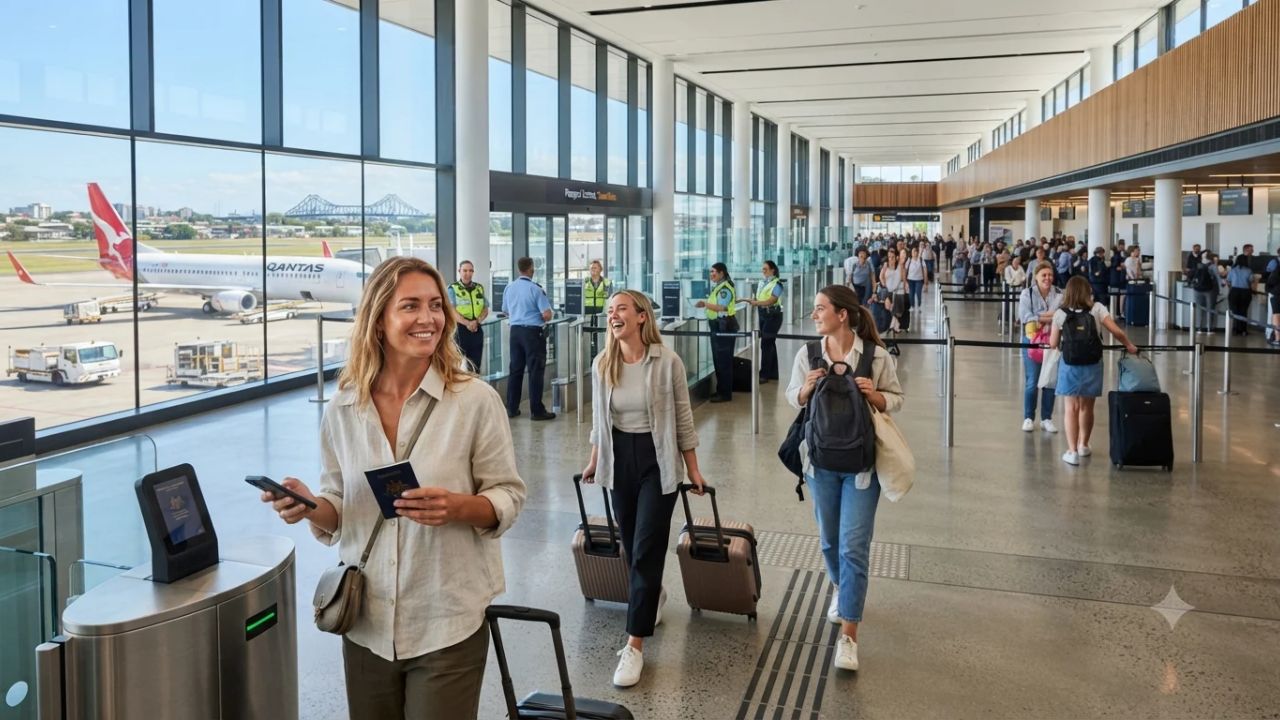
Image generated by AI
A projected wave of more than 1.8 million spring holiday travelers and an anticipated 84,100-passenger surge on Monday 5 October—forecast to become the second-busiest day in the hub’s history—has prompted Brisbane Airport to open an advanced 12-lane passport control concourse on Level 4 of its International Terminal. Executed under the precinct’s AU$5 billion "Future BNE" transformation, the infrastructure overhaul marks the first time that passenger check-in, primary security screening, and Australian Border Force passport clearance have been consolidated onto a single operational floor. As international departures from Queensland rise by 6.1% compared to last year's spring holiday period, Brisbane Airport is systematically eliminating vertical terminal bottlenecks to accelerate passenger throughput ahead of the long weekend rush, while simultaneously clearing floor space to nearly double the footprint of its airside duty-free retail precinct.
Consolidating the Departure Journey: The Engineering of Level 4
The operational restructuring of Brisbane Airport's International Terminal resolves an enduring architectural limitation that has complicated outbound passenger flows for over a decade. In the terminal’s legacy configuration, travelers were required to navigate disjointed, multi-level routes, checking baggage on one level, ascending to security, and maneuvering through separate corridors to reach immigration checkpoints. This vertical circulation produced chronic queue spillbacks during morning and evening departure banks, particularly when widebody flights to Asia, North America, and the Pacific departed within concentrated departure windows.
Under the new operational design, the newly constructed 12-lane passport control facility sits directly adjacent to the modernized security screening zone within an expansive, light-filled atrium on Level 4. By integrating check-in, screening, and border clearance onto a unified horizontal plane, the airport removes vertical transit friction entirely. Passengers proceed in a linear sequence from bag drop straight through security lanes and into passport control without encountering escalators, elevators, or transitional holding areas.
Beyond passenger movement, the relocation executes a major commercial objective. Vacating the former immigration footprint on the lower levels liberates prime terminal real estate, enabling the airport to nearly double the square meterage dedicated to international duty-free retail. The expansion aligns terminal capacity with record long-term demand: over the past twelve months, Brisbane Airport processed an unprecedented 25 million passengers across its network of 35 international and 63 domestic destinations.
The immediate trial for the new facility arrives with the spring school holiday travel window spanning Friday 18 September through Monday 12 October. Forecasts compiled by airport analysts project a 6.1% expansion in outbound international travel compared to the corresponding 2025 holiday period. Outbound demand is heavily weighted toward long-haul routes into Japan, China, Europe, and North America, supported by robust short-haul leisure traffic to regional Pacific hubs including Bali, Fiji, and Vanuatu promoted by Tourism and Events Queensland.
Operational Metrics and Holiday Peak Traffic Forecast
The operational performance of the reconfigured terminal will face peak stress across the October long weekend, coinciding with major national sporting fixtures and public holidays:
| Operational Parameter | Official Metric / Forecast Volume | Comparative Baseline | Strategic Passenger Guidance |
|---|---|---|---|
| Spring Holiday Window | Friday 18 September to Monday 12 October 2026 | Over 1.8 million total passengers across domestic and international terminals | Arrive three hours before international departures; 90 minutes for domestic flights |
| Peak Single-Day Traffic | Monday 5 October 2026 (NRL Grand Final Long Weekend) | Forecast 84,100 passengers; projected 2nd busiest day in airport history | Heavy congestion anticipated on airport access roads, parking bays, and check-in zones |
| Outbound International Growth | 6.1% increase in passenger departures | Compared to corresponding 2025 spring school holiday travel period | High volumes on services to Japan, China, Europe, North America, Bali, and Fiji |
| New Passport Control Scope | 12 dedicated automated and staffed processing lanes | Consolidated onto Level 4 beside newly commissioned security screening | Seamless transition from screening into Australian Border Force checks |
| Future BNE Capital Programme | AU$5 billion investment across the precinct | Multi-year modernization across terminal, apron, and commercial facilities | Doubling duty-free retail space while preparing infrastructure for Brisbane 2032 |
| Annual Network Throughput | Record 25 million passengers welcomed over the past year | Connecting Queensland to 35 international and 63 domestic destinations | High-capacity gateway serving resource, business, and leisure transit corridors |
Monday 5 October is modeled as the operational apex of the holiday period. Combining returning sports fans from the National Rugby League (NRL) Grand Final with families concluding school holiday vacations, the forecast of 84,100 passengers will test terminal curb-to-gate capacity. Airport management has reiterated strict arrival advisories, urging international travelers to arrive at least three hours before scheduled departure, while domestic travelers should maintain a 90-minute buffer to absorb security and bag-drop volume.
Expert Analysis: The Commercial Mechanics of Single-Level Concourse Architecture
The physical reconfiguration of Brisbane’s International Terminal illustrates a broader paradigm shift in international airport management. For travelers booking outbound international flights from Brisbane, the direct consequence is a marked reduction in dwell time spent negotiating security and customs queues. In aviation operations, multi-floor transitions represent the primary source of passenger disorientation and bottlenecking. By aligning check-in, advanced computed tomography (CT) security screening, and automated biometric passport control onto a single level, Brisbane Airport reduces average curb-to-airside transit times, smoothing the flow of travelers toward departure gates.
The pricing pressure this creates across airport concessions is substantial. By eliminating transit friction and moving passengers through border formalities rapidly, the airport maximizes "dwell time" within the airside concourse. In modern airport economics, passenger dwell time directly correlates with retail revenue. The deliberate strategy to nearly double the duty-free concession footprint allows Brisbane Airport to capture elevated per-passenger discretionary spending on luxury retail, dining, and local goods. This commercial expansion is essential for underwriting the non-aeronautical revenue baselines required to service the capital expenditure of the AU$5 billion Future BNE program.
In addition, the 12-lane passport facility reflects an operational adjustment to post-pandemic border control protocols. Integrating next-generation biometric e-gates operated by the Australian Border Force directly adjacent to security screening prevents queuing overflows from spilling back into public check-in halls. When passenger volume surges to 84,100 travelers on peak days like Monday 5 October, the linear layout enables terminal operations managers to dynamically scale lane allocations, shifting automated lanes to staffed manual counters based on passenger nationality profiles and family travel demographics.
Looking further ahead, this terminal realignment serves as the foundational testing ground for Brisbane’s Olympic readiness. With the Brisbane 2032 Olympic and Paralympic Games on the horizon, the airport must scale its processing capacity to absorb global athletic delegations, international media, and intercontinental tourism spikes without catastrophic gridlock. Consolidating Level 4 into an integrated processing super-floor proves that capital investment in spatial efficiency can deliver immediate passenger relief during seasonal holiday peaks while laying the structural groundwork for long-term international expansion.
Key Takeaways
- Single-Level Departure Flow: Brisbane Airport has opened a new 12-lane passport control concourse on Level 4 of the International Terminal, uniting check-in, security, and immigration on one floor for the first time.
- 1.8 Million Holiday Wave: The terminal upgrade goes live ahead of the spring school holiday period from 18 September to 12 October, which will process over 1.8 million passengers.
- Historic Peak Forecast: Monday 5 October (NRL Grand Final long weekend) is projected to handle 84,100 passengers, marking the second-busiest travel day in Brisbane Airport's history.
- Outbound Travel Expansion: International passenger departures are forecast to rise 6.1% compared to last year's spring holidays, driven by high demand for Japan, China, Europe, and the Pacific.
- $5 Billion Future BNE Investment: The passport control relocation is a core milestone in the AU$5 billion precinct transformation, which includes nearly doubling the airside duty-free retail footprint.
FAQ: Brisbane Airport New Passport Control and Holiday Travel 2026
Where is the new passport control located at Brisbane Airport?
The new 12-lane passport control facility is located on Level 4 of the International Terminal, positioned directly beside the main security screening atrium.
Why did Brisbane Airport move passport control to Level 4?
The move consolidates check-in, security screening, and border clearance onto a single level to eliminate vertical terminal congestion and allow the duty-free retail precinct to nearly double in size.
When is the busiest day expected during the 2026 spring school holidays?
Monday 5 October 2026 is projected to be the busiest day, with approximately 84,100 passengers traveling across domestic and international terminals.
What are the recommended arrival times for Brisbane Airport holiday passengers?
International travelers are advised to arrive three hours prior to departure, while domestic passengers should arrive 90 minutes before their scheduled flight.
[Consolidating security, immigration, and retail into a frictionless single-level concourse sets a new operational baseline for Australia's gateway infrastructure.]
Related Travel Guides
Cathay Pacific Celebrates Skytrax Success With World’s Best Cabin Crew and Lounge Recognition
Japan Airlines Sets New Green Aviation Milestone With CORSIA Carbon Removal Partnership
10 Best Airline Lounges at JFK Airport: Complete Terminal Guide 2026
Disclaimer
This article is for informational and educational purposes only. It does not constitute legal, financial, or professional advice. While we strive to provide accurate and up-to-date information, travel policies, regulations, and conditions change rapidly. Always verify information with official sources before making travel decisions. Nomad Lawyer makes no representations about the accuracy, reliability, completeness, or suitability of the information provided. Readers should consult qualified professionals for advice specific to their circumstances. The views expressed in this article are those of the author and do not necessarily reflect the views of Nomad Lawyer.
Raushan Kumar
Founder & Lead Developer
Full-stack developer with 11+ years of experience and a passionate traveller. Raushan built Nomad Lawyer from the ground up with a vision to create the best travel and law experience on the web.
Learn more about our team →