
Military Hypersonic Missiles: U.S. Falls Behind Russia, China After 25 Years
Despite 25 years of development and billions in defense spending, U.S. military hypersonic missiles remain in testing while Russia and China deploy operational nuclear-capable systems in 2026.

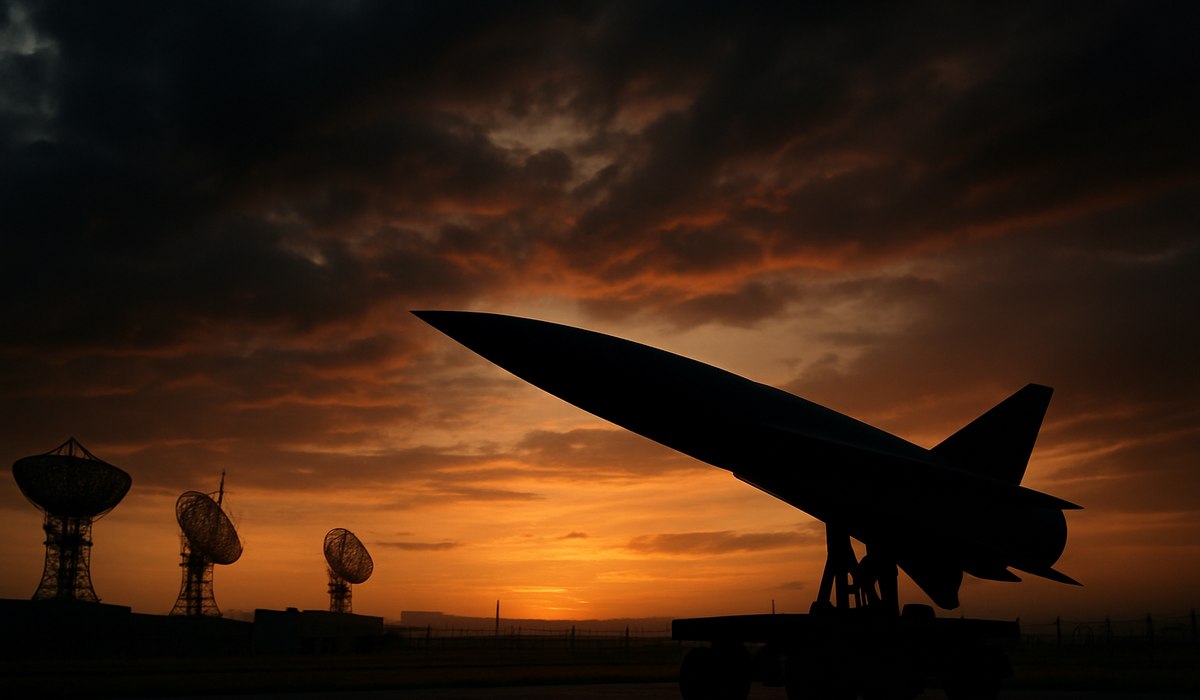
Image generated by AI
Understanding the Hypersonic Weapons Development Crisis
The United States military has invested billions of dollars and invested over two decades into developing military hypersonic missiles, yet Russia and China have already deployed operational systems. After 25 years and roughly $3.9 billion annually in defense research, American hypersonic weapons remain in testing phases while adversaries field nuclear-capable alternatives. This strategic gap represents one of the most significant defense technology challenges facing the Department of Defense in 2026. Hypersonic weapons—projectiles traveling at speeds exceeding Mach 5—represent the next generation of military capability, offering rapid deployment, extended range, and extreme evasion difficulty.
The U.S. Hypersonic Weapons Race: 25 Years and Counting
The United States initiated the Conventional Prompt Global Strike Program nearly 25 years ago, establishing military hypersonic missiles as a critical strategic priority. The program encompasses multiple service branches developing competing prototypes with distinct capabilities. The Navy's Conventional Prompt Strike system can launch from Zumwalt-class destroyers and Virginia-class submarines. The Army's Long-Range Hypersonic Weapon, known as Dark Eagle, achieves ranges exceeding 1,700 miles with precision targeting capabilities. The Air Force pursues two parallel programs: the Air-Launched Rapid Response Weapon reaching velocities between Mach 6.5 and Mach 8, and the Hypersonic Attack Cruise Missile with potential bomber and fighter jet deployment options.
Despite this multi-pronged approach, funding complications have emerged. The Department of Defense reduced hypersonic research and development budgets by $3 billion in fiscal year 2026, requesting $3.9 billion instead of the previous $6.9 billion allocation. This reduction signals competing budgetary priorities and raises concerns about development timelines. Military analysts warn that prototype competition for limited resources may delay operational deployment beyond 2030. The technological complexity of achieving exceptional accuracy with conventional warheads adds another layer of difficulty, as nuclear-armed systems can tolerate broader targeting margins.
Russia and China's Operational Advantage
Russia has already deployed three operational military hypersonic missiles systems, fundamentally shifting global military balance. The Avangard hypersonic glide vehicle launches via ICBM platforms, while the 3M22 Tsirkon achieves Mach 6 to Mach 8 speeds from naval platforms. Russia's Kinzhal air-launched system, derived from the Iskander missile, reaches speeds of Mach 10 when deployed from fighter aircraft. Most significantly, the Oreshnik ballistic hypersonic weapon has seen combat employment against Ukraine at least twice, confirming operational readiness and battlefield effectiveness.
China maintains equally advanced capabilities with distinct development pathways. The DF-17 medium-range ballistic missile carries hypersonic glide vehicle payloads, while the DF-27 and DF-41 ICBM systems provide strategic delivery mechanisms. China has tested the DF-ZF hypersonic glide vehicle at least nine times since 2014, achieving demonstrated ranges around 1,200 miles with extreme maneuverability. The Starry Sky-2 nuclear-capable hypersonic vehicle entered testing phases, complementing the YJ family of hypersonic anti-ship cruise missiles and ballistic systems. Unlike American systems emphasizing conventional accuracy, both Russia and China equipped their military hypersonic missiles with nuclear warheads, reducing targeting precision requirements while maximizing deterrent value.
Tactical Applications and Strategic Importance
Military hypersonic missiles solve critical operational challenges that conventional weapons cannot address. Consider road-mobile missile launchers employing "shoot and scoot" tactics—rapid positioning and repositioning makes conventional air strikes ineffective. Hypersonic delivery systems compress response time from hours to minutes, reducing target escape opportunities. The extended range capability means deploying systems from safe distances, protecting launch platforms from air defense countermeasures. This tactical advantage became apparent during regional military operations where rapid, long-range strikes against moving targets provided decisive advantages.
Strategic implications extend beyond conventional warfare scenarios. Nuclear-armed hypersonic systems create new deterrent equations by reducing warning times to near-zero levels. Traditional ballistic missile defense calculations assume 15-30 minute warning windows. Hypersonic trajectories compress this window to 5-10 minutes, potentially overwhelming existing air defense networks. This technological shift forces comprehensive reassessment of strategic stability, deterrence credibility, and arms control verification requirements. The simultaneous pursuit of military hypersonic missiles by three great powers signals acceptance that conventional deterrence frameworks require fundamental restructuring.
Defense Budget Priorities and Development Gaps
The $3 billion reduction in hypersonic weapons funding reflects broader defense budget pressures. The Pentagon faces competing demands from cyber warfare capabilities, artificial intelligence integration, space defense systems, and traditional platform modernization. Congressional debates prioritize immediate operational gaps over speculative future capabilities, creating budgetary friction that extends development timelines. Some military analysts argue that dispersed funding across four competing programs reduces efficiency compared to Russia and China's consolidated development approaches.
The accuracy challenge distinguishes American military hypersonic missiles from adversary systems. Russian and Chinese nuclear-armed variants tolerate circular error probable measurements measured in hundreds of meters. American conventional systems require accuracy measured in tens of meters for effective point-target destruction. Achieving this precision while maintaining hypersonic velocities introduces extraordinary engineering challenges. Guidance system miniaturization, real-time navigation updates, and terminal maneuver control represent unsolved technological problems that $3.9 billion annual funding may insufficiently address. Defense officials suggest that consolidating programs and prioritizing specific mission requirements could accelerate development timelines by 3-5 years.
Key Data Table: Military Hypersonic Missiles Comparison
| System | Country | Type | Max Speed | Range | Status | Warhead |
|---|---|---|---|---|---|---|
| Conventional Prompt Strike (CPS) | United States | Glide Vehicle | Mach 5+ | 1,000+ miles | Testing | Conventional |
| Long-Range Hypersonic Weapon (Dark Eagle) | United States | Ballistic | Mach 5+ | 1,700+ miles | Testing | Conventional |
| Air-Launched Rapid Response Weapon (ARRW) | United States | Cruise Missile | Mach 6.5-8 | 1,000 miles | Testing | Conventional |
| Hypersonic Attack Cruise Missile (HACM) | United States | Cruise Missile | Mach 5+ | TBD | Development | Conventional |
| Avangard | Russia | Glide Vehicle | Mach 20+ | ICBM Range | Operational | Nuclear |
| 3M22 Tsirkon | Russia | Cruise Missile | Mach 6-8 | 500+ miles | Operational | Nuclear |
| Kinzhal (Dagger) | Russia | Air-Launched | Mach 10 | 1,250+ miles | Operational | Conventional/Nuclear |
| Oreshnik | Russia | Ballistic | Mach 10+ | 1,000+ miles | Operational | Nuclear |
| DF-17 | China | Ballistic | Mach 5+ | 1,250 miles | Operational | Nuclear |
| DF-ZF Hypersonic Glide Vehicle | China | Glide Vehicle | Mach 5+ | 1,200 miles | Operational | Nuclear |
What This Means for Travelers
Geopolitical instability stemming from military hypersonic missiles development affects international travel planning and security considerations.
- Monitor Regional Tensions: Travelers planning visits to Eastern Europe, Russia, or China should monitor military tensions and diplomatic developments. Hypersonic weapons deployment increases regional conflict
Raushan Kumar
Founder & Lead Developer
Full-stack developer with 11+ years of experience and a passionate traveller. Raushan built Nomad Lawyer from the ground up with a vision to create the best travel and law experience on the web.
Learn more about our team →